Dual photon
From Wikipedia, the free encyclopedia
| Composition | Elementary particle |
|---|---|
| Statistics | Bosonic |
| Family | Gauge boson |
| Interactions | Electromagnetic |
| Status | Hypothetical |
| Theorized | 2000s[1][2][3][4][5] |
| Electric charge | 0 e |
| Spin | 1 ħ |
| String theory |
|---|
 |
| Fundamental objects |
| Perturbative theory |
| Non-perturbative results |
| Phenomenology |
| Mathematics |
| Beyond the Standard Model |
|---|
 |
| Standard Model |
In theoretical physics, the dual photon is a hypothetical elementary particle that is a dual of the photon under electric–magnetic duality which is predicted by some theoretical models,[3][4][5] including M-theory.[1][2]
It has been shown that including magnetic monopole in Maxwell's equations introduces a singularity. The only way to avoid the singularity is to include a second four-vector potential, called dual photon, in addition to the usual four-vector potential, photon.[6] Additionally, it is found that the standard Lagrangian of electromagnetism is not symmetric under duality (i.e. symmetric under rotation between electric and magnetic charges), which causes problems for the stress–energy, spin, and orbital angular momentum tensors. To resolve this issue, a dual symmetric Lagrangian of electromagnetism has been proposed,[3] which has a self-consistent separation of the spin and orbital degrees of freedom. The Poincaré symmetries imply that the dual electromagnetism naturally makes self-consistent conservation laws.[3]
The free electromagnetic field is described by a covariant antisymmetric tensor of rank 2 by


where is the electromagnetic potential.

The dual electromagnetic field is defined as

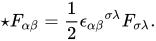
where is the Hodge star, and is the Levi-Civita tensor


For the electromagnetic field and its dual field, we have


Then, for a given gauge field , the dual configuration is defined as[2]


where the field potential of the dual photon, and non-locally linked to the original field potential .
p-form electrodynamics
A p-form generalization of Maxwell's theory of electromagnetism is described by a gauge-invariant 2-form defined as

- .

which satisfies the equation of motion

where is the Hodge star.
This implies the following action in the spacetime manifold :[7][8]

![{\displaystyle S=\int _{M}\left[{\frac {1}{2}}\mathbf {F} \wedge \star \mathbf {F} -\mathbf {A} \wedge \star \mathbf {J} \right]}](https://wikimedia.org/api/rest_v1/media/math/render/svg/25b599529922ca4c1f51034005265dada893b0fc)
where is the Hodge dual of the gauge-invariant 2-form for the electromagnetic field.


