Grothendieck trace theorem
From Wikipedia, the free encyclopedia
In functional analysis, the Grothendieck trace theorem is an extension of Lidskii's theorem about the trace and the determinant of a certain class of nuclear operators on Banach spaces, the so-called -nuclear operators.[1] The theorem was proven in 1955 by Alexander Grothendieck.[2] Lidskii's theorem does not hold in general for Banach spaces.

The theorem should not be confused with the Grothendieck trace formula from algebraic geometry.
2/3-nuclear operators
Given a Banach space with the approximation property and denote its dual as .


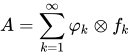
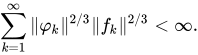
Let be a nuclear operator on , then is a -nuclear operator if it has a decomposition of the form where and and




Grothendieck's trace theorem
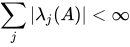
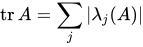
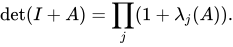
Let denote the eigenvalues of a -nuclear operator counted with their algebraic multiplicities. If then the following equalities hold: and for the Fredholm determinant