Hankyu 8300 series
From Wikipedia, the free encyclopedia
In service1989–present
ManufacturerAlna Kōki
Refurbished2023–
Number built84 vehicles (15 sets)
| Hankyu 8300 series | |
|---|---|
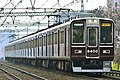
 8-car set 8300 on a local service, July 2019 | |
| In service | 1989–present |
| Manufacturer | Alna Kōki |
| Refurbished | 2023– |
| Number built | 84 vehicles (15 sets) |
| Number in service | 84 vehicles (15 sets) |
| Formation | 2/4/6/8 cars per trainset |
| Operator | Hankyu Railway |
| Depot | Katsura |
| Lines served | |
| Specifications | |
| Car body construction | Aluminium alloy |
| Car length | 18,900 mm (62 ft 0 in) |
| Width | 2,850 mm (9 ft 4 in) |
| Height | 4,095 mm (13 ft 5.2 in) |
| Doors | 3 pairs per side |
| Maximum speed | 115 km/h (71 mph) |
| Traction system | Variable frequency (GTO) |
| Power output | 170 kW (228 hp) per motor[1] |
| Electric system | 1,500 V DC overhead catenary |
| Current collection | Pantograph |
| Bogies | FS-369A, FS-069A SS-139A, SS-039A |
| Braking system | Electronically controlled pneumatic brakes with regenerative braking |
| Safety systems | ATS, ATC |
| Coupling system | Shibata-type |
| Multiple working | 7300 series |
| Track gauge | 1,435 mm (4 ft 8+1⁄2 in) |
The Hankyu 8300 series (阪急電鉄8300系) is an electric multiple unit (EMU) train type operated in Japan by the private railway operator Hankyu Railway since 1989.[2]
8-car sets
As of 1 April 2012, the fleet consists of 84 vehicles formed as five 8-car sets, four 6+2-car sets, and two 6-car sets which normally run coupled with 2-car 7300 series sets.[3]
4-car sets began operation in 2026.[4]
| Car No. | 1 | 2 | 3 | 4 | 5 | 6 | 7 | 8 |
|---|---|---|---|---|---|---|---|---|
| Designation | Mc1 | M2 | T1 | T2 | T2 | T1 | M1 | Mc2 |
| Numbering | 8300 | 8900 | 8850 | 8950 | 8980 | 8870 | 8800 | 8400 |
- The "Mc1" and "M1" cars are each fitted with two scissors-type pantographs.[3]
- The "Mc1" and "M1" cars of set 8315 are each fitted with two single-arm pantographs.[3]
- Sets from 8303 onward have a modified front end design.[3]
2+6-car sets
| Car No. | 1 | 2 | 3 | 4 | 5 | 6 | 7 | 8 | |
|---|---|---|---|---|---|---|---|---|---|
| Designation | Mc1 | Tc | Mc1 | T1 | T2 | T1 | M1 | Mc2 | |
| Numbering | 8330 | 8450 | 8300 | 8850 | 8950 | 8870 | 8800 | 8400 |
- The "Mc1" and "M1" cars are each fitted with two scissors-type pantographs.[3]
2+6-car mixed 7300/8300 series sets
| Car No. | 1 | 2 | 3 | 4 | 5 | 6 | 7 | 8 | |
|---|---|---|---|---|---|---|---|---|---|
| Designation | Mc | Tc | Mc1 | T1 | T2 | T1 | M1 | Mc2 | |
| Numbering | 7300 | 7450 | 8300 | 8850 | 8950 | 8870 | 8800 | 8400 |
- The "Mc", "Mc1", and "M1" cars are each fitted with two scissors-type pantographs.[3]
 8300 series in original style before 1995
 8300 series second build train, July 2018
 8-car set 8315 with single-arm pantographs, July 2017
 Set 8330 leading a 2+6-car formation, July 2006
 Set 8300 "classic 8300" livery, March 2020


