January 14 (Eastern Orthodox liturgics)
Day in the Eastern Orthodox liturgical calendar
From Wikipedia, the free encyclopedia
January 13 - Eastern Orthodox liturgical calendar - January 15

All fixed commemorations below are observed on January 27 by Eastern Orthodox Churches on the Old Calendar.[note 1]
For January 14th, Orthodox Churches on the Old Calendar commemorate the Saints listed on January 1.
Feasts
- Apodosis (Leavetaking) of the Theophany of Our Lord and Savior Jesus Christ.[1][2]
Saints
- Virgin Martyr Agnes, in dark solitary confinement[3]
- Saint Nina (Nino), Equal-to-the-Apostles, Enlightener of Georgia (335)[1][4][5]
- Saint Joseph Analytinus of Raithu Monastery (4th century)[1][note 2]
- The Holy Fathers slain at Mount Sinai and Raithu (4th-5th century),[1][7] including the Holy 38 Fathers slain at Mount Sinai,[8][note 3] and the Holy 33 Fathers slain at Raithu:[10][note 4]
- Hieromartyrs Isaiah, Sabbas, Moses and his disciple Moses, Jeremiah, Paul, Adam,[11] Sergius, Domnus, Proclus, Hypatius, Isaac, Macarius, Mark, Benjamin, Eusebius, Elias, and others
Pre-Schism Western saints
- Saint Felix, a presbyter at Nola near Naples, Italy, sometimes referred to as a martyr (c. 250)[16][note 5][note 6]
- Saint Euphrasius, a bishop martyred in North Africa by the Arian Vandals[9][16]
- Saint Dacius (Datius), Bishop of Milan (552)[16][note 7]
- Saint Kentigern (Mungo), first Bishop of Strathclyde (Glasgow), Scotland (614)[1][17] (see also January 13 - Greek and West)
- Saint Fulgentius of Cartagena, Bishop of Ecija, Spain (630 or 632)[1]
Post-Schism Orthodox saints
- Saint Sava I (Savva I), Enlightener and first Archbishop of Serbia (1235)[1][18][19] (see also January 12)
- Saint Joannicius of Tarnovo, Metropolitan of Tarnovo in Bulgaria (13th century)[20]
- Saint Acacius, Bishop of Tver (1567)[21][note 8] (see also June 29)
- Saint Meletius (Meletios) Yakimov, Bishop of Ryazan, Missionary to Yakutia (1900)[1][23][24][25][note 9]
New martyrs and confessors
- New Hieromartyr Ambrose (Ambrosius) Gudko, Bishop of Sarapul and Yelabug (1918)[23][24]
- New Hieromartyrs Platon Kulbusch, Bishop of Revel (Tallinn), Estonia, Nicholas Bezhanitsky and Michael Bleive, Archpriests (1919), and all the New Martyrs of Estonia[26] (see also January 1)
- New Martyrs slain at Raithu Monastery near Kazan: Joseph, Anthony, Barlaam, Job, and Sergius, Hieromonks, and Peter, Novice (1930)[1][23]
- New Hieroconfessor John Kevroletin, Hieroschemamonk of Verkhoturye (1961)[1][23]
Other commemorations
- Repose of Nicholas Motovilov (1879), disciple of Saint Seraphim of Sarov[1]
- Repose of Hieromonk Cosmas of Grigoriou, Missionary to Zaire (1989)[1][27]
Icon gallery


 St. Dacius, Bishop of Milan, as an exorcist.
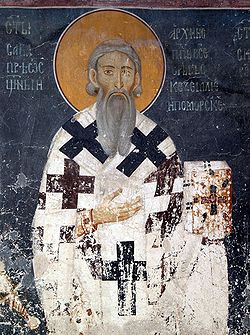 Saint Sava I, Equal-to-the-Apostles, Enlightener and first Archbishop of Serbia.
 St. Meletius (Yakimov), Bishop of Ryazan, Missionary to Yakutia.
 New Martyr Ambrosius (Gudko), Bishop of Sarapul and Yelabug.
 Nicholas Motovilov, disciple of St. Seraphim of Sarov, and Fool for Christ.


.jpg)


.jpg)

Notes
- The notation Old Style or (OS) is sometimes used to indicate a date in the Julian Calendar (which is used by churches on the "Old Calendar").
The notation New Style or (NS), indicates a date in the Revised Julian calendar (which is used by churches on the "New Calendar"). - The son of a Romano-Syrian soldier who had settled in Nola near Naples in Italy. Felix was ordained a priest and devoted himself to his bishop, St. Maximus, especially during the persecution which broke out under Decius. On account of his sufferings during the persecution, he was sometimes referred to as a martyr.
- "At Nola, in Campania, the birthday of St. Felix, priest, who (as is related by bishop St. Paulinus), after being subjected to torments by the persecutors, was cast into prison and extended, bound hand and foot, on (snail) shells and broken earthenware. In the night, however, his bonds were loosened and he was delivered by an angel. The persecution over, he brought many to the faith of Christ by his exemplary life and teaching, and, renowned for miracles, rested in peace."[9]
- His diocese was overrun by Arian Ostrogoths and he had to flee to Constantinople where he spent the rest of his life.
- "Acacius, Bishop of Tver, died Moscow, 14 January 1567. Russian Church. Known as Alexander in his monastery, he was bishop from 1522. Feast 29 June."[22] See also: (in Russian): Ðкакий (епиÑкоп ТвеÑÑкой). Russian Wikipedia.
- See also: (in Russian): ÐелеÑий (Якимов). Russian Wikipedia.