Keisei 3300 series
From Wikipedia, the free encyclopedia
| Keisei 3300 series | |
|---|---|
 A Keisei 3300 series EMU, January 2009 | |
| In service | November 1968– February 2015 |
| Manufacturer | Tokyu Car Corporation, Nippon Sharyo, Kisha Seizo |
| Constructed | 1968–1972 |
| Refurbished | 1989–1992 |
| Scrapped | 2003–2015 |
| Number built | 54 vehicles |
| Number in service | None |
| Formation | 4/6 cars per set |
| Operators | Keisei Electric Railway |
| Lines served | Keisei Main Line, Toei Asakusa Line |
| Specifications | |
| Car body construction | Steel |
| Car length | 18 m (59 ft 1 in) |
| Doors | 3 pairs per side |
| Maximum speed | 100 km/h (60 mph) |
| Traction system | Resistor control |
| Electric system(s) | 1,500 V DC |
| Current collector(s) | Overhead catenary |
| Track gauge | 1,435 mm (4 ft 8+1⁄2 in) |
The Keisei 3300 series (京成3300形) was a commuter electric multiple unit (EMU) train type formerly operated by the private railway operator Keisei Electric Railway in the Tokyo area of Japan from 1968 until February 2015.[1]
In their later years, the 3300 series sets normally operated on all-stations "Local" services on the Keisei Main Line.[1]
Formations
By 1 April 2014, the fleet consisted of just two four-car sets, formed as follows.[2]
| Designation | M2 | M1' | M1' | M2 |
|---|
All cars were motored, and the two M1' cars were each fitted with one lozenge-type pantograph.[2]
History

The 3300 series trains entered service in November 1968.[3] A total of 54 vehicles were built between 1968 and 1972.[1] Initially without air-conditioning, roof-mounted air-conditioning units were installed to the fleet from 1984.[1] The fleet was refurbished between 1989 and 1992, with the front headlamps moved to below the cab windows.[1]
Withdrawals began in 2003 due to accident damage.[1] The last remaining sets were withdrawn from service on 28 February 2015, following special commemorative limited express services run from Keisei Ueno to Narita.[3]
Liveries
The trains were initially painted in a two-tone livery of ivory and "fire orange" separated by a silver waistline stripe.[1] From 1981, the livery was changed to all-over "fire orange" with an ivory waistline stripe, and from 1993, the trains were repainted into a new livery of "active silver" with "human red" and "future blue" bodyside stripes.[1]
 Set 3324 repainted into ivory and "fire" orange livery, September 2009
 Set 3309 repainted into all-over "fire" orange livery, September 2009
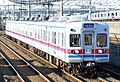 A 3300 series set in "Active" silver livery, January 2009


