Kounotori (train)
From Wikipedia, the free encyclopedia
 287 series on a Kounotori service, March 2011 | |
| Overview | |
|---|---|
| Service type | Limited express |
| Locale | Tokaido Main Line, Fukuchiyama Line, Sanin Main Line |
| First service | 12 March 2011 |
| Current operator(s) | JR West |
| Route | |
| Termini | Shin-Ōsaka Kinosaki Onsen |
| Technical | |
| Rolling stock | 287 series/289 series EMUs |
| Track gauge | 1,067 mm (3 ft 6 in) |
| Electrification | 1,500 V DC overhead |
The Kounotori (こうのとり, Kōnotori) is a limited express train service operated by the West Japan Railway Company (JR West) between Shin-Ōsaka and Kinosaki Onsen in Japan since 12 March 2011. It replaced the previous Kitakinki services.[1]
The name means "stork", and was chosen because the stork is the prefectural bird of Hyōgo, and the city of Toyooka in particular has close involvement with stork breeding programmes.[1]

14 down services (Kounotori 1–27) from Shin-Osaka and 13 up services (Kounotori 2–26) to Shin-Osaka run daily, with the journey time from Shin-Osaka to Kinosaki Onsen taking approximately 2 hours 45 minutes.[2]
Kounotori services stop at the following stations. (Stations in parentheses are not served by all trains.)[2]
Shin-Ōsaka - Ōsaka - Amagasaki - Takarazuka - Sanda - (Shin-Sanda) - (Aino) - Sasayamaguchi - (Tanikawa) - Kaibara - (Kuroi) - Fukuchiyama - (Wadayama) - (Yōka) - (Ebara) - (Toyooka) - (Kinosaki Onsen)
Kounotori, Kinosaki, Hashidate, Maizuru, and Hamakaze constitute the Kitakinki Big X Network of limited express services connecting the northern Kinki/Kansai (Kitakinki) region with the Keihanshin metropolitan area.

Rolling stock
The following rolling stock is used on Kounotori services.[3]
- 287 series EMUs (since 12 March 2011)
- 289 series EMUs (from 31 October 2015)
289 series EMUs converted from former dual-voltage 683 series trainsets were introduced on Kounotori services from 31 October 2015, replacing the remaining JNR-era 381 series trains.[4]
Former rolling stock
- 183 series 4/6-car EMUs (12 March 2011 – 15 March 2013)[5]
- 381 series 4/6-car EMUs (from 12 March 2011 to 31 May 2011, and from 1 June 2012 to 30 October 2015)[6][7][8]
 183 series 6-car set, April 2012
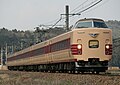 381 series 6-car set, March 2011


.svg)