Myerson value
From Wikipedia, the free encyclopedia
The Myerson value is a solution concept in cooperative game theory. It is a generalization of the Shapley value to communication games on networks. The solution concept and the class of cooperative communication games it applies to was introduced by Roger Myerson in 1977.[1]
Cooperative games
A (transferable utility) cooperative game is defined as a pair , where is a set of players and is a characteristic function, and is the power set of . Intuitively, gives the "value" or "worth" of coalition , and we have the normalization restriction . The set of all such games for a fixed is denoted as .[2]


Solution concepts and the Shapley value
A solution concept – or imputation – in cooperative game theory is an allocation rule , with its -th component giving the value that player receives.[nb 1]A common solution concept is the Shapley value , defined component-wise as[4]


Intuitively, the Shapley value allocates to each how much they contribute in value (defined via the characteristic function ) to every possible coalition .

Communication games
Given a cooperative game , suppose the players in are connected via a graph – or network – . This network represents the idea that some players can communicate and coordinate with each other (but not necessarily with all players), imposing a restriction on which coalitions can be formed. Such overall structure can be represented by a communication game .[2]


The graph can be partitioned into its components, which in turn induces a unique partition on any subset given by[1]

Intuitively, if the coalition were to break up into smaller coalitions in which players could only communicate with each through the network , then is the family of such coalitions.


The communication game induces a cooperative game with characteristic function given by


Definition
Main definition
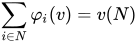
Given a communication game , its Myerson value is simply defined as the Shapley value of its induced cooperative game :


Extensions
Beyond the main definition above, it is possible to extend the Myerson value to networks with directed graps.[5] It is also possible define allocation rules which are efficient (see below) and coincide with the Myerson value for communication games with connected graphs.[6][7]