NGC 2283
From Wikipedia, the free encyclopedia
Right ascension06h 45m 52.7853s[1]
Declination−18° 12′ 37.319″[1]
| NGC 2283 | |
|---|---|
.jpg) NGC 2283 imaged by SDSS | |
| Observation data (J2000 epoch) | |
| Constellation | Canis Major |
| Right ascension | 06h 45m 52.7853s[1] |
| Declination | −18° 12′ 37.319″[1] |
| Redshift | 0.002805[1] |
| Heliocentric radial velocity | 841 ± 3 km/s[1] |
| Distance | 47.8 ± 3.4 Mly (14.66 ± 1.04 Mpc)[1] |
| Group or cluster | RR 140 |
| Apparent magnitude (V) | 11.5[1] |
| Characteristics | |
| Type | SB(s)cd[1] |
| Size | ~56,500 ly (17.31 kpc) (estimated)[1] |
| Apparent size (V) | 3.6′ × 2.7′[1] |
| Other designations | |
| ESO 557- G 013, RR 140b, IRAS 06436-1809, 2MASS J06455276-1812374, MCG -03-18-002, PGC 19562[1] | |
NGC 2283 is a barred spiral galaxy in the constellation of Canis Major. Its velocity with respect to the cosmic microwave background is 994 ± 11 km/s, which corresponds to a Hubble distance of 14.66 ± 1.04 Mpc (~48 million light-years).[1] It was discovered by German-British astronomer William Herschel on 6 February 1785.[2]
NGC 2283 forms a physical pair with galaxy IC 2171, collectively named RR 140, with an optical separation of 1593″ between them.[3]
SIMBAD lists NGC 2283 as an active galaxy nucleus candidate.[4]
One supernova has been observed in NGC 2283: SN 2023axu (Type II, mag. 15.6404) was discovered by the Distance Less Than 40 Mpc Survey (DLT40) on 28 January 2023.[5]
 Hubble Space Telescope image of NGC 2283
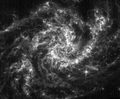 James Webb Space Telescope image of NGC 2283
 James Webb Space Telescope image of NGC 2283


.jpg)

