Nitta Maru-class cargo liner
From Wikipedia, the free encyclopedia
 Nippon Yūsen (NYK Line)
- Osaka Shosen Kaisha (OSK line)
 Imperial Japanese Navy (IJN)


 Nitta Maru in passenger service, 1940 | |
| Class overview | |
|---|---|
| Name | Nitta Maru class ocean liners |
| Builders | Mitsubishi's Nagasaki shipyard |
| Operators |
|
| Preceded by | Kashiwara Maru class (Hiyō class) |
| Built | 1938 – 1941 |
| In service | 1939 – 1944 |
| In commission | 1939 – 1941 (as liners) |
| Planned | 3 |
| Building | 3 |
| Completed | 3 |
| Active | 3 |
| Lost | 3 |
| General characteristics | |
| Type | Ocean liner |
| Tonnage | 17,163 GRT |
| Length | 170 m (557 ft 9 in) overall |
| Beam | 22.5 m (73 ft 10 in) |
| Draught | 12.4 m (40 ft 8 in) |
| Propulsion | 25,200 shaft horsepower (18,800 kW) using 1 propeller shaft & 4 water-tube boilers |
| Speed | 19 knots (22 mph; 35 km/h) |
| Capacity | 285 passengers (127 first class, 88 second, and 70 third) |
| Crew | 130 |
The Nitta Maru-class ocean liner (新田丸級貨客船, Nitta Maru-kyū Kakyakusen) was a class of ocean liners of Japan, serving briefly during the late 1930s up to the beginning of World War II, being converted as the Taiyō-class escort carriers of the Imperial Japanese Navy.

The class was designed from the start to be converted, featuring military-grade hull and facilities. These ships were built by Mitsubishi at their Nagasaki shipyard for the shipping lines Nippon Yusen Kaisha (NYK) and Osaka Shosen Kaisha (OSK). Their names where chosen to match the "NYK" abbreviation (Nitta Maru, Yawata Maru, Kasuga Maru). Nitta Maru and Yawata Maru were ordered for NYK and both were completed before the beginning of the Pacific War in December 1941. The ships were intended for service to Europe, but the start of World War II in September 1939 restricted them to the Pacific.[1] Kasuga Maru had been ordered by OSK and was fitting out when she was acquired by the IJN in 1940 and towed to Sasebo Naval Arsenal on 1 May 1941 to finish her conversion into an escort carrier.[2][Note 1] She was the first ship to be completed as her sister ships were not converted until 1942.[4]
The Nitta Maru-class ships were 17,163-gross register ton (GRT) cargo liners that had a length of 170 metres (557 ft 9 in), a beam of 22.5 metres (73 ft 10 in) and a depth of hold of 12.4 metres (40 ft 8 in). They had a net tonnage of 9,397 and a cargo capacity of 11,800 tons.[7][8] They had accommodations for 285 passengers (127 first class, 88 second and 70 third).[7] The ships were powered by two sets of geared steam turbines made by the shipbuilder, each driving one propeller shaft, using steam produced by four water-tube boilers.[8] The turbines were rated at a total of 25,200 shaft horsepower (18,800 kW)[2] that gave them an average speed of 19 knots (35 km/h; 22 mph)[5] and a maximum speed of 22.2 knots (41.1 km/h; 25.5 mph).[2][Note 2]
Escort carrier conversion
The conversion of the Taiyō-class ships, as the former liners were now known, was fairly austere and they were flush-decked escort carriers that displaced 18,120 tonnes (17,830 long tons) at standard load[10] and 20,321 tonnes (20,000 long tons) at normal load. The ships had an overall length of 180.2 metres (591 ft 4 in), a beam of 22.5 metres (73 ft 10 in) and a draught of 7.7–8 metres (25 ft 3 in – 26 ft 3 in). As carriers they had a speed of 21 knots (39 km/h; 24 mph).[9] The uptakes for the boilers were trunked together into a downward-curving funnel on the starboard side of the hull amidships.[3] The ships carried 2,290 tonnes (2,250 long tons) of fuel oil that gave them a range of 6,500 nautical miles (12,000 km; 7,500 mi) at a speed of 18 knots (33 km/h; 21 mph).[9][11][Note 3] Taiyō's crew numbered 747 officers and ratings while her sisters had 850 officers and crewmen.[13]
The flight deck was 172 metres (564 ft 3 in) long and 23.5 metres (77 ft) wide. The ships had a single hangar, approximately 91.4 metres (300 ft) long, served by two centreline aircraft lifts, each 12 by 13 metres (39.4 ft × 42.7 ft).[11] Taiyō could accommodate a total of 27 aircraft, including four spares, and her sisters had a capacity of 30 aircraft.[3] Although larger, faster and having a larger aircraft-carrying capacity than their western counterparts, these ships were unsuited to a traditional carrier role as they lacked arresting gear.[4][14]
Ships
| Original name[15] | Kanji | Conversion name | Laid down | Launched[13] | Commissioned (as carrier)[13] | Fate[13] |
|---|---|---|---|---|---|---|
| Nitta Maru | 新田丸 | Chūyō | 9 May 1938[16] | 20 May 1939 | 25 November 1942 | Sunk by USS Sailfish, 4 December 1943 |
| Yawata Maru | 八幡丸 | Un'yō | 14 December 1938[17] | 31 October 1939 | 31 May 1942 | Sunk by USS Barb, 17 September 1944 |
| Kasuga Maru | 春日丸 | Taiyō | 6 January 1940[5] | 19 September 1940 | 2 September 1941 | Sunk by USS Rasher, 18 August 1944 |
Photos
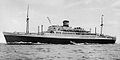 Nitta Maru
 Yawata Maru
 Taiyō (Kasuga Maru) as a carrier

