Phlomoides tuberosa
Species of flowering plant
From Wikipedia, the free encyclopedia
Phlomoides tuberosa (syn. Phlomis tuberosa), the sage-leaf mullein,[2] is a perennial herbaceous flowering plant in the family Lamiaceae, native to China, Kazakhstan, Kyrgyzstan, Mongolia, Russia, south west Asia and Europe. Enlarged, tuberous roots give rise to erect stems to 150 cm bearing purple-red flowers.[3]

| Phlomoides tuberosa | |
|---|---|
| |
Scientific classification  | |
| Kingdom: | Plantae |
| Clade: | Embryophytes |
| Clade: | Tracheophytes |
| Clade: | Angiosperms |
| Clade: | Eudicots |
| Clade: | Asterids |
| Order: | Lamiales |
| Family: | Lamiaceae |
| Genus: | Phlomoides |
| Species: | P. tuberosa |
| Binomial name | |
| Phlomoides tuberosa | |
| Synonyms[1] | |
|
Synonymy
| |
Chemistry
Phytochemical analyses of Phlomoides tuberosa leaves have found flavonoids apigenin, apigenin-7-O-glucuronide, luteolin, luteolin-7-O-glucoside, luteolin-7-О-glucuronide, orientin, isoorientin,[4][5][6][7] phenylpropanoids acteoside (verbascoside), forsythoside B,[8] decaffeoyl-acteoside, leucosceptoside A, marthynoside, neolignanes,[9] iridoids sesamoside, 5-desoxy-sesamoside, shanzhiside methyl ester, lamalbide,[10] 8-O-acetyl-shanzhiside, phloyoside I, chlorotuberoside,[9] sterols, triterpenes oleanolic acid, ursolic acid.[11] Dried leaves of plants collected in Buryatia yielded 0.02% of essential oil with a weak aroma with dominant phytol, linalool, eugenol and caryophyllene oxide.[12] The seed has yielded 11.8% of oil, including 3.3% gadoleic acid and some fatty acids containing the unusual allene group, 25.1% laballenic acid and 2.9% phlomic acid.[13] The roots shown the presence of oligosaccharides raffinose, stachyose, verbascose, flavonoids luteolin, linarin, quercitrin, phenylpropanoids acteoside, isoacteoside (isoverbascoside), forsythoside B, chlorogenic acid, decaffeoyl-acteosyde, iridoids shazhiside methyl ester, 8-O-acetyl-shanzhiside methyl ester, 8-O-acetyl-shanzhigenin methyl ester, floyoside I, phlotuberosides I and II, phlorigidoside C, diterpenes (abietanes, labdanes).[14][15]
Cultivation
This plant is grown in full sun, but may tolerate some shade.[2] The cultivar 'Amazone' has won the Royal Horticultural Society's Award of Garden Merit.[16]
Uses
The Kalmyks are said to have eaten the cooked root, calling the plant bodmon sok.[17] Another source for Mongolia has the plant used as a folk restorative medicine against intoxication, tuberculosis, pulmonary and cardiovascular diseases and rheumatoid arthritis.[14] Buryat lamas used some part of the plant to treat diarrhoea, eye and lung disease and as a sedative.[12]
Gallery
 Densely pubescent Spring shoots emerging from the soil among remains of previous season's growth
 Basal rosettes of a stand of plants in Spring, forest margin, Austria
 Single, basal rosette of Spring foliage
 Elongating flowering stem before development of inflorescence
 Flowering stem arising from basal rosette of foliage showing inflorescence at early stage of development
 Detail of single cordate basal leaf
 Paired, opposite, cauline leaves at a stem node
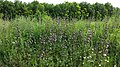 Stand of flowering plants in a tall-herb meadow, lower Austria
 Stand of plants in flower in a tall-herb meadow, Ukraine
 Detail of inflorescence in bud
 Detail of inflorescence
 Single flower, showing ciliate upper lip of corolla
 Ciliate upper lip of corolla viewed from beneath to show stamens
 Detail of unripe infructescence
 Detail of ripe infructescence showing the four nutlets in each fruiting calyx
 Array of ripe fruits (nutlets) separated from their fruiting calyces
 Edible tuberous roots: Kalmyk: bodmon sok


