Seibu 4000 series
From Wikipedia, the free encyclopedia
| Seibu 4000 series | |
|---|---|
 A 4000 series set on the Seibu Ikebukuro Line in June 2024 | |
| In service | 1988–present |
| Manufacturer | Tokyu Car Corporation |
| Constructed | 1988-1992 |
| Refurbished | 2002 |
| Number built | 48 vehicles (12 sets) |
| Number in service | 48 vehicles (12 sets) |
| Formation | 4 cars per trainset |
| Fleet numbers | 4001–4023 |
| Operator | Seibu Railway |
| Depot | Musashigaoka |
| Lines served | Seibu Ikebukuro Line, Seibu Chichibu Line, Chichibu Main Line |
| Specifications | |
| Car body construction | Steel |
| Car length | 20 m (65 ft 7 in) |
| Doors | 2 pairs per side |
| Maximum speed | 105 km/h (65 mph) |
| Traction system | Resistor control |
| Traction motors | HS-836-Nrb HS-836-Prb |
| Power output | 150 kW |
| Acceleration | 2.3 km/(h⋅s) (1.4 mph/s) |
| Electric system | 1,500 V DC |
| Current collection | overhead catenary |
| Track gauge | 1,067 mm (3 ft 6 in) |
The Seibu 4000 series (西武4000系) is an electric multiple unit (EMU) train type operated by the private railway operator Seibu Railway mainly on Seibu Chichibu Line services in Saitama Prefecture, Japan since 1988.[1]
The 4000 series trains were built between 1988 and 1992 by combining electrical equipment from former 101 series EMUs with new steel bodies.[1] The trains are finished in a livery of ivory white with blue, red, and green stripes along the waist line, the team colours of the Saitama Seibu Lions baseball team.[1] The driving cabs have a similar configuration to the earlier 101 series and 2000 series EMUs, with a left-hand master controller and right-hand brake control.[1]
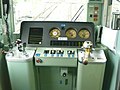 The driving cab console

Operations

The fleet of four-car trains is primarily used on all-stations driver only operation "Local" services on the Seibu Chichibu Line between Hannō and Seibu Chichibu, but the trains are also used as eight-car formations on through "Rapid Express" train services from Ikebukuro on the Seibu Ikebukuro Line to Mitsumineguchi and Nagatoro on the Chichibu Main Line.[1] These trains divide and couple at Yokoze, with separate portions for Mitsumineguchi and Nagatoro.[1]
Fleet
Formations
Sets are formed as shown below with two motored ("M") cars and two non-powered driving trailer ("Tc") cars, and the Tc1 car at the southern (Ikebukuro) end.[2]
| Designation | Tc1 | M1 | M2 | Tc2 |
|---|---|---|---|---|
| Numbering | 40xx | 41xx | 41xx | 40xx |
The M1 car is fitted with two single-arm pantographs (originally lozenge-type pantographs).[1][2]
 Car 4002 of set 4001 in May 2006
 Car 4001 of set 4001 in May 2006


Interior


History
The first train entered service in 1988, with twelve four-car sets built by 1992.[1] The fleet was refurbished in 2002 for use on wanman driver only operation services on the Seibu Chichibu Line. Modifications included the addition of automatic passenger announcements.[1]
Fifty-two Seats of Happiness

One four-car set was modified from set 4009[3] into a tourist train called the Fifty-two Seats of Happiness (52席の至福, Gojūni seki no shifuku) for use on services operating between Seibu Shinjuku and Ikebukuro in Tokyo and Seibu Chichibu and Hon-Kawagoe in Saitama Prefecture, entering service from 17 April 2016.[4] The interior and exterior design of the train was overseen by architect Kengo Kuma.[5]
The automated on-board passenger announcements in Japanese use the voice of TV presenter Tomomi Kuno, and the melody chimes accompanying the announcements were created by musician Minoru Mukaiya, who was formerly the keyboard player in the group Casiopea.[3]
The train is formed as shown below, with car 1 at the Tokyo (southern) end.[2][6]
| Car No. | 1 | 2 | 3 | 4 |
|---|---|---|---|---|
| Numbering | 4009 | 4109 | 4110 | 4010 |
| Seating capacity | - | 26 | - | 26 |
| Facilities | Multipurpose space, toilets | Dining seating | Open kitchen | Dining seating |
 Car 4009 (car 1) with spring motif
 Car 4109 (car 2) with summer motif
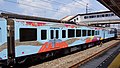 Car 4110 (car 3) with autumn motif
 Car 4010 (car 4) with winter motif


