Seibu 30000 series
From Wikipedia, the free encyclopedia
| Seibu 30000 series Smile Train | |
|---|---|
 8-car set 38117 in June 2024 | |
| In service | 2008–present |
| Manufacturer | Hitachi Rail |
| Built at | Kudamatsu, Yamaguchi |
| Family name | Hitachi A-train |
| Replaced | 101 series, 301 series |
| Constructed | 2008–2016 |
| Entered service | April 2008 |
| Number built | 216 vehicles (30 sets) |
| Number in service | 216 vehicles (30 sets) |
| Formation | 2/8/10 cars per trainset |
| Operators |  Seibu Seibu |
| Depots | Kotesashi, Minami-Iriso, Musashigaoka, Tamagawa-Josui |
| Lines served | |
| Specifications | |
| Car body construction | Aluminium |
| Car length | 20,000 mm (65 ft 7 in) |
| Width | 2,930 mm (9 ft 7 in) |
| Doors | 4 pairs per side |
| Maximum speed | 105 km/h (65 mph) |
| Acceleration | 3.3 km/(h⋅s) (2.1 mph/s) |
| Electric system(s) | 1,500 V DC |
| Current collector(s) | overhead catenary |
| Track gauge | 1,067 mm (3 ft 6 in) |


The Seibu 30000 series (西武30000系) is an electric multiple unit (EMU) train type operated by the private railway operator Seibu Railway on commuter services in the Tokyo area of Japan. First introduced in April 2008, a total of six 10-car sets, eighteen 8-car sets, and six 2-car sets were built by Hitachi Rail between 2008 and 2016 to replace older three-door 101 series and 301 series sets.[1] It is nicknamed the "Smile Train" (スマイルトレイン, Sumairu Torein).[2]
Fleet
As of 10 November 2021[update], the fleet consists of 6 ten-car sets, 18 eight-car sets, and six two-car sets, based at Kotesashi, Minami-Iriso, Musashigaoka, and Tamagawa-Josui depots for use on Seibu Shinjuku Line and Seibu Ikebukuro Line workings.[3][4]
The last set ordered, eight-car set 38118, was delivered in June 2016, bring the total size of the fleet to 216 vehicles (30 sets).[4]
Formations
Sets are formed as shown below.[3]
2-car sets
The six 2-car sets, numbered 32101 to 32106, are formed as follows, with car 1 at the Hanno end.
| Car No. | 1 | 2 |
|---|---|---|
| Designation | Mc | Tc |
| Numbering | 32100 | 32200 |
- The Mc cars are equipped with two single-arm pantographs.[3]
8-car sets
The eighteen 8-car sets, numbered 38101 to 38118, are formed as follows, with car 1 at the Hanno end.
| Car No. | 1 | 2 | 3 | 4 | 5 | 6 | 7 | 8 |
|---|---|---|---|---|---|---|---|---|
| Designation | Tc1 | M1 | M2 | T1 | T3 | M5 | M6 | Tc2 |
| Numbering | 38100 | 38200 | 38300 | 38400 | 38500 | 38600 | 38700 | 38800 |
- The M1 and M5 cars are each equipped with one single-arm pantograph.[3]
10-car sets
The six 10-car sets, numbered 30101 to 30106, are formed as follows, with car 1 at the Hanno end.
| Car No. | 1 | 2 | 3 | 4 | 5 | 6 | 7 | 8 | 9 | 10 |
|---|---|---|---|---|---|---|---|---|---|---|
| Designation | Tc1 | M1 | M2 | T1 | M3 | T2 | T3 | M5 | M6 | Tc2 |
| Numbering | 30100 | 30200 | 30300 | 30400 | 30500 | 30600 | 30700 | 30800 | 30900 | 30000 |
- The M1 and M6 cars are each equipped with one single-arm pantograph.[3]
Interior
Seating consists of longitudinal bench seating throughout. Wheelchair spaces are provided in the two outermost cars at each end of eight-car sets and in the 32100 cars of two-car sets.[3] Priority seats are provided at the end of each car.[3] Sets built from fiscal 2013 feature LED lighting and transparent overhead luggage racks in place of the earlier stainless steel pipe racks.[5]
Batches 1–6
 Interior
 Priority seating
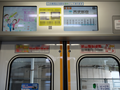 LCD information display


の鴨居部案内表示器。プログラム更新後(2014-01-05撮影)_2014-01-21_21-43.png)
Batches 7–10
 Interior
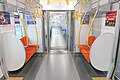 Priority seating
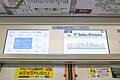 LCD information display


History
The first train entered service on the Seibu Shinjuku Line on 26 April 2008.[6]
Livery variations
Doraemon
From 8 October 2020, eight-car set 38101 was operated with an all-over Doraemon-themed wrap. The sides are blue; some doors resemble Doraemon, and others are plain, in line with the rest of the body. The interior is also Doraemon-themed.[7] The Doraemon-themed train is scheduled to operate until 20 September 2024.[8]
 Set 38101

Interior
 Interior view, May 2021
 Priority seating, May 2021
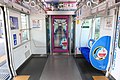 Wheelchair and stroller space, May 2021
 Door view, May 2021


