Seibu 20000 series
From Wikipedia, the free encyclopedia
| Seibu 20000 series | |
|---|---|
 10-car set 20108 on the Seibu Ikebukuro Line in October 2021 | |
| In service | 2000–present |
| Manufacturer | Hitachi |
| Built at | Kudamatsu, Yamaguchi |
| Family name | Hitachi A-train |
| Constructed | 1999–2005 |
| Entered service | 2000 |
| Number built | 144 vehicles (16 sets) |
| Number in service | 144 vehicles (16 sets) |
| Formation | 8/10 cars per trainset |
| Fleet numbers |
|
| Operators | Seibu Railway |
| Depots | Kotesashi, Minami-Iriso, Musashigaoka, Tamagawa-Josui |
| Lines served | |
| Specifications | |
| Car body construction | Aluminium |
| Car length | 20,000 mm (65 ft 7 in) |
| Doors | 4 pairs per side |
| Maximum speed | 105 km/h (65 mph) |
| Traction system | Variable frequency (IGBT) |
| Electric system(s) | 1,500 V DC |
| Current collector(s) | overhead catenary |
| Track gauge | 1,067 mm (3 ft 6 in) |


The Seibu 20000 series (西武20000系) is an electric multiple unit (EMU) train type operated by the private railway operator Seibu Railway on commuter services in the Tokyo area of Japan. First introduced in 2000,[1] a total of eight 10-car sets and eight 8-car sets were built between 1999 and 2005 by Hitachi for use on Seibu Ikebukuro Line and Seibu Shinjuku Line services.
As of 1 April 2017[update], the fleet consists of eight ten-car sets and eight eight-car (20050 series) sets, based at Kotesashi, Minami-Iriso, Musashigaoka, and Tamagawa-Josui depots for use on Seibu Shinjuku Line and Seibu Ikebukuro Line services.[2]
Formations
8-car sets
The eight-car sets (20151 to 20158) are formed as shown below with four motored (M) cars and four unpowered trailer (T) cars, and car 8 at the Shinjuku/Ikebukuro end.[2]
| Car No. | 1 | 2 | 3 | 4 | 5 | 6 | 7 | 8 |
|---|---|---|---|---|---|---|---|---|
| Designation | Tc1 | M1 | M2 | T1 | T3 | M5 | M6 | Tc2 |
| Numbering | 2015x | 2025x | 2035x | 2045x | 2075x | 2085x | 2095x | 2005x |
The M1 and M5 cars are each equipped with one single-arm pantograph.[2]
10-car sets
The eight ten-car sets (20101 to 20108) are formed as shown below with five motored (M) cars and five unpowered trailer (T) cars, and car 10 at the Shinjuku/Ikebukuro end.[2]
| Car No. | 1 | 2 | 3 | 4 | 5 | 6 | 7 | 8 | 9 | 10 |
|---|---|---|---|---|---|---|---|---|---|---|
| Designation | Tc1 | M1 | M2 | T1 | M3 | T2 | T3 | M5 | M6 | Tc2 |
| Numbering | 2010x | 2020x | 2030x | 2040x | 2050x | 2060x | 2070x | 2080x | 2090x | 2000x |
The M1, M3, and M5 cars are each equipped with one single-arm pantograph.[2]
Interior
Seating consists of sculpted longitudinal bench seating throughout, with an individual seat width of 460 mm (18 in) per person.[1] Wheelchair spaces are provided in the two outermost cars at each end.[2] Priority seats are provided at the end of each car.[2] Scrolling LED passenger information displays are provided above the doorways.[1]
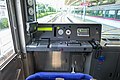 Driver's cab (8-car set)
 Driver's cab (10-car set)
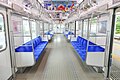 Interior view (Set 20154)
 Priority seating (Set 20154)
 Wheelchair space (Set 20154)
 Interior view (Set 20108)
 Priority seating (Set 20108)
 Wheelchair space (Set 20108)
 LED passenger information display


