Talk:Golden ratio
From Wikipedia, the free encyclopedia
| This is the talk page for discussing improvements to the Golden ratio article. This is not a forum for general discussion of the subject of the article. |
Article policies
|
Archives: 1, 2, 3, 4, 5, 6, 7, 8, 9Auto-archiving period: 12 months  |
 | This  level-4 vital article is rated B-class on Wikipedia's content assessment scale. level-4 vital article is rated B-class on Wikipedia's content assessment scale.It is of interest to the following WikiProjects: | |||||||||||||
| ||||||||||||||


Semi-protected edit request on 15 March 2025
 | This edit request has been answered. Set the |answered= parameter to no to reactivate your request. |
Please change:
The decimal expansion of the golden ratio 

to:
The decimal expansion of the golden ratio 
as the referenced y-cruncher link indicates Jordan Ranous computed 20,000,000,000,000 digits of the golden ratio on November 27, 2023. Qqid (talk) 10:00, 15 March 2025 (UTC)
 Done Warriorglance(talk to me) 06:16, 16 March 2025 (UTC)

Unreasoned reversion
The imaginary and negative values of the Golden Ratio is an important part in terms of number theory.
Imaginary Golden Ratio
Discussions on the negative value and the imaginary value of the Golden Ratio emerged in modern and contemporary mathematics. The negative value of the function 


- I don't think there is anything in the 2014 reference that is not already in our article, Math Forums is not a reliable source by Wikipedia standards, and your "imaginary value" is not the golden ratio (it is a different complex number) and does not satisfy the usual definitions or equations for the golden ratio. —David Eppstein (talk) 18:23, 19 June 2025 (UTC)
- By definition of the Golden Ratio, it never implicated its numerical value, but only the satisfaction of the functional predicate. The Golden Ratio is defined by the proportions, not the numerical solutions. Quinhonk (talk) 08:01, 20 June 2025 (UTC)
- The golden ratio is the positive solution of the equation
. Both solutions of that equation are real. There is no imaginary solution and no solution with an imaginary component. If you want a root that is not real, you need to start with a different equation. There is no "imaginary golden ratio". Stepwise Continuous Dysfunction (talk) 15:39, 20 June 2025 (UTC)
- The golden ratio is the positive solution of the equation
- By definition of the Golden Ratio, it never implicated its numerical value, but only the satisfaction of the functional predicate. The Golden Ratio is defined by the proportions, not the numerical solutions. Quinhonk (talk) 08:01, 20 June 2025 (UTC)

- There's no such thing as an "imaginary golden ratio", or an "imaginary value of the golden ratio". The golden ratio is a real number by definition. Stepwise Continuous Dysfunction (talk) 20:10, 19 June 2025 (UTC)
- The complex number has an interesting analogy to the golden ratio (some identities correspond with a changed sign), but is not itself golden. With language suited to this caveat it might be worth mention. —Tamfang (talk) 02:06, 20 June 2025 (UTC)
- I think you're on something. Indeed, from the definition of the Golden Ratio, many identities can be derived and look quite fun. But the positive solution is only one of the identities that was accepted, depending on the number line. Quinhonk (talk) 08:04, 20 June 2025 (UTC)
- From the Chinese history of mathematical philosophy, Taoism never conceived the notion of negative numbers, and zero is literally reserved in the wording of Tao. Quinhonk (talk) 08:06, 20 June 2025 (UTC)
- Your number is a sixth root of unity and a unit among the Eisenstein integers. There are many analogies between Eisenstein integers and the "golden integers" (and various other quadratic integers), between the numbers in the corresponding quadratic fields, etc. For example the norm of a number
where
is
and the norm of a number
where
is
in the field
. Analogously, the norm of a number
is
and the norm of a number
is
in the field
. But these are distinct topics which should be largely discussed separately in their own articles. Conceivably a whole new article could be written about the field
- Update: Stepwise Continuous Dysfunction created an article about
- Thanks for the explanations. It looks like it can be furthered to the Möbius Band again... I'll leave the Golden Ratio consensus as is then... Quinhonk (talk) 14:18, 22 June 2025 (UTC)
- Update: Stepwise Continuous Dysfunction created an article about


References
- García-Caballero, Esther M.; Moreno, Samuel G.; Prophet, Michael P. (2014). "The golden ratio and Viéte's formula". Teaching Mathematics and Computer Science. 12 (1): 43–54. doi:10.5485/TMCS.2014.0351.
- Agno. "Imaginary Golden Ratio". Math Forums.
Constructible Number
It looks like no one wants to change the status quo here with the revision (mainly I see that this page is entirely written in Python style but computing is not maths):
The infinite power root of 

References
- Cao, Yang I. "Defining Zero According to the Definition of the Golden Ratio". ResearchGate.
Inconsistent expressions for constants involving the golden ratio
I wonder if there's a way to clarify that some of the different-looking constants which appear in § Geometry and § Other properties are equal (or related), or perhaps try to pick some more consistent conventions. Letting 
![{\displaystyle {\begin{aligned}{\sqrt {5}}&=-1+2\varphi \\[5mu]\varphi {\sqrt {5}}&=\varphi (-1+2\varphi )=2+\varphi ,\\[8mu]\varphi ^{-1}{\sqrt {5}}&=(-1+\varphi )(-1+2\varphi )=3-\varphi =2+{\overline {\varphi }},\\[6mu]{\sqrt {\frac {2+\varphi }{5}}}&={\sqrt {\frac {\varphi }{\sqrt {5}}}}={\frac {1}{\sqrt {\varphi ^{-1}{\sqrt {5}}}}}={\frac {1}{\sqrt {3-\varphi }}}={\frac {1}{\sqrt {2+{\overline {\varphi }}}}},\\{\sqrt {\frac {3-\varphi }{5}}}&={\sqrt {\frac {\varphi ^{-1}}{\sqrt {5}}}}={\frac {1}{\sqrt {\varphi {\sqrt {5}}}}}={\frac {1}{\sqrt {2+\varphi }}},\\{\frac {15\varphi }{\sqrt {3-\varphi }}}&=15\varphi {\sqrt {\frac {\varphi }{\sqrt {5}}}}=3{\bigl (}\varphi {\sqrt {5}}~\!{\bigr )}^{3/2}=3(2+\varphi )^{3/2},\\{\frac {5\varphi ^{3}}{6-2\varphi }}&={\frac {1}{2}}{\frac {5\varphi ^{3}}{\varphi ^{-1}{\sqrt {5}}}}={\frac {1}{2}}\varphi ^{4}{\sqrt {5}}={\frac {1}{2}}(4+7\varphi ),\\{\frac {5}{6}}(1+\varphi )&={\frac {5}{6}}\varphi ^{2}={\frac {1}{6}}(\varphi {\sqrt {5}})^{2}.\end{aligned}}}](http://wikimedia.org/api/rest_v1/media/math/render/svg/b45f24fd049ea5229e52f010a943d8b6bd545b05)
It's weird to have inconsistent examples such as:

When we could instead write these more consistently as one of:

Cheers, –jacobolus (t) 12:57, 11 July 2025 (UTC)
- IMO, every golden number must be written in a canonical form, either as
, with
and
rational numbers. So, expressions such as
and
must definitively be avoided. For elements of a quadratic extension of the golden numbers, I would prefer
where
are golden numbers in canonical form and
is square free for the prime factorizaation of golden numbers. So, for the last formulas, I would prefer
- (the colons around the formula, now fixed, seem a bug of Phabricator which, in automatic replies, inserts colons at the beginning of every line inside latex formulas).
- The advantage of these canonical forms is to make immediately apparent which numbers are algebraic integers. D.Lazard (talk) 15:10, 11 July 2025 (UTC)
- One alternative would be to give specific symbolic names to a few of these numbers someplace, e.g.
and
, and then write some of the other constants in those terms, like:
instead of
;
instead of
; and
instead of
or
. These particular constants show up a lot because
is the ratio between the side length and circumradius of a regular pentagon and
is the ratio between the diagonal length and circumradius. –jacobolus (t) 15:46, 11 July 2025 (UTC)
- I do not like introducing too many notations.
- However, I should moderate my above comment: in some cases, especially for radicands, the prime factorization is a canonical form that is more informative. This leads writing
and
. This gives a much more symmetric formula for the above example:
- (except for possible sign errors by myself). The advantage is that the natural symmetry is not hidden. D.Lazard (talk) 17:53, 11 July 2025 (UTC)
- One alternative would be to give specific symbolic names to a few of these numbers someplace, e.g.


golden ratio conjugate
I started with a simple task – I saw a unreferenced statement in Phi:
The uppercase F is used as a symbol for: The golden ratio conjugate -0.618... in mathematics.
I thought I would track down a reference. That sentence linked to this article, so I thought it would be a good place to look for a solid reference.
However, while this article has a section Golden ratio conjugate and powers, It doesn't explicitly say that capital Φ is the golden ratio conjugate.
In fact this article doesn't even explicitly define "Golden ratio conjugate". It does calculate the conjugate root, and some might argue this implicitly is the golden ratio conjugate, but other sources (e.g. https://basicknowledge101.com/pdf/Golden_ratio.pdf) distinguish between the conjugate root (a negative value) and the Golden ratio conjugate (A positive value)
I don't know enough about the source I linked to know whether it qualifies as a reliable source.
Wolfram (https://mathworld.wolfram.com/GoldenRatioConjugate.html) does refer to the conjugate as the value with the negative sign and enhance without being as explicit as I would like that the absolute value should have the symbol capital Φ.
It would be nice if someone could do some research and clarify this section. While I'm not hundred percent certain what the right answer is, I am fairly certain that the Wikipedia discussion is deficient as it doesn't explicitly define golden ratio conjugate. It only leaves the impression which I think is wrong that the golden ratio conjugate is the conjugate root to a particular polynomial. S Philbrick(Talk) 13:07, 25 September 2025 (UTC)
- The "golden ratio conjugate" must be understood as the algebraic conjugate of the golden ratio, and is undoubtly the negative value. Apparently, the article at basicknowledge101 is a copy of some old version of the Wikipedia article, and cannot therefore be used as a source. Wolfram is not a WP:reliable source, since it is WP:USERGENERATED.
- The use of
for
is, as far as I know, only historical. Therefore, I removed this entry from Phi D.Lazard (talk) 14:01, 25 September 2025 (UTC)
- Thanks for the removal. That makes things easier. S Philbrick(Talk) 19:43, 25 September 2025 (UTC)
- These numbers have been represented by a variety of symbols in different sources over time (I have seen
,
,
,
, ...). I have seen
,
or
, depending on the source. I think it's fine to have this mentioned at Phi, but saying it is "the" symbol for one of these numbers is misleading. –jacobolus (t) 16:20, 25 September 2025 (UTC)
- Thanks for the response. One of the general problems when trying to find sources to support the claim that some Greek letter is used to represent some concept is that it's not hard to find an example supporting the existence, but it's a little tougher to find evidence that it is "the" symbol. S Philbrick(Talk) 19:45, 25 September 2025 (UTC)


Article formatting confusing on mobile browser
Using Firefox mobile, the article breaks up the intro paragraph oddly
The line "Expressed algebraically, for quantities a and b with a > b > 0, a is in a golden ratio to b if" is then interrupted by the infobox and a picture example.
The picture captions then run into the expression that is supposed to follow the "if" in my above quote and it makes the article quite confusing.
I guess my point is that the infobox is breaking up the flow of the introduction paragraph in a way that's confusing and the expression along with the explanation of phi as the golden number should either be displayed before the infobox or the entire description should be moved after the box so as to not have it floating underneath a picture description detached from the explanatory sentence 2600:1700:A99F:4010:F03E:1062:5B2D:5395 (talk) 16:01, 26 October 2025 (UTC)
- I tried removing the paragraph breaks around the expression; does that help? It looks ok on my mobile device but I'm using the Android Wikipedia app, not the Firefox mobile browser. —David Eppstein (talk) 19:41, 26 October 2025 (UTC)
- How does it look now? I further consolidated the first paragraph by replacing a div for the block math with a span (styled as a div with css). –jacobolus (t) 19:58, 26 October 2025 (UTC)
Semi-protected edit request on 11 November 2025
| This edit request has been answered. Set the |answered= parameter to no to reactivate your request. |
The line "Stacking golden rectangles produces golden rectangles anew" is wrong, or at least very misleading. Two golden rectangles combined does not yield a golden rectangle. This statement should be removed. ~2025-32552-47 (talk) 20:46, 11 November 2025 (UTC)
- Done —David Eppstein (talk) 20:52, 11 November 2025 (UTC)
Steel Ball Run's "Golden Spin Ratio" (Horihiko Araki, JOJO's BIZARRE ADVENTURE)
Just thought i would add this in the talk section since I'm guessing a lot of people searched up this article because of Horihiko Araki's 2004 manga "Steel Ball Run". The Golden Spin Ratio is a property that allows an object to spin at high speeds using the golden ratio, usually a steel ball or round object. Its a property used for combat. Please note that this is a fictional power and is NOT a real property.. I don't really care whether we add this in or not, just thought it would be good to clarify. ~2025-33131-41 (talk) 21:45, 12 November 2025 (UTC)
- This is a topic which could be mentioned on Steel Ball Run if it seems relevant there. It's not worth mentioning here. –jacobolus (t) 01:35, 13 November 2025 (UTC)
- I tend to agree. If it's just a phrase with the words "golden" and "ratio" in it, and not the actual number
, then I think it is off-topic here; this article is about the number, not about that combination of words. —David Eppstein (talk) 01:44, 13 November 2025 (UTC)
- I tend to agree. If it's just a phrase with the words "golden" and "ratio" in it, and not the actual number

Golden Ratio in Pythagorean Triples
The primitive Pythagorean triples yield the precise value of the Golden Ratio in the following way.[1]

Consider a couple of primitive Pythagorean triples (3, 4, 5) and (7, 24, 25). The larger acute angles of these two triples combinely yield the precise value of Golden ratio in a peculiar way. The cotangent of one quarter of the sum of the larger acute angles of these two triples equals the Golden Ratio.
There are infinite numbers of such pairs of Pythagorean triples which give the Golden Ratio in same way; like
(5, 12, 13) and (33, 56, 65),
(8, 15, 17) and (36, 77, 85),
(9, 40, 41) and (133, 156, 205),
(12, 35, 37) and (104, 153, 185), and so on.
~2025-43276-30 (talk | contribs) 11:44, 3 January 2026 (UTC)
- If the quarter-angle cotangent is the golden ratio then the half-angle cotangent is 1/2. That is, the half-angle tangent is 2. To get two angles whose sum has a tangent of 2, the two angles' tangents, α and β must satisfy
. The acute angles of a Pythagorean triangle necessarily have rational values for their half-angle tangents. So yes, for any α that is rational we can find a Pythagorean triangle with that half-angle tangent. And yes, we can necessarily find a β that makes that expression equal 2. And yes, we can necessarily find a Pythagorean triangle with β as its half-angle tangent. But this trivial set of throwing around equations doesn't add any intuition to anything that I can see. I recommend against including anything about this in the article. —Quantling (talk | contribs) 01:14, 7 January 2026 (UTC)
- These pairs of Pythagorean triples give the precise value of golden Ratio, not just approximations like other things present in the main article page. This is a novel and accurate finding.
- Such pairs of Pythagorean Triples can be generated by multiplying any Pythagorean triple by (3, 4, 5) triple using the Bramhagupta-Fibonacci Identity.
- The beauty of the equation lies in the following couple of things.
- First, the irrational and transcendental number Golden Ratio in precisely substantiated in classical geometry. And the results are entirely accurate, precise, novel and unprecedented.
- The non-inclusion of this cardinal aspect of Golden Ratio in main article will deprive the mathematics of this important aspect and accurate geometric substantiation of Golden Ratio in Euclidean geometry.
- Kindly consider the inclusion of it in main article. ~2025-43276-30 (talk) 08:46, 7 January 2026 (UTC)
"this cardinal aspect"
Let's not go overboard here; if you want to characterize something as a "cardinal aspect" of a topic you're going to need a reliable source – not a brand new never-cited paper from an obscure journal. The golden ratio is the solution to one of the simplest quadratic polynomials (all coefficients ), so inevitably shows up in many places purely by coincidence, often without any special significance, in the same way that, say, the numbers 4 or 7 might appear. –jacobolus (t) 09:00, 7 January 2026 (UTC)
- The results are not a coincidence. The Golden Ratio is embedded in (3, 4, 5) Pythagorean triple. The Golden Ratio precisely equals the cotangent of one quarter of the sum of 90 degrees and smaller acute angle of the Pythagorean triangle (3, 4, 5). Hence more importantly, Golden ratio is substantiated in the pairs of Pythagorean Triples those can be generated by multiplying any Pythagorean triple by (3, 4, 5) triple, as shown in the equations.
- This is the first accurate geometric substantiation of Golden Ratio in Euclidean geometry. Kindly consider these new results on the background of the historical efforts to generate Golden Ratio in Pythagorean Triples and classical geometry. Historic attempts to link the Golden Ratio with Pythagorean triples include several key historical milestones that tried to bridge these two foundational concepts.
- Notability : The new results connect the two foundational concepts (Pythagorean triples and the Golden Ratio) that have historically been studied together by figures like Kepler. This new connection might be considered a significant and encyclopedic mathematical observation.
- Accuracy over publication platform : In mathematics articles, the primary criterion is the correctness and verifiability of the mathematical statement itself, provided it is notable enough for an encyclopedia.
- The reliability of the source is a valid concern, as the journal might be considered "obscure" or potentially "predatory." However, the result itself is a precise mathematical calculation (WP:CALC) that can be verified for accuracy by editors or a mathematics expert.
- The Journal might be obscure. But, see the accuracy, precision, originality and novelty of the results. Such precise and accurate results deserve the inclusion of it in main article. The main article on Golden Ratio and mathematics at large should not be deprived of such results only due to so called obscurity of the journal. Maybe the journal is obscure, but the results are not. After all, mathematics is all about accuracy and elegance of the equations, not about the reputation of the publishing platform.
- I believe this is a legitimate point of interest and a verifiable mathematical result that enhances the article's depth. I am open to community consensus on the notability and appropriate placement within the article.
- Kindly consider. Regards. ~2025-43276-30 (talk) 10:47, 7 January 2026 (UTC)
- Every rational number
is the half-angle tangent of an acute angle of a Pythagorean triangle. Let
. It too is thus the half-angle tangent of an acute angle of a Pythagorean triangle. That I was able to generate two Pythagorean triangles starting with a single number is not exciting to me.
- It is also the case that the formula for
means that the sum of the quarter angles will have a cotangent equal to the golden ratio. That I was able to choose
- That I could choose to do both of the above and then claim a connection between pairs of Pythagorean triples and the golden ratio is not exciting to me. We would need more than the provided source as evidence that this string of thinking is noteworthy.
- I am happy that you are motivated to improve Wikipedia. Unfortunately, I'm not seeing that this particular edit is worthwhile. —Quantling (talk | contribs) 17:57, 7 January 2026 (UTC)
- This comes about because if we use take a golden rectangle and double the angle between a side and diagonal, and build an axis-aligned rectangle around the resulting diagonal, we get a rectangle with rational legs (in this case, a 2 × 1 rectangle), and if use the same technique on any rational-legged right triangle we end up with a Pythagorean triple. The golden ratio is then coincidentally related to the (3, 4, 5) triple (we get a simple one here because we're dealing with small numbers), but it's not clear that this point is worth calling out or that there's any broader significance to this coincidence. You can see the relation between the 2 × 1 rectangle and the golden rectangle discussed at Golden rectangle, and the relation between the 2 × 1 rectangle and the (3, 4, 5) triple discussed as an example at Pythagorean triple § Generating a triple. If you wanted to discuss both of these relations in the same place, it would probably best fit in at an article about the geometry of the domino shape, or maybe at the article 2, or similar. –jacobolus (t) 20:20, 7 January 2026 (UTC)
- Every rational number


References
- Rajput, Chetansing (2025). "Metallic Means in Primitive Pythagorean Triples:Metallic Ratios substantiated in Pythagorean Triangles and other Right Angled Triangles | Journal of Advances in Mathematics Vol 24 (2025) ISSN: 2347-1921". Journal of Advances in Mathematics.
{{cite web}}: CS1 maint: numeric names: authors list (link)
Calculation
@Jacobolus et al. — I am looking to avoid wording like "we may substitute 1 for b". Substituting in arbitrary values for variables is not a typical way that algebraic equations are solved, so I think it is a rather counterintuitive way to do things — even if we were to explain why it isn't distorting the mathematics in this case. I'd much rather arrive at something like ϕb + b = ϕ2b and simply cancel out the non-zero value b, instead of having to set b to some value. You didn't like my attempt. Perhaps you could start a new attempt that also addresses this concern? —Quantling (talk | contribs) 19:04, 27 February 2026 (UTC)
- Would this do?
- Two non-zero quantities
if
- We substitute
into
to get
. We divide through by
- which can be rearranged to
- Two non-zero quantities
- —Quantling (talk | contribs) 19:09, 27 February 2026 (UTC) —Quantling (talk | contribs) 19:09, 27 February 2026 (UTC)
- I didn't like your previous phrase "plug in", which is an informal and potentially confusing synonym for "substitute".
- Aside: Worth noticing here is that the "quantities a and b" do not need to be numbers, but might also be lengths, areas, vectors, bivectors, flow rates, or whatever other type.
- Your proposal here seems pretty confusing to me, and worse than either the original version or my attempt. Another idea is something like:
Two non-zero quantities
To determine
and then substitute
, to obtain
Multiplying both sides by
which can be rearranged to
- –jacobolus (t) 19:24, 27 February 2026 (UTC)
- Your version is good by my eyes. (Well, I'd change it from a recipe in the imperative tense by changing To determine
- Your version is good by my eyes. (Well, I'd change it from a recipe in the imperative tense by changing To determine
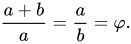





symbol
Shouldn't the ratio be the straight phi symbol, rather than the round letter form? It was mixed up in early versions of Unicode, which messed things up, but AFAICT the intended form was ϕ. That's what's used at Wolframalpha and in math texts that predate the Unicode screwup. — kwami (talk) 21:21, 25 March 2026 (UTC)
- Many older texts that I looked at use
(lowercase and slanted), although the original Cook 1914 and some later sources use
- WolframAlpha, for one.
- By "straight" I didn't mean roman typeface rather than italic (I agree italic is more common), but the shape of the character: a straight stroke
- The texts I'm familiar with have all used
- I checked the first 7 popular titles I could find on the topic, and none of them use
- Richard A Dunlap (1997) The Golden Ratio And Fibonacci Numbers
- Mario Livio (2003) The Golden Ratio: The Story of Phi, the World's Most Astonishing Number
- Alfred S. Posamentier & Ingmar Lehmann (2012) The Glorious Golden Ratio
- Vincent Siu (2016) The Interesting Golden Ratio: A Simple Mathematical Approach
- all use
- Gary B. Meisner (2018) The Golden Ratio: The Divine Beauty of Mathematics
- uses
- Hans Walser (2024) Der Goldene Schnitt (7th edition)
- and its English translation use
- My search brought up a 7th title,
- R. A. Dunlap (1997) The Golden Ratio and Fibonacci Numbers
- I couldn't access it, though a review used
- Whether it should be upright, as in one of those, because it's a constant, is a separate issue, and minority usage. — kwami (talk) 23:42, 25 March 2026 (UTC)
- I'm not sure if pop math books are necessarily representative of what you'd find in research papers. –jacobolus (t) 03:20, 26 March 2026 (UTC)
- But as you noted above, tau may be more likely there, so neither form would be representative. Of the two, the straight glyph would seem to be the more familiar.
- The Unicode character was designed for this symbol, and intended to be distinct from the orthographic letter. — kwami (talk) 04:01, 26 March 2026 (UTC)
- Mathematicians largely do not care about unicode. Unicode decisions have no bearing on this.
- I made an unscientific survey of recent publications with signed reviews in MathSciNet (so, filtering out journals not recognized by MathSciNet as serious) and then sampling among those for journals whose names I recognized. I tried ten before stopping, and found:
- My impression from this is that in recent mathematics the curly phi is strongly preferred. —David Eppstein (talk) 05:25, 26 March 2026 (UTC)
- When they both appear in the same font, the unicode symbols φ and ϕ are usually distinct, but which one is which depends on the font, and I don't think there's any particular requirement about the appearance (my understanding is that both variants are common in Greek writing). For example, on my computer, in the Palatino, Symbol, and Hiragino Mincho ProN fonts, "φ" looks like
- Given that's the case, we should presumably use the intended Unicode character in text, independently of which LaTeX code is chosen. — kwami (talk) 01:43, 27 March 2026 (UTC)
- No. We should not use one character in text and a likely-different-looking character in formulas. We should use a single notation, consistently. That means LaTeX, both in text and in formulas, regardless of whether it is
- So the article as it currently is is wrong. I'll go ahead and fix it. — kwami (talk) 05:10, 27 March 2026 (UTC)
- No, I think the point is that the article as it currently stands seems basically fine. These are two ways of writing the same Greek letter, and in most contexts the choice is basically arbitrary (as long as the symbol is consistent within the same source). Among recent math papers the version used in the article seems to be common (though it's plausible that Wikipedia is exerting influence), whereas in recent pop math books the opposite choice seems to be more common (it's also plausible that this choice was not intentional, but just resulted from the choice of font for the Greek alphabet used in these books).
- You shouldn't make a stylistic change like this without achieving consensus for the change, which I don't think you have accomplished yet. Personally I'm pretty indifferent, either symbol seems fine, but I have a slight bias against making changes of this type unless there's a clear benefit, because the change itself can be mildly disruptive. –jacobolus (t) 05:50, 27 March 2026 (UTC)
- I think the recent change was not intended as a stylistic change or a new choice of one symbol over another, just making consistent the formatting of the status quo choice. —David Eppstein (talk) 06:25, 27 March 2026 (UTC)
- Yes. Personally I prefer the straight glyph, but if we're going to use the round one, we should use the round one. It's weird to have one in the text and the other in the figures. They were consistent with my browser and fonts, but as noted above, that wasn't true for everyone. — kwami (talk) 07:21, 27 March 2026 (UTC)
- @Kwamikagami The main problem with your recent changes is that you put LaTeX into image captions. We should avoid that based on the unfortunate bug that clicking the image will pop up a full-window view of the image with caption at the bottom, but any LaTeX elements will disappear in that caption, which causes confusion. It's also frowned on to mix LaTeX with math templates within the same expression. We're in a bit of a lesser-evil situation here; the typical consensus recommendation is to avoid the use of LaTeX in captions. A small minority of readers may see a circle-and-line version of the letter phi rather than a loopy version in the image captions, but that's considered better than having the caption completely broken for all readers when the image is clicked on. –jacobolus (t) 20:01, 27 March 2026 (UTC)
- Okay, but then if we are to use Unicode, then we should use proper Unicode. The phi symbol is the Unicode character for the Golden Ratio, not the alphabetical phi. What either of them looks like will depend on the user's default font, but at least the code point should be correct. — kwami (talk) 01:59, 28 March 2026 (UTC)
- There is no such thing as a "Unicode symbol for the golden ratio". –jacobolus (t) 02:16, 28 March 2026 (UTC)
- The "phi symbol" is the Unicode character for phi used as a mathematical or technical symbol, as it is for the golden ratio. — kwami (talk) 02:23, 28 March 2026 (UTC)
- That is incorrect. Both φ (U+03C6 GREEK SMALL LETTER PHI) and ϕ (U+03D5 GREEK PHI SYMBOL) represent the Greek letter phi, and either can be used in mathematical contexts (or both together if there is a need for two distinct symbols). The unicode specification makes no mention of the golden ratio. Looking at the spec, apparently now in fonts intended for mathematical use U+03C6 is recommended to use a "loopy" glyph and U+03D5 is recommended to be a "closed" glyph, but as I mentioned before, some fonts adopt the opposite convention (maybe it wasn't previously specified?) and many fonts intended for use setting ordinary Greek text use a "closed" variant for U+03C6 (and do not include U+03D5 at all). If the article used
- That is incorrect. Both φ (U+03C6 GREEK SMALL LETTER PHI) and ϕ (U+03D5 GREEK PHI SYMBOL) represent the Greek letter phi, and either can be used in mathematical contexts (or both together if there is a need for two distinct symbols). The unicode specification makes no mention of the golden ratio. Looking at the spec, apparently now in fonts intended for mathematical use U+03C6 is recommended to use a "loopy" glyph and U+03D5 is recommended to be a "closed" glyph, but as I mentioned before, some fonts adopt the opposite convention (maybe it wasn't previously specified?) and many fonts intended for use setting ordinary Greek text use a "closed" variant for U+03C6 (and do not include U+03D5 at all). If the article used
- The "phi symbol" is the Unicode character for phi used as a mathematical or technical symbol, as it is for the golden ratio. — kwami (talk) 02:23, 28 March 2026 (UTC)
- There is no such thing as a "Unicode symbol for the golden ratio". –jacobolus (t) 02:16, 28 March 2026 (UTC)
- Okay, but then if we are to use Unicode, then we should use proper Unicode. The phi symbol is the Unicode character for the Golden Ratio, not the alphabetical phi. What either of them looks like will depend on the user's default font, but at least the code point should be correct. — kwami (talk) 01:59, 28 March 2026 (UTC)
- @Kwamikagami The main problem with your recent changes is that you put LaTeX into image captions. We should avoid that based on the unfortunate bug that clicking the image will pop up a full-window view of the image with caption at the bottom, but any LaTeX elements will disappear in that caption, which causes confusion. It's also frowned on to mix LaTeX with math templates within the same expression. We're in a bit of a lesser-evil situation here; the typical consensus recommendation is to avoid the use of LaTeX in captions. A small minority of readers may see a circle-and-line version of the letter phi rather than a loopy version in the image captions, but that's considered better than having the caption completely broken for all readers when the image is clicked on. –jacobolus (t) 20:01, 27 March 2026 (UTC)
- Yes. Personally I prefer the straight glyph, but if we're going to use the round one, we should use the round one. It's weird to have one in the text and the other in the figures. They were consistent with my browser and fonts, but as noted above, that wasn't true for everyone. — kwami (talk) 07:21, 27 March 2026 (UTC)
- I think the recent change was not intended as a stylistic change or a new choice of one symbol over another, just making consistent the formatting of the status quo choice. —David Eppstein (talk) 06:25, 27 March 2026 (UTC)
- So the article as it currently is is wrong. I'll go ahead and fix it. — kwami (talk) 05:10, 27 March 2026 (UTC)
- No. We should not use one character in text and a likely-different-looking character in formulas. We should use a single notation, consistently. That means LaTeX, both in text and in formulas, regardless of whether it is
- Given that's the case, we should presumably use the intended Unicode character in text, independently of which LaTeX code is chosen. — kwami (talk) 01:43, 27 March 2026 (UTC)
- I'm not sure if pop math books are necessarily representative of what you'd find in research papers. –jacobolus (t) 03:20, 26 March 2026 (UTC)

Only U+03C6 is the Greek alphabet letter, as only it has a casing relationship with the capital. Using 03D5 in Greek text would be an error.
Yes, either may be used in mathematics: 03C6 may be used, for example as a variable, just as any other Greek letter may. 03D5 is specifically a technical or mathematical symbol, distinct from the simple alphabetic letter. — kwami (talk) 02:39, 28 March 2026 (UTC)
- In a technical context, especially if you get to specifically choose the font, you should generally use U+03C6 if you want a "loopy" letter (LaTeX \varphi) and U+03D5 if you want a "closed" letter (LaTeX \phi), unless the specific font you chose has these variants reversed, in which case you should reverse your glyph choice.
- In a non-technical context (for example, making a poster with Greek writing in it), you should generally use U+03C6, trusting that the font will have a nice looking glyph for it, but if the specific font you are using includes both symbols, you can pick U+03D5 instead to get a glyph variant that might be preferable in your context. If you are typesetting your own document you can use whatever symbols you want; fonts include variant symbols to give typesetters choices and flexibility, and taking advantage of that is not an "error". –jacobolus (t) 03:27, 28 March 2026 (UTC)
- We're talking about Wikipedia, not making a poster where you could use a font that assigns Greek letters to the ASCII range. But it is an error if you're exchanging data, which is what happens with Wikipedia. For a poster, you could draw it by hand -- again, not an option for us. Here, in an online article, U+03D5 would be wrong for the Greek letter. It is right for the technical symbol. How it displays to the reader depends on their fonts -- that's out of our control.
- "unless the specific font you chose has these variants reversed" -- but we don't get to choose the specific font. That happens in the user's browser. — kwami (talk) 04:56, 28 March 2026 (UTC)
- If you are writing a non-technical Wikipedia article (e.g. for the Greek Wikipedia), I can't see any reason why you'd use U+03D5. So what? If you are writing a technical article on English Wikipedia, you should choose U+03C6 if you want to (most of the time) get a "loopy" letter and U+03D5 if you want to (most of the time) get a "closed" letter. Which is what we are currently doing in the image captions in this article, a context where LaTeX is buggy. It's fine, we don't need to make any change. We're now repeating ourselves, and this discussion seems to be pretty much done. –jacobolus (t) 05:33, 28 March 2026 (UTC)
- You're confusing glyphs with characters. If we're not using LaTeX, then unless we want to use SVG images we use characters. We don't get to choose the glyphs unless we embed a particular font in the article. — kwami (talk) 05:47, 28 March 2026 (UTC)
- You are correct that we don't choose the font. Which is why, to the extent possible we try to use LaTeX in this article. But LaTeX should not be used in image captions, so we do the best we can with a {{math}} template, using the Unicode character which will appear the same for the large majority of readers, accepting that a small minority of readers will end up with an inconsistent looking phi symbol in the image captions, something we can't do anything about. –jacobolus (t) 05:55, 28 March 2026 (UTC)
- You're confusing glyphs with characters. If we're not using LaTeX, then unless we want to use SVG images we use characters. We don't get to choose the glyphs unless we embed a particular font in the article. — kwami (talk) 05:47, 28 March 2026 (UTC)
- If you are writing a non-technical Wikipedia article (e.g. for the Greek Wikipedia), I can't see any reason why you'd use U+03D5. So what? If you are writing a technical article on English Wikipedia, you should choose U+03C6 if you want to (most of the time) get a "loopy" letter and U+03D5 if you want to (most of the time) get a "closed" letter. Which is what we are currently doing in the image captions in this article, a context where LaTeX is buggy. It's fine, we don't need to make any change. We're now repeating ourselves, and this discussion seems to be pretty much done. –jacobolus (t) 05:33, 28 March 2026 (UTC)
I'd like to keep the article as it has been for some while now. For one, I am not at all sure that a unicode varphi looks different from a LaTeX varphi if the former is done in math mode: {{math|''ϕ''}} or {{mvar|ϕ}}. After all, this {{math}} mode is setting the font. For two, it is often hard to get good legibility with a conversion of <math display="block">...</math> to unicode, but in inline text, unicode math usually works well and has the advantage of being easier to cut and paste as part of its enclosing sentence. —Quantling (talk | contribs) 19:24, 27 March 2026 (UTC)
- If we are going to use either
- How many readers are affected by fonts that are bad for Greek phi? Is the worst for a reader in this subset that the reader would see something more like
- Which side effects are you thinking about? Using LaTeX generally confers a net benefit: everything looks a whole lot better. –jacobolus (t) 21:30, 27 March 2026 (UTC)
- For example, if I cut and paste a sentence with math in it into most editors that I use, the math disappears if it is LaTeX-generated image, but works just fine if it is unicode text. But I'm not trying to settle once and for all that LaTeX or unicode is generally superior to the other. I argue that it depends upon context and, yes, the editor who is creating the content, and that this font issue isn't strong enough, in my opinion, to tilt that balance. And I do my best to convince others .... —Quantling (talk | contribs) 01:06, 28 March 2026 (UTC)
- Which browser are you using? Here, copy/pasting a sentence with LaTeX expressions will paste both the individual symbols (bizarrely separated by line breaks) and also the LaTeX source. If I copy/paste a sentence with math templates, the formatting also gets completely wrecked, with a lot of extraneous line breaks thrown in and output that is typically semantically invalid. This doesn't seem like a particularly important difference compared to the visual fidelity of the mathematical notation, but you can try to ask for better or different copy/paste support at the Mediawiki bug tracker. It's not entirely clear what the behavior should be, since most places where the paste is targeted won't have any kind of special math support. –jacobolus (t) 01:25, 28 March 2026 (UTC)
- Should we go back to Unicode then? — kwami (talk) 02:02, 28 March 2026 (UTC)
- No. In general you shouldn't make stylistic changes like that without consensus for the change, which there doesn't seem to be here. See WP:STYLEVAR and also Help:Displaying a formula § LaTeX vs. {{math}}. –jacobolus (t) 05:38, 28 March 2026 (UTC)
- Um ... thus why I was asking rather than doing.
- Okay, we will continue to use LaTeX in the figures. — kwami (talk) 05:44, 28 March 2026 (UTC)
- Okay, you said we should not use Unicode, then changed the article to Unicode. I restored what you claimed to be the consensus.
- So, which is it: do we used Unicode or not? — kwami (talk) 05:50, 28 March 2026 (UTC)
- @Kwamikagami The article is completely fine as it was. It uses LaTeX where possible, and uses {{math}} templates where LaTeX is best avoided because of a mediawiki software bug. –jacobolus (t) 05:52, 28 March 2026 (UTC)
- Also, please no revert warring. –jacobolus (t) 05:52, 28 March 2026 (UTC)
- So we do use Unicode, just embedded in {{math}}. — kwami (talk) 05:56, 28 March 2026 (UTC)
- We use LaTeX where we can, and where that is broken, such as here in image captions, we use plain HTML/wikimarkup instead, wrapped inside {{math}} templates. If you like you can call the use of {{math}} templates "unicode", though that label might be confusing/misleading. –jacobolus (t) 06:06, 28 March 2026 (UTC)
- It contains a Unicode character, which we chose. We/you have chosen the Unicode alphabetic letter phi rather than the technical symbol phi, correct? I don't follow how it's misleading to say that. When I copy and paste, I get the Unicode character, so it doesn't seem that the {math} template converts it into something else. — kwami (talk) 06:21, 28 March 2026 (UTC)
- Yes, in the image captions we are using the character φ (U+03C6, GREEK SMALL LETTER PHI), because for most readers it will appear similar to
- I feel like we already went over this about 10 times. –jacobolus (t) 14:20, 28 March 2026 (UTC)
- Yes, in the image captions we are using the character φ (U+03C6, GREEK SMALL LETTER PHI), because for most readers it will appear similar to
- It contains a Unicode character, which we chose. We/you have chosen the Unicode alphabetic letter phi rather than the technical symbol phi, correct? I don't follow how it's misleading to say that. When I copy and paste, I get the Unicode character, so it doesn't seem that the {math} template converts it into something else. — kwami (talk) 06:21, 28 March 2026 (UTC)
- We use LaTeX where we can, and where that is broken, such as here in image captions, we use plain HTML/wikimarkup instead, wrapped inside {{math}} templates. If you like you can call the use of {{math}} templates "unicode", though that label might be confusing/misleading. –jacobolus (t) 06:06, 28 March 2026 (UTC)
- So we do use Unicode, just embedded in {{math}}. — kwami (talk) 05:56, 28 March 2026 (UTC)
- No. In general you shouldn't make stylistic changes like that without consensus for the change, which there doesn't seem to be here. See WP:STYLEVAR and also Help:Displaying a formula § LaTeX vs. {{math}}. –jacobolus (t) 05:38, 28 March 2026 (UTC)
- @Jacobolus since you asked... I'm using Firefox to copy from Wikipedia. I'm hoping to paste text into text editors, so all the extra lines, extra spaces, images, and LaTeX source that <math> often leads to are unhelpful to me. On the other hand, if I am copying a simple unicode φ or ϕ then I get exactly what I am hoping for. So for me, it makes sense to use unicode for very simple math. —Quantling (talk | contribs) 18:07, 29 March 2026 (UTC)
- Ah you just mean single symbols? Fair enough. I was thinking of examples with fractions, subscripts, etc. It would indeed be nice if the copy/paste behavior worked better for single symbols marked up with LaTeX. Personally I find consistent appearance more important than copy/paste in most cases. In this particular article, there will necessarily be many inline LaTeX formulas because they involve square roots, etc., and having symbols in close proximity in the same sentence change randomly in size and font seems really ugly. YMMV. –jacobolus (t) 18:58, 29 March 2026 (UTC)
- Should we go back to Unicode then? — kwami (talk) 02:02, 28 March 2026 (UTC)
- Which browser are you using? Here, copy/pasting a sentence with LaTeX expressions will paste both the individual symbols (bizarrely separated by line breaks) and also the LaTeX source. If I copy/paste a sentence with math templates, the formatting also gets completely wrecked, with a lot of extraneous line breaks thrown in and output that is typically semantically invalid. This doesn't seem like a particularly important difference compared to the visual fidelity of the mathematical notation, but you can try to ask for better or different copy/paste support at the Mediawiki bug tracker. It's not entirely clear what the behavior should be, since most places where the paste is targeted won't have any kind of special math support. –jacobolus (t) 01:25, 28 March 2026 (UTC)
- For example, if I cut and paste a sentence with math in it into most editors that I use, the math disappears if it is LaTeX-generated image, but works just fine if it is unicode text. But I'm not trying to settle once and for all that LaTeX or unicode is generally superior to the other. I argue that it depends upon context and, yes, the editor who is creating the content, and that this font issue isn't strong enough, in my opinion, to tilt that balance. And I do my best to convince others .... —Quantling (talk | contribs) 01:06, 28 March 2026 (UTC)
- Which side effects are you thinking about? Using LaTeX generally confers a net benefit: everything looks a whole lot better. –jacobolus (t) 21:30, 27 March 2026 (UTC)
- How many readers are affected by fonts that are bad for Greek phi? Is the worst for a reader in this subset that the reader would see something more like