1684 – Isaac Newton proves that planets moving under an inverse-square force law will obey Kepler's laws in a letter to Edmond Halley.[7]
1686 – Isaac Newton uses a fixed length pendulum with weights of varying composition to test the weak equivalence principle to 1 part in 1000.[9][10]:353–4
1740s-1750s – Leonhard Euler and Alexis Clairault independently derive the equations of motion for the three-body problem and apply them to the Moon.[19]
1783 – John Michell speculates that a star could be so massive that its gravitational field would prevent light from escaping.[26]:372 Pierre-Simon de Laplace proposes the same thing in 1795.[27]:537
1849 – Armand Fizeau makes the first terrestrial determination of the speed of light.[31]:5
1855 – Le Verrier observes a 38 arc-second per century excess precession of Mercury's orbit and attributes it to another planet, inside Mercury's orbit. The planet, called Vulcan, was never found. Le Verrier's figure is revised by Simon Newcomb to 43 arc-second per century in 1882.[19]
1876 – William Kingdon Clifford suggests that the motion of matter may be due to changes in the geometry of space.[32]
1888 – Oliver Heaviside calculates the electromagnetic field of a moving point charge at constant velocity,[39] and realizes, with some help by George Frederick Charles Searle, that the field contracts in the direction of motion.[40]:181
The U.S. Navy's nuclear-powered Task Force 1 underway for Operation Sea Orbit in the Mediterranean, 1964.
1902 – Paul Gerber explains the movement of the perihelion of Mercury using finite speed of gravity.[43] His formula, at least approximately, matches the later model from Einstein's general relativity, but Gerber's theory was incorrect.
1906 – Max Planck coins the term Relativtheorie. Albert Einstein later uses the term Relativitätstheorie in a conversation with Paul Ehrenfest. He originally prefers calling it Invariance Theory.[54]
Einstein's 1911 argument for gravitational redshift
1911 – Max von Laue publishes the first textbook on special relativity.[66]
1911 – Albert Einstein explains the need to replace both special relativity and Newton's theory of gravity; he realizes that the principle of equivalence only holds locally, not globally.[67]
1916 – Karl Schwarzschild publishes the Schwarzschild metric about a month after Einstein published his general theory of relativity.[75][76] This was the first solution to the Einstein field equations other than the trivial flat space solution.[77][78][79]
1919 – Arthur Eddington leads a solar eclipse expedition which detects gravitational deflection of light by the Sun,[94] which, despite opinion to the contrary, survives modern scrutiny.[95] Other teams fail for reasons of war and politics.[96]
1949 – Fred Hoyle coins the term "Big Bang" theory in contrast with his "Steady State" model, though the term Big Bang only becomes widespread in the 1970s.[140]
1954 – Suraj Gupta sketches how to derive the equations of general relativity from quantum field theory for a massless spin-2 particle (the graviton).[148] His procedure is later carried out by Stanley Deser in 1970.[149][150]
1955-56 – Robert Kraichnan shows that under the appropriate assumptions, Einstein's field equations of gravitation arise from the quantum field theory of a massless spin-2 particle coupled to the stress-energy tensor.[152][153] This follows from his unpublished work as an undergraduate in 1947.[150]
1964 – Steven Weinberg shows that a quantum field theory of interacting massless spin-2 particles is Lorentz invariant only if it satisfies the principle of equivalence.[180][181][150]
1971 – Introduction of the Khan–Penrose vacuum, a simple explicit colliding plane wave spacetime.
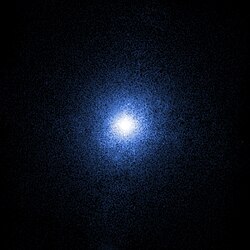
1971 – Robert H. Gowdy introduces the Gowdy vacuum solutions (cosmological models containing circulating gravitational waves).Image of Cygnus X-1 by the Chandra X-ray Observatory (2009)
1973 – Charles W. Misner, Kip Thorne and John Archibald Wheeler publish the treatise Gravitation, a textbook that remains in use in the twenty-first century.[223][224]
Computer simulation of a black hole accretion disk published in 1979 by Jean-Pierre Luminet1974 – James W. York and Niall Ó Murchadha present the analysis of the initial value formulation and examine the stability of its solutions.
1974 – R. O. Hansen introduces Hansen–Geroch multipole moments.
Variations in the temperature of the cosmic microwave background measured by the COBE satellite. The plane of the Milky Way Galaxy is horizontal across the middle of each picture.
1980 – Vera Rubin and colleagues study the rotational properties of UGC 2885, demonstrating the prevalence of dark matter.[244][245]
1986 – Bernard Schutz shows that cosmic distances can be determined using sources of gravitational waves without references to the cosmic distance ladder.[253] Standard-siren astronomy is born.
1995 – John F. Donoghue shows that general relativity is a quantum effective field theory.[261] This framework could be used to analyze binary systems observed by gravitational-wave observatories.[262]
2017 – LIGO-VIRGO collaboration detects gravitational waves emitted by a neutron-star binary, GW170817.[287] The Fermi Gamma-ray Space Telescope and the International Gamma-ray Astrophysics Laboratory (INTEGRAL) unambiguously detect the corresponding gamma-ray burst.[288][289] LIGO-VIRGO and Fermi constrain the difference between the speed of gravity and the speed of light in vacuum to 10−15.[290] This marks the first time electromagnetic and gravitational waves are detected from a single source,[291][292] and give direct evidence that some (short) gamma-ray bursts are due to colliding neutron stars.[287][288]
2017 – MICROSCOPE satellite experiment verifies the principle of equivalence to 10−15 in terms of the Eötvös ratio .[301] The final report is published in 2022.[302][303]
2017 – Scientists begin using gravitational-wave sources as "standard sirens" to measure the Hubble constant, finding its value to be broadly in line with the best estimates of the time.[305][306] An improved result is published in 2019.[307] Refinements of this technique will help resolve discrepancies between the different methods of measurements.[308][309]
2018 – Final paper by the Planck satellite collaboration.[310] Planck operated between 2009 and 2013.
2018 – Mihalis Dafermos and Jonathan Luk disprove the strong cosmic censorship hypothesis for the Cauchy horizon of an uncharged, rotating black hole.[311]
2018 – Advanced LIGO-VIRGO collaboration constrains equations of state for a neutron star using GW170817.[314][315]
2018 – Luciano Rezzolla, Elias R. Most, and Lukas R. Weih used gravitational-wave data from GW170817 constrain the possible maximum mass for a neutron star to around 2.01 to 2.16 (solar masses).[316][317]
2018 – Kris Pardo, Maya Fishbach, Daniel Holz, and David Spergel limit the number of spacetime dimensions through which gravitational waves can propagate to 3 + 1, in line with general relativity and ruling out models that allow for "leakage" to higher dimensions of space.[318][319] Analyses of GW170817 have also ruled out many alternatives to general relativity,[320] such as scalar-tensor theory[321][322][323] and bimetric gravity,[324] and proposals for dark energy.[325][326][327][328]
2018 – Two different experimental teams report highly precise values of Newton's gravitational constant that slightly disagree.[329][330][331]
2019 – Advanced LIGO and VIRGO detect GW190814, the collision of a 26-solar-mass black hole and a 2.6-solar-mass object, either an extremely heavy neutron star or a very light black hole.[335][336] This is the largest mass gap seen in a gravitational-wave source to-date.
2020s
The size of Sagittarius A* is smaller than the orbit of Mercury.
2021 – Jun Ye and his team measure gravitational redshift with an accuracy of 7.6 × 10⁻²¹ using an ultracold cloud of 100,000 strontium atoms in an optical lattice.[340][341]
2021 – EHT measures the polarization of the ring of M87*,[342] and other properties of the magnetic field in its vicinity.[343]
2021 – EHT releases an image of Sagittarius A*,[344][345] measures its shadow,[346] and shows that it is accurately described by the Kerr metric.[347][348]
2023 – Geraint F. Lewis and Brendon Brewer present evidence of cosmological time dilation in quasars.[370][371]
2023 – CERN demonstrates by experiment that antimatter obeys the weak principle of equivalence, meaning it does not have antigravitational properties.[372][373]
2025 – LIGO-VIRGO-KAGRA collaboration verifies Hawking's area theorem for two merging black holes with GW250114, the clearest gravitational-wave signal to-date.[381][382] Alternatives to general relativity are further constrained.[383][384]
Bauer, Susan Wise (2015). "Chapter Seven: The Last Ancient Astronomer". The Story of Science from the Writings of Aristotle to the Big Bang Theory. New York: W. W. Norton & Company. ISBN978-0-393-24326-0.
Gribbin, John (2004). The Scientists: A History of Science Told Through the Lives of Its Greatest Inventors. New York: Random House. ISBN978-0-812-96788-3.
Pasachoff, Naomi; Pasachoff, Jay (2012). "Galileo Galilei". In Robinson, Andrew (ed.). The Scientists: An Epic of Discovery. New York: Thames and Hudson. ISBN978-0-500-25191-1.
Dolnick, Edward (2011). "Timeline". The Clockwork Universe: Isaac Newton, the Royal Society, and the Birth of the Modern World. New York: Harper Collins. ISBN978-0-06-171951-6.
Bauer, Susan Wise (2015). "Chapter Ten: The Death of Aristotle". The Story of Science: From the Writings of Aristotle to the Big Bang Theory. New York: W. W. Norton & Company. ISBN978-0-393-24326-0.
Iliffe, Rob (2012). "Isaac Newton". In Robinson, Andrew (ed.). The Scientists: An Epic of Discovery. New York: Thames and Hudson. ISBN978-0-500-25191-1.
Newton, Isaac (1999). The Principia: The Authoritative Translation and Guide. Translated by Cohen, I. Bernard; Whitman, Anne; Budenz, Julia. University of California Press. ISBN978-0-520-29088-4.
Kaku, Michio (2008). Physics of the Impossible: A Scientific Exploration Into the World of Phasers, Force Fields, Teleportation, and Time Travel. New York: Doubleday. ISBN978-0-385-52069-0.
Chandrasekhar, Subrahmanyan (1969). "5: The Maclaurin Spheroids". Ellipsoidal Figures of Equilibrium. New Haven: Yale University Press. ISBN978-0-30001-116-6.
Wilson, Curtis (2002). "Newton and Celestial Mechanics". In Cohen, I. Bernard; Smith, George (eds.). The Cambridge Companion to Newton. Cambridge University Press. ISBN0-521-65696-6.
Woolfson, M.M. (1993). "Solar System– its origin and evolution". Q. J. R. Astron. Soc. 34: 1–20. Bibcode:1993QJRAS..34....1W. For details of Kant's position, see Stephen Palmquist, "Kant's Cosmogony Re-Evaluated", Studies in History and Philosophy of Science 18:3 (September 1987), pp.255–269.
Goldstein, Martin; Goldstein, Inge F. (1993). The Refrigerator and the Universe: Understanding the Laws of Energy. Cambridge, Massachusetts: Harvard University Press. ISBN0-674-75324-0.
Eisenstaedt, Jean (2006). The Curious History of Relativity: How Einstein's Theory of Gravity Was Lost and Found Again. Translated by Sangalli, Arturo. Princeton, NJ: Princeton University Press. ISBN978-0-691-11865-9.
Bianchi, Luigi (1902). "Sui simboli a quattro indici e sulla curvatura di Riemann" [On Four-Index Symbols and Riemann Curvature]. Rend. Acc. Naz. Lincei (in Italian). 11 (5): 3–7.
Robinson, Andrew (2012). "Albert Einstein". In Robinson, Andrew (ed.). The Scientists: An Epic of Discovery. New York: Thames and Hudson. ISBN978-0-500-25191-1.
Ehrenfest, Paul (1909). "Gleichförmige Rotation starrer Körper und Relativitätstheorie" [Uniform Rotation of Rigid Bodies and Theory of Relativity]. Physikalische Zeitschrift (in German). 10 (918): 918. Bibcode:1909PhyZ...10..918E.
Kottler, Friedrich (1912). "Über die Raumzeitlinien der Minkowski'schen Welt" [On the Spacetime Lines of a Minkowski World]. Wiener Sitzungsberichte 2a (in German). 121: 1659–1759.
Einstein, Albert (1915). "Feldgleichungen der Gravitation" [Field Equations of Gravitation]. Preussische Akademie der Wissenschaften, Sitzungsberichte: 844–847.
Einstein, Albert (1915). "Erklärung der Perihelbewegung des Merkur aus der allgemeinen Relativitätstheorie" [Explanation of the Perihelion Motion of Mercury from the General Theory of Relativity]. Preussische Akademie der Wissenschaften, Sitzungsberichte: 831–839. Bibcode:1915SPAW.......831E.
Hilbert, David (1915), "Die Grundlagen der Physik" [Foundations of Physics], Nachrichten von der Gesellschaft der Wissenschaften zu Göttingen – Mathematisch-Physikalische Klasse (in German), 3: 395–407
Marsden, Jerrold; Tromba, Anthony (2012). "7.7 Applications to Differential Geometry, Physics, and Forms of Life". Vector Calculus (6thed.). New York: W. H. Freeman Company. p.422. ISBN978-1-4292-1508-4.
Schwarzschild, Karl (1916). "Über das Gravitationsfeld einer Kugel aus inkompressibler Flüssigkeit" [On the Gravitational Field of a Sphere of Incompressible Fluid]. Sitzungsberichte der Königlich-Preussischen Akademie der Wissenschaften.
Eisenstaedt, "The Early Interpretation of the Schwarzschild Solution," in D. Howard and J. Stachel (eds), Einstein and the History of General Relativity: Einstein Studies, Vol. 1, pp. 213-234. Boston: Birkhauser, 1989.
Bartusiak, Marcia (2015). "Chapter 3: One Would Then Find Oneself... in a Geometrical Fairyland". Black Hole: How An Idea Abandoned by Newtonians, Hated by Einstein, and Gambled on by Hawking Became Loved. New Haven, CT: Yale University Press. ISBN978-0-300-21085-9.
Nordström, G. (1918). "On the Energy of the Gravitational Field in Einstein's Theory". Koninklijke Nederlandsche Akademie van Wetenschappen Proceedings. 20 (2): 1238–1245. Bibcode:1918KNAB...20.1238N.
Einstein, Albert (1916). "Näherungsweise Integration der Feldgleichungen der Gravitation" [Approximate Integration of the Field Equations of Gravitation]. Preussische Akademie der Wissenschaften, Sitzungsberichte (in German): 688–696. Bibcode:1916SPAW.......688E.
Einstein, Albert (1917). "Kosmologische Betrachtungen zur allgemeinen Relativitätstheorie" [Cosmological Considerations in the General Theory of Relativity]. Preussische Akademie der Wissenschaften, Sitzungsberichte (in German). 1: 142–152.
Thirring, H. (1918). "Über die Wirkung rotierender ferner Massen in der Einsteinschen Gravitationstheorie". Physikalische Zeitschrift. 19: 33. Bibcode:1918PhyZ...19...33T. [On the Effect of Rotating Distant Masses in Einstein's Theory of Gravitation]
Thirring, H. (1921). "Berichtigung zu meiner Arbeit: 'Über die Wirkung rotierender Massen in der Einsteinschen Gravitationstheorie'". Physikalische Zeitschrift. 22: 29. Bibcode:1921PhyZ...22...29T. [Correction to my paper "On the Effect of Rotating Distant Masses in Einstein's Theory of Gravitation"]
Lense, J.; Thirring, H. (1918). "Über den Einfluss der Eigenrotation der Zentralkörper auf die Bewegung der Planeten und Monde nach der Einsteinschen Gravitationstheorie". Physikalische Zeitschrift. 19: 156–163. Bibcode:1918PhyZ...19..156L. [On the Influence of the Proper Rotation of Central Bodies on the Motions of Planets and Moons According to Einstein's Theory of Gravitation]
Kaluza, Theodor (1921). "Zum Unitätsproblem in der Physik". Sitzungsber. Preuss. Akad. Wiss. Berlin. (Math. Phys.) (in German): 966–972. Bibcode:1921SPAW.......966K.
Pais, Abraham (2000). "Chapter 7: Oskar Klein". The Genius of Science: A Portrait Gallery of Twentieth-Century Physicists. New York: Oxford University Press. ISBN0-19-850614-7.
van Stuckum, Willem Jacob (1938). "The gravitational field of a distribution of particles rotating around an axis of symmetry". Proceedings of the Royal Society of Edinburgh. 57: 135–154. doi:10.1017/S0370164600013699.
Einstein, Albert (1931). "Zum kosmologischen Problem der allgemeinen Relativitätstheorie" [On the Cosmological Problem of the General Theory of Relativity]. Sitzungsberichte der Preussischen Akademie der Wissenschaften, Physikalisch-mathematische Klasse (in German): 235–237.
D. I., Blokhintsev; F. M., Gal'perin (1934). "Гипотеза нейтрино и закон сохранения энергии" [Neutrino hypothesis and conservation of energy]. Pod Znamenem Marxisma (in Russian). 6: 147–157. ISBN978-5-04-008956-7.{{cite journal}}: ISBN / Date incompatibility (help)
Einstein, Albert; Infeld, Leopold; Hoffmann, Banesh (1938). "The Gravitational Equations and the Problem of Motion". Annals of Mathematics. 39 (1): 65–100. doi:10.2307/1968714. JSTOR1968714.
"X-ray Astronomy". Goddard Space Flight Center. National Aeronautics and Space Administration (NASA). August 22, 2009. Archived from the original on August 13, 2009. Retrieved January 23, 2026.
Boyer, Robert H.; Lindquist, Richard W. (1967). "Maximal Analytic Extension of the Kerr Metric". Journal of Mathematical Physics. 8 (2): 265–281. Bibcode:1967JMP.....8..265B. doi:10.1063/1.1705193.
Chiu, Hong-Yee (May 1964). "Gravitational collapse". Physics Today. 17 (5): 21–34. Bibcode:1964PhT....17e..21C. doi:10.1063/1.3051610. So far, the clumsily long name 'quasi-stellar radio sources' is used to describe these objects. Because the nature of these objects is entirely unknown, it is hard to prepare a short, appropriate nomenclature for them so that their essential properties are obvious from their name. For convenience, the abbreviated form 'quasar' will be used throughout this paper.
Weinberg, Steven (1964). "Photons and gravitons in S-matrix theory: derivation of charge conservation and equality of gravitational and inertial mass". Physical Review. 135 (4B): B1049–B1056. Bibcode:1964PhRv..135.1049W. doi:10.1103/PhysRev.135.B1049.
Bartusiak, Marcia (2015). "Chapter 9: Why Don't You Call It A Black Hole?". Black Hole: How an Idea Abandoned by Newtonians, Hated by Einstein, and Gambled on by Hawking Became Loved. New Haven, CT: Yale University Press. ISBN978-0-300-21085-9.
Chandrasekhar, S. (1967). "The post-Newtonian effects of General Relativity on the equilibrium of uniformly rotating bodies. II. The deformed figures of the MacLaurin spheroids". The Astrophysical Journal. 147: 334. Bibcode:1967ApJ...147..334C. doi:10.1086/149003.
H. G. Ellis (1973). "Ether flow through a drainhole: A particle model in general relativity". Journal of Mathematical Physics. 14 (1): 104–118. Bibcode:1973JMP....14..104E. doi:10.1063/1.1666161.
Hulse, Russell A.; Taylor Jr., Joseph H. (1975). "Discovery of a Pulsar in a Binary System". Astrophysical Journal. 195: L51–L53. Bibcode:1975ApJ...195L..51H. doi:10.1086/181708.
Townsend, John S. (2012). "Section 8.7: Quantum Interference due to Gravity". A Modern Approach to Quantum Mechanics (2nded.). University Science Books. pp.297–99. ISBN978-1-891389-78-8.
Taylor, J. H.; Weisberg, J. M. (1982). "A new test of general relativity – Gravitational radiation and the binary pulsar PSR 1913+16". Astrophysical Journal. 253: 908–920. Bibcode:1982ApJ...253..908T. doi:10.1086/159690.
Reiss, Adam G.; Filippenko, Alexei V.; Challis, Peter; Clocchiatti, Alejandro; Diercks, Alan; Garnavich, Peter M.; Gilliland, Ron L.; Hogan, Craig J.; Jha, Saurabh; Kirshner, Robert P.; Leibundgut, B.; Phillips, M. M.; Reiss, David; Schmidt, Brian P.; Schommer, Robert A.; Smith, R. Chris; Spyromilio, J.; Stubbs, Christopher; Suntzeff, Nicholas B.; Tonry, John (1998). "Observational Evidence from Supernovae for an Accelerating Universe and a Cosmological Constant". The Astronomical Journal. 116 (3): 1009–1038. arXiv:astro-ph/9805201. Bibcode:1998AJ....116.1009R. doi:10.1086/300499. S2CID15640044.
McLaughlin, Maura (October 16, 2017). "Neutron Star Merger Seen and Heard". Physics. Vol.10, no.114. American Physical Society. Retrieved May 12, 2023.
Landau, Elizabeth (April 10, 2019). "Black Hole Image Makes History". Jet Propulsion Laboratory, California Institute of Technology. Retrieved May 17, 2023.


,_USS_Long_Beach_(CGN-9)_and_USS_Bainbridge_(DLGN-25)_underway_in_the_Mediterranean_Sea_during_Operation_Sea_Orbit,_in_1964.jpg)




.jpg)