Tourism in France
From Wikipedia, the free encyclopedia
Tourism in France directly contributed 79.8 billion euros to gross domestic product (GDP) in 2013, 30% of which comes from international visitors and 70% from domestic tourism spending. As of 2023, France is the world's sixth-largest travel and tourism market, with the sector contributing approximately $264.7 billion to the country's GDP.[1] The total contribution of travel and tourism represents 9.7% of GDP and supports 2.9 million jobs (10.9% of employment) in the country.[2] Tourism contributes significantly to the balance of payments.


France was visited by 102 million foreign tourists in 2025, making it the most visited country in the world.[3] However, France ranks fifth in terms of hotel stays, with 147 million nights, behind the United States, Spain, Italy, and the United Kingdom: this is because France is a transit country, and many international visitors do not stay in hotels. It ranks third (after the United States and Spain) in terms of international tourism receipts.[4]
France has 53 sites inscribed in the UNESCO's World Heritage List and features cities or sites of high cultural interest (Paris being the foremost, but also Loire Valley, Toulouse, Strasbourg, Bordeaux, Lyon and others), beaches and seaside resorts, ski resorts, as well as rural regions that many enjoy for their beauty and tranquility (green tourism). Small and picturesque French villages of quality heritage (such as Collonges-la-Rouge, Locronan, or Montsoreau) are promoted through the association Les Plus Beaux Villages de France (literally "The Most Beautiful Villages of France"). The "Remarkable Gardens" label is a list of the over two hundred gardens classified by the Ministry of Culture. This label is intended to protect and promote remarkable gardens and parks.
Statistics

 |
Most tourists arriving to France in 2018 came from the following countries or territories:[9][dead link]
| Rank | Country or territory | Number of tourists |
|---|---|---|
| 1 |  United Kingdom United Kingdom | 13,000,000 |
| 2 |  Germany Germany | 12,300,000 |
| 3 |  Belgium Belgium
|
11,600,000 |
| 4 |  Italy Italy | 7,000,000 |
| 5 |  Switzerland Switzerland | 6,800,000 |
| 6 |  Spain Spain | 6,700,000 |
| 7 |  Netherlands Netherlands | 4,700,000 |
| 8 |  United States United States | 4,500,000 |
| Total | 89,300,000 | |

Number of stays

| Rank | Country | Stays |
|---|---|---|
| 1 | Germany | 18,300,000 |
| 2 | United Kingdom | 17,200,000 |
| 3 | Netherlands | 16,800,000 |
| 4 | Belgium | 10,400,000 |
| 5 | United States | 8,800,000 |
| 6 | Spain | 6,900,000 |
| 7 | Italy | 6,100,000 |
| 8 | Switzerland | 5,900,000 |
| 9 | Oceania | 910,000 |
| 10 |  Canada Canada | 1,400,000 |
| 11 |  China China | 1,100,000 |
| 12 | Scandinavia | 2,400,000 |
| 13 | Asia | 2,200,000 |
| 14 | Africa | 1,500,000 |
| 15 |  Japan Japan | 800,000 |
| Other countries | 27,700,000 | |
| Total | 146,800,000 |
Most visited cities by tourist arrivals and overnight stays
Tourist stays by region
The following table shows the most visited regions by number of tourist stays in 2023.[12]
| Region | Non-residents | Residents | Total stays |
|---|---|---|---|
| Île-de-France | 48,103,742 | 34,912,658 | 83,016,400 |
| Provence-Alpes-Côte d'Azur | 22,458,611 | 34,786,219 | 57,244,830 |
| Auvergne-Rhône-Alpes | 15,231,904 | 36,504,992 | 51,736,896 |
| Occitanie | 12,946,387 | 39,828,447 | 52,774,834 |
| Nouvelle-Aquitaine | 10,854,903 | 38,605,194 | 49,460,097 |
| Grand Est | 10,207,115 | 18,427,660 | 28,634,775 |
| Brittany | 4,842,663 | 20,516,288 | 25,358,951 |
| Normandy | 4,201,976 | 16,342,198 | 20,544,174 |
| Pays de la Loire | 4,118,552 | 19,273,841 | 23,392,393 |
| Corsica | 3,982,447 | 8,593,114 | 1,257,5561 |
| Hauts-de-France | 3,611,248 | 16,119,055 | 19,730,303 |
| Centre-Val de Loire | 3,544,809 | 10,872,911 | 14,417,720 |
| Bourgogne-Franche-Comté | 2,713,590 | 11,258,469 | 1,397,2059 |
| Total | 146,817,947 | 315,346,796 | 460,271,796 |
Most visited tourist sites in France
The following ranking lists the 30 most visited cultural sites in France in 2023.[13] Notre-Dame de Paris is not included.
Touristic regions
Paris
.jpg)
Paris, the capital city of France, is the third most visited city in the world.[14]
It has some of the world's largest and renowned museums, including the Louvre, which is the most visited art museum in the world, but also the Musée d'Orsay which, like the nearby Musée de l'Orangerie, is mostly devoted to impressionism, and Centre Georges Pompidou, dedicated to Contemporary art.
Paris hosts some of the world's most recognizable landmarks such as the Eiffel Tower, which is the most-visited paid monument in the world,[15] the Arc de Triomphe, the cathedral of Notre-Dame, or the Sacré-Cœur on Montmartre. The Cité des Sciences et de l'Industrie, located in Parc de la Villette, is the biggest science museum in Europe.[16] Near Paris are located the Palace of Versailles, the former palace of the Kings of France, now a museum, and the medieval village of Provins. Both attractions are protected as UNESCO World Heritage Sites.
French Riviera

With more than 10 million tourists a year, the French Riviera (French: Côte d'Azur), in Southeastern France, is the second leading tourist destination in the country, after the Parisian region.[17]
According to the Côte d'Azur Economic Development Agency, it benefits from 300 days of sunshine per year, 115 kilometres (71 mi) of coastline and beaches, 18 golf courses and 3,000 restaurants.[18] Each year the Côte d'Azur hosts 50% of the world's superyacht fleet, with 90% of all superyachts visiting the region's coast at least once in their lifetime.[19]
Main cities on the French Riviera include Nice, Antibes and Cannes; Cap Ferrat is also a popular destination. Cannes hosts the annual Cannes Film Festival. Tourists often visit Port-Cros National Park, east of Toulon, as well as the city-state of Monaco, famous for its Monte Carlo Casino, near the Italian border.
Provence

A large part of Provence, with Marseille as its leading city, was designed as the 2013 European Capital of Culture. Numerous famous natural sites can be found in the region, as the Gorges du Verdon, the Camargue, the Calanques National Park and the typical landscape of Luberon. Provence hosts dozens of renowned historical sites like the Pont du Gard, the Arles' Roman Monuments or the Palais des Papes in Avignon. Several smaller cities also attracts a lot of tourists, like Aix-en-Provence, La Ciotat or Cassis, on the Mediterranean Sea coastline.
Loire Valley

Another major destination are the Châteaux (castles) of the Loire Valley. The French Revolution saw a number of the great French châteaux destroyed and many ransacked, their treasures stolen. The overnight impoverishment of many of the deposed nobility, usually after one of its members lost his or her head to the guillotine, saw many châteaux demolished.
During World War I and World War II, some chateaux were commandeered as military headquarters. Some of these continued to be used this way after the end of the Second World War.
This World Heritage Site is noteworthy for the quality of its architectural heritage, in its historic towns such as Amboise, Angers, Blois, Chinon, Orléans, and Saumur, but in particular for its castles, such as the Châteaux d'Amboise, de Chambord, d'Ussé, de Villandry, de Chenonceau and de Montsoreau, which illustrate to an exceptional degree the ideals of the French Renaissance.
French Alps

The French Alps are the portions of the Alps mountain range that stand within France, located in the Rhône-Alpes and Provence-Alpes-Côte d'Azur regions. While some of the ranges of the French Alps are entirely in France, others, such as the Mont Blanc massif, are shared with Switzerland and Italy.
More than 20 skiing resorts make it a popular destination among Europeans in the winter.
Corsica

Corsica is the fourth largest island in the Mediterranean Sea after Sicily, Sardinia and Cyprus. It is a popular attraction for tourists with both cultural aspects (with its main cities Ajaccio and Bastia and smaller towns like Porto-Vecchio and Sartène) and geographical features (Parc naturel régional de Corse).
The Calanques de Piana and Scandola Nature Reserve are listed on the UNESCO World Heritage List. The island is 183 kilometres (114 miles) long at longest, 83 kilometres (52 miles) wide at widest, has 1,000 kilometres (620 miles) of coastline, more than 200 beaches, and is very mountainous, with Monte Cinto as the highest peak at 2,706 metres (8,878 feet) and around 120 other summits of more than 2,000 metres (6,600 feet).
Mountains comprise two-thirds of the island, forming a single chain. Forests make up 20% of the island.
Other tourist attractions
Notable places
Cities
France has many cities of cultural interest, some of them are classified as "Town of Art and History" by the French Ministry of Culture. All major cities in France are worth seeing since they all have cultural and historic attributes.

.jpg)

.jpg)

.jpg)

.jpg)
Villages
Les Plus Beaux Villages de France (English: "The most beautiful villages of France") is an independent association, created in 1982, that aims to promote small and picturesque French villages of quality heritage. As of 2008, 152 villages in France have been labelled as the "Plus Beaux Villages de France".
There are a few criteria before entering the association: the population of the village must not exceed 2,000 inhabitants, there must be at least two protected areas (picturesque or legendary sites, or sites of scientific, artistic or historic interest), and the decision to apply must be taken by the municipal council.


Specific destinations
Religious sites
France attracts many religious pilgrims along the Way of St. James, or to Lourdes, a town in the Hautes-Pyrénées that hosts a few million visitors a year.[20] The Taizé Community has become one of the world's most important sites of Christian pilgrimage. Over 100,000 young people from around the world make pilgrimages to Taizé each year for prayer, Bible study, sharing, and communal work.
Theme parks
Disneyland Paris is France's and Europe's most popular theme park, with 15,405,000 combined visitors to the resort's Disneyland Park and Walt Disney Studios Park in 2009.[21] In 2019, the park attracted over 9.7 million visitors, more than the Eiffel Tower, the Louvre, or the Palace of Versailles.[22] The historical theme park Puy du Fou in Vendée is the second most visited park of France.[23] Other popular theme parks are the Futuroscope of Poitiers, Vulcania in Auvergne-Rhône-Alpes and the Parc Astérix near Paris.
Most popular tourist attractions
The most popular tourist sites include (visitors per year):[24]
- Notre-Dame de Paris (13.6 million)
- Basilique du Sacré-Coeur (10.5 million)
- Louvre Museum (8.5 million)
- Eiffel Tower (6.2 million)
- Palace of Versailles (6 million)
- Centre Pompidou (3.6 million)
- Musée d'Orsay (2.9 million)
- Musée du quai Branly (1.3 million)
- Arc de Triomphe (1.2 million)
- Mont Saint-Michel (1 million)
- Notre-Dame de la Garde (800,000)[25]
- Château de Chambord (711,000)
- Sainte-Chapelle (683,000)
- Metz Cathedral (652,000)[26]
- Bastille of Grenoble (600 000)
- Centre Pompidou-Metz (550,000)[26]
- Château du Haut-Kœnigsbourg (549,000)
- Puy de Dôme (500,000)
- Musée Picasso (441,000)
- Carcassonne (362,000)
Gallery


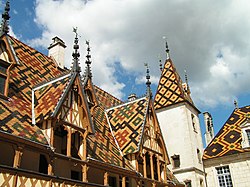


 Limestone cliffs in Étretat
 The Pont du Gard, a Roman vestige
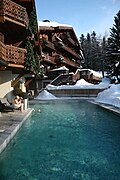 Ski resort in Megève
 The Verdon Gorge is a popular destination for kayaking


_(2).jpg)


_-_Centre_Pompidou_-_Außenansicht.jpg)


.JPG)
See also
- List of museums in France
- List of castles in France
- List of cathedrals in France
- List of basilicas in France
- List of medieval bridges in France
- List of spa towns in France
- List of ski resorts in France
- List of World Heritage Sites in France
- National parks of France
- Regional natural parks of France
- Tourism in Brittany
- Tourism in Guadeloupe
- Tourism in Martinique
- Tourism in Mayotte
- Tourism in New Caledonia
- Tourism in Réunion
- Tourism in Saint Barthélemy
- Tourism in Saint Martin

