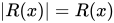
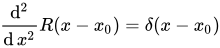
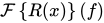
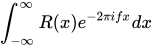
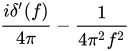
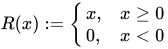
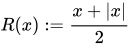
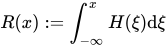
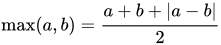
ランプ関数 From Wikipedia, the free encyclopedia ランプ関数(英: ramp function)とは、一変数の実関数であり、独立変数とその絶対値の平均として容易に求められる。区分線形関数。 ランプ関数のグラフ この関数は工学において(DSPの理論など)応用を持つ。"ramp function"の名は、グラフの形状が傾斜路(英: ramp)に似ていることに由来する。 定義 ランプ関数 R(x) : R → R には幾つかの同値な定義が存在する。 場合分け R ( x ) := { x , x ≥ 0 0 , x < 0 {\displaystyle R(x):={\begin{cases}x,&x\geq 0\\0,&x<0\end{cases}}} 指数 1 の切断冪関数 R ( x ) := x + {\displaystyle R(x):=x_{+}} 最大値関数 R ( x ) := max ( x , 0 ) {\displaystyle R(x):=\max(x,0)} 傾きが1の直線とその絶対値との平均[1] R ( x ) := x + | x | 2 {\displaystyle R(x):={\frac {x+|x|}{2}}} 傾きが1の直線とヘビサイド関数との積 R ( x ) := x H ( x ) {\displaystyle R\left(x\right):=xH\left(x\right)} ヘビサイド関数とそれ自身の畳み込み R ( x ) := H ( x ) ∗ H ( x ) {\displaystyle R\left(x\right):=H\left(x\right)*H\left(x\right)} ヘビサイド関数の積分 R ( x ) := ∫ − ∞ x H ( ξ ) d ξ {\displaystyle R(x):=\int _{-\infty }^{x}H(\xi )\mathrm {d} \xi } マコーレーの括弧 R ( x ) := ⟨ x ⟩ {\displaystyle R(x):=\langle x\rangle } 解析的性質 非負性 ランプ関数は定義域全体で非負となる。 ∀ x ∈ R : R ( x ) ≥ 0 {\displaystyle \forall x\in \mathbf {R} :R(x)\geq 0} そのため、関数の値はその絶対値に等しい。 | R ( x ) | = R ( x ) {\displaystyle |R(x)|=R(x)} 導関数 ランプ関数の導関数はヘビサイド関数に等しい。 R ′ ( x ) = H ( x ) i f x ≠ 0 {\displaystyle R'(x)=H(x)\ \mathrm {if} \ x\neq 0} 二階導関数 ランプ関数は次の微分方程式を満たす。但し δ(x) はディラックのデルタ関数である。 d 2 d x 2 R ( x − x 0 ) = δ ( x − x 0 ) {\displaystyle {\frac {\operatorname {d} ^{2}}{\operatorname {d} x^{2}}}R(x-x_{0})=\delta (x-x_{0})} これは、R(x) が二階微分作用素のグリーン関数であることを意味する。これにより、可積分な二階導関数 f′′(x) を持つ任意の関数 f(x) は、a < x < b のとき次の方程式を満たす。 f ( x ) = f ( a ) + ( x − a ) f ′ ( a ) + ∫ a b R ( x − s ) f ″ ( s ) d s {\displaystyle f(x)=f(a)+(x-a)f'(a)+\int _{a}^{b}R(x-s)f''(s)\operatorname {d} s} フーリエ変換 ランプ関数のフーリエ変換は次の通りとなる。 F { R ( x ) } ( f ) {\displaystyle {\mathcal {F}}\left\{R(x)\right\}(f)} = {\displaystyle =} ∫ − ∞ ∞ R ( x ) e − 2 π i f x d x {\displaystyle \int _{-\infty }^{\infty }R(x)e^{-2\pi ifx}dx} = {\displaystyle =} i δ ′ ( f ) 4 π − 1 4 π 2 f 2 {\displaystyle {\frac {i\delta '(f)}{4\pi }}-{\frac {1}{4\pi ^{2}f^{2}}}} ここで δ(x) は ディラックのデルタ関数(式中では導関数が使用されていることに注意)。 ラプラス変換 ランプ関数の片側ラプラス変換は次の通りとなる。 L { R ( x ) } ( s ) = ∫ 0 ∞ e − s x R ( x ) d x = 1 s 2 . {\displaystyle {\mathcal {L}}\left\{R\left(x\right)\right\}(s)=\int _{0}^{\infty }e^{-sx}R(x)dx={\frac {1}{s^{2}}}.} 代数的性質 冪等性 ランプ関数の任意の反復合成はランプ関数に等しい。[2] R ( R ( x ) ) = R ( x ) {\displaystyle R(R(x))=R(x)} 脚注 [1] これは max(a,b) が次のように定義できることによる。 max ( a , b ) = a + b + | a − b | 2 {\displaystyle \max(a,b)={\frac {a+b+|a-b|}{2}}} これを最大値関数による定義 R(x) := max(x,0) に代入すればよい。 [2] 次の証明には非負性が用いられている。 R ( R ( x ) ) := R ( x ) + | R ( x ) | 2 = R ( x ) + R ( x ) 2 = R ( x ) {\displaystyle R(R(x)):={\frac {R(x)+|R(x)|}{2}}={\frac {R(x)+R(x)}{2}}=R(x)} 外部リンク Weisstein, Eric W. “Ramp Function”. mathworld.wolfram.com (英語). Related Articles