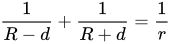
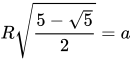
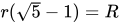
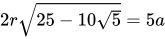
双心多角形 From Wikipedia, the free encyclopedia 正三角形 直角凧形 等脚接線台形 正五角形 幾何学における双心多角形[1](そうしんたかくけい、英: bicentric polygon)は内接円と外接円を持つ多角形である。すべての三角形は外接円と内接円を持つので、双心多角形である。しかし例えば正方形でない長方形は、外接円を持つが内接円を持たないため双心多角形でない。 前述のとおり、任意の三角形は外接円と内接円を持つ[2]。内半径、外半径をそれぞれr, R、内心と外心の距離をdとして 1 R − d + 1 R + d = 1 r {\displaystyle {\frac {1}{R-d}}+{\frac {1}{R+d}}={\frac {1}{r}}} が成り立つ[3]。これはオイラーの定理である。 双心四角形 すべての四角形が内接円と外接円を持つわけではない。R > rを満たすr, Rをそれぞれ半径とする円の中心の距離をdとする。この2円に内接、外接する四角形が存在することと、次の式が成り立つことは同値である[3][4]。 1 ( R − d ) 2 + 1 ( R + d ) 2 = 1 r 2 {\displaystyle {\frac {1}{(R-d)^{2}}}+{\frac {1}{(R+d)^{2}}}={\frac {1}{r^{2}}}} この定理はフースの定理として知られている[5]。 n > 4の多角形 Summarize Timeline Fact Check r, R, dを前項と同様に定義する。一般の双心n角形のr, R, dの関係式は非常に複雑である[6][7][8]。 以下に、いくつかの双心n角形のr, R, dに関する関係式を挙げた。 n = 5 : r ( R − d ) = ( R + d ) ( R − r + d ) ( R − r − d ) + ( R + d ) 2 R ( R − r − d ) {\displaystyle n=5:\quad r(R-d)=(R+d){\sqrt {(R-r+d)(R-r-d)}}+(R+d){\sqrt {2R(R-r-d)}}} n = 6 : 3 ( R 2 − d 2 ) 4 = 4 r 2 ( R 2 + d 2 ) ( R 2 − d 2 ) 2 + 16 r 4 d 2 R 2 {\displaystyle n=6:\quad 3(R^{2}-d^{2})^{4}=4r^{2}(R^{2}+d^{2})(R^{2}-d^{2})^{2}+16r^{4}d^{2}R^{2}} n = 8 : 16 p 4 q 4 ( p 2 − 1 ) ( q 2 − 1 ) = ( p 2 + q 2 − p 2 q 2 ) 4 {\displaystyle n=8:\quad 16p^{4}q^{4}(p^{2}-1)(q^{2}-1)=(p^{2}+q^{2}-p^{2}q^{2})^{4}} ただし、p = R + d/r, q = R − d/rである。 正多角形 Summarize Timeline Top Qs Fact Check 全ての正多角形は双心である[3]。さらに、その外接円と内接円は同心円となる。また、内接円の半径は辺心距離と等しい。 辺長がaである正n角形について、次の式が成立する。 R = a 2 sin π n = r cos π n {\displaystyle R={\frac {a}{2\sin {\frac {\pi }{n}}}}={\frac {r}{\cos {\frac {\pi }{n}}}}} 定規とコンパスによる作図可能な正多角形については次のような関係式がある。 n Rとa rとa rとR 3 R 3 = a {\displaystyle R{\sqrt {3}}=a\!\,} 2 r = a 3 3 {\displaystyle 2r={\frac {a}{3}}{\sqrt {3}}\!\,} 2 r = R {\displaystyle 2r=R\!\,} 4 R 2 = a {\displaystyle R{\sqrt {2}}=a\!\,} r = a 2 {\displaystyle r={\frac {a}{2}}\!\,} 2 r = R 2 {\displaystyle 2r=R{\sqrt {2}}\!\,} 5 R 5 − 5 2 = a {\displaystyle R{\sqrt {\frac {5-{\sqrt {5}}}{2}}}=a\!\,} r ( 5 − 1 ) = a 10 50 + 10 5 {\displaystyle r\left({\sqrt {5}}-1\right)={\frac {a}{10}}{\sqrt {50+10{\sqrt {5}}}}\!\,} r ( 5 − 1 ) = R {\displaystyle r({\sqrt {5}}-1)=R\!\,} 6 R = a {\displaystyle R=a\!\,} 2 r 3 3 = a {\displaystyle {\frac {2r}{3}}{\sqrt {3}}=a\!\,} 2 r 3 3 = R {\displaystyle {\frac {2r}{3}}{\sqrt {3}}=R\!\,} 8 R 2 + 2 = a ( 2 + 1 ) {\displaystyle R{\sqrt {2+{\sqrt {2}}}}=a\left({\sqrt {2}}+1\right)\!\,} r 4 − 2 2 = a 2 4 + 2 2 {\displaystyle r{\sqrt {4-2{\sqrt {2}}}}={\frac {a}{2}}{\sqrt {4+2{\sqrt {2}}}}\!\,} 2 r ( 2 − 1 ) = R 2 − 2 {\displaystyle 2r\left({\sqrt {2}}-1\right)=R{\sqrt {2-{\sqrt {2}}}}\!\,} 10 ( 5 − 1 ) R = 2 a {\displaystyle ({\sqrt {5}}-1)R=2a\!\,} 2 r 25 − 10 5 = 5 a {\displaystyle 2r{\sqrt {25-10{\sqrt {5}}}}=5a\!\,} 2 r 5 25 − 10 5 = R 2 ( 5 − 1 ) {\displaystyle {\frac {2r}{5}}{\sqrt {25-10{\sqrt {5}}}}={\frac {R}{2}}\left({\sqrt {5}}-1\right)\!\,} 外半径、内半径、1辺の長さの比の近似値は以下のようになる。 n R/a r/a R/r 3 {\displaystyle 3\,} 0.577 {\displaystyle 0.577\,} 0.289 {\displaystyle 0.289} 2.000 {\displaystyle 2.000\,} 4 {\displaystyle 4} 0.707 {\displaystyle 0.707\,} 0.500 {\displaystyle 0.500} 1.414 {\displaystyle 1.414\,} 5 {\displaystyle 5} 0.851 {\displaystyle 0.851\,} 0.688 {\displaystyle 0.688} 1.236 {\displaystyle 1.236\,} 6 {\displaystyle 6} 1.000 {\displaystyle 1.000\,} 0.866 {\displaystyle 0.866} 1.155 {\displaystyle 1.155\,} 8 {\displaystyle 8} 1.307 {\displaystyle 1.307\,} 1.207 {\displaystyle 1.207} 1.082 {\displaystyle 1.082\,} 10 {\displaystyle 10} 1.618 {\displaystyle 1.618\,} 1.539 {\displaystyle 1.539} 1.051 {\displaystyle 1.051\,} ポンスレの閉形問題 →詳細は「ポンスレの閉形定理」を参照 2つの円に外接、内接するようなn角形が1つでも存在すれば、同様にその2円に外接、内接するn角形が無数に存在する。これはポンスレの閉形定理と呼ばれる。より一般には円を円錐曲線へ置き換えても成り立つ[9]。 さらに、そのような多角形のどの対角線もある円錐曲線へ接する[10]。 出典 [脚注の使い方] ↑ 松田, 康雄「双心多角形の中の円」『長崎大学教育学部紀要』第88号、2021年、13-22頁。 ↑ Gorini, Catherine A. (2009), The Facts on File Geometry Handbook, Infobase Publishing, p. 17, ISBN 9780816073894, https://books.google.com/books?id=ZnkASIOYJWsC&pg=PA17 . 1 2 3 Reiman, István (2005), International Mathematical Olympiad: 1976-1990, Anthem Press, pp. 170–171, ISBN 9781843312000, https://books.google.com/books?id=xE_qYoJBpf4C&pg=PA170 . ↑ Davison, Charles (1915), Subjects for mathematical essays, Macmillan and co., limited, p. 98, https://books.google.com/books?id=Uz0_AQAAIAAJ&pg=PA98 . ↑ Dörrie, Heinrich (1965), 100 Great Problems of Elementary Mathematics: Their History and Solution, Courier Dover Publications, p. 192, ISBN 9780486613482, https://books.google.com/books?id=i4SJwNrYuAUC&pg=PA192 . ↑ Weisstein, Eric W. “Poncelet's Porism”. mathworld.wolfram.com (英語). ↑ Cheng, Junhao; Ma, Long; Zhou, Yuanfeng (2023-09-01). “A new method for researching and constructing spherical bicentric polygons based on geometric mapping”. Computer Aided Geometric Design 105: 102232. doi:10.1016/j.cagd.2023.102232. ISSN 0167-8396. https://www.sciencedirect.com/science/article/pii/S016783962300064X. ↑ Cieślak, Waldemar; Mozgawa, Witold (2018-11-01). “The Fuss formulas in the Poncelet porism”. Computer Aided Geometric Design 66: 19–30. doi:10.1016/j.cagd.2018.07.006. ISSN 0167-8396. https://www.sciencedirect.com/science/article/pii/S0167839618300943. ↑ Flatto, Leopold (2009), Poncelet's Theorem, American Mathematical Society, ISBN 9780821886267 . ↑ Johnson, Roger A. (1929). Advanced Euclidean Geometry. Dover Publ. p. 94 関連項目 ヴェイユの定理 円外接多角形 円外接多角形状図形 外部リンク Weisstein, Eric W. “Bicentric polygon”. mathworld.wolfram.com (英語). Related Articles~TimelinesTop QsFact Checks