The classes of s-convex measures form a nested increasing family as s decreases to −∞"

or, equivalently

Thus, the collection of −∞-convex measures is the largest such class, whereas the 0-convex measures (the logarithmically concave measures) are the smallest class.
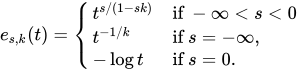
The convexity of a measure μ on n-dimensional Euclidean space Rn in the sense above is closely related to the convexity of its probability density function.[2] Indeed, μ is s-convex if and only if there is an absolutely continuous measure ν with probability density function ρ on some Rk so that μ is the push-forward on ν under a linear or affine map and 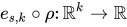 is a convex function, where
Convex measures also satisfy a zero-one law: if G is a measurable additive subgroup of the vector space X (i.e. a measurable linear subspace), then the inner measure of G under μ,

must be 0 or 1. (In the case that μ is a Radon measure, and hence inner regular, the measure μ and its inner measure coincide, so the μ-measure of G is then 0 or 1.)[1]




