Inner measure
From Wikipedia, the free encyclopedia
In mathematics, in particular in measure theory, an inner measure is a function on the power set of a given set, with values in the extended real numbers, satisfying some technical conditions. Intuitively, the inner measure of a set is a lower bound of the size of that set.
An inner measure is a set function defined on all subsets of a set that satisfies the following conditions:
![{\displaystyle \varphi :2^{X}\to [0,\infty ],}](https://wikimedia.org/api/rest_v1/media/math/render/svg/1682da42090dc091d1599a2ce9ecb44fc4fdbf40)

- Null empty set: The empty set has zero inner measure (see also: measure zero); that is,
- Superadditive: For any disjoint sets and
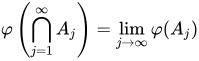
- Limits of decreasing towers: For any sequence of sets such that for each and
- If the measure is not finite, that is, if there exist sets with , then this infinity must be approached. More precisely, if for a set then for every positive real number there exists some such that








The inner measure induced by a measure
Let be a σ-algebra over a set and be a measure on Then the inner measure induced by is defined by



Essentially gives a lower bound of the size of any set by ensuring it is at least as big as the -measure of any of its -measurable subsets. Even though the set function is usually not a measure, shares the following properties with measures:
- is non-negative,
- If then










