Disintegration theorem
From Wikipedia, the free encyclopedia
In mathematics, the disintegration theorem is a result in measure theory and probability theory. It rigorously defines the idea of a non-trivial "restriction" of a measure to a measure zero subset of the measure space in question. It is related to the existence of conditional probability measures. In a sense, "disintegration" is the opposite process to the construction of a product measure.
Consider the unit square in the Euclidean plane . Consider the probability measure defined on by the restriction of two-dimensional Lebesgue measure to . That is, the probability of an event is simply the area of . We assume is a measurable subset of .
![{\displaystyle S=[0,1]\times [0,1]}](https://wikimedia.org/api/rest_v1/media/math/render/svg/9cfec53e317e30f420a56a950c0db306a92d9103)


Consider a one-dimensional subset of such as the line segment . has -measure zero; every subset of is a -null set; since the Lebesgue measure space is a complete measure space,
![{\displaystyle L_{x}=\{x\}\times [0,1]}](https://wikimedia.org/api/rest_v1/media/math/render/svg/9dd4abca9ec5b60810aad5b2141cfbeb4bfd8254)


While true, this is somewhat unsatisfying. It would be nice to say that "restricted to" is the one-dimensional Lebesgue measure , rather than the zero measure. The probability of a "two-dimensional" event could then be obtained as an integral of the one-dimensional probabilities of the vertical "slices" : more formally, if denotes one-dimensional Lebesgue measure on , then for any "nice" . The disintegration theorem makes this argument rigorous in the context of measures on metric spaces.


![{\displaystyle \mu (E)=\int _{[0,1]}\mu _{x}(E\cap L_{x})\,\mathrm {d} x}](https://wikimedia.org/api/rest_v1/media/math/render/svg/f47a1870d36eef3db833a3d8c274afb6a9176f7f)
Statement of the theorem
(Hereafter, will denote the collection of Borel probability measures on a topological space .) The assumptions of the theorem are as follows:


- Let and be two Polish spaces (i.e. separably completely metrizable spaces).
- Let .
- Let be a Borel-measurable function. Here one should think of as a function to "disintegrate" , in the sense of partitioning into . For example, for the motivating example above, one can define , , which gives that , a slice we want to capture.
- Let be the pushforward measure . This measure provides the distribution of (which corresponds to the events ).



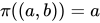
![{\displaystyle (a,b)\in [0,1]\times [0,1]}](https://wikimedia.org/api/rest_v1/media/math/render/svg/c81e0a7eaa0aacc0ba85aac34a5c2f6b1a9afcc7)
![{\displaystyle \pi ^{-1}(a)=a\times [0,1]}](https://wikimedia.org/api/rest_v1/media/math/render/svg/e111a1daddcc7303a8239b7b3cc568b408bf3f3d)




The conclusion of the theorem: There exists a -almost everywhere uniquely determined family of probability measures , which provides a "disintegration" of into , such that:



- the function is Borel measurable, in the sense that is a Borel-measurable function for each Borel-measurable set ;
- "lives on" the fiber : for -almost all , and so ;
- for every Borel-measurable function , In particular, for any event , taking to be the indicator function of ,[1] which shows that the family is a regular conditional probability.




![{\displaystyle f:Y\to [0,\infty ]}](https://wikimedia.org/api/rest_v1/media/math/render/svg/95fb617f884135a105d279508a45f9e6446e6c0a)













