Flags of Europe
From Wikipedia, the free encyclopedia
This is a list of international, national and subnational flags used in Europe.

Supranational and international flags
An incomplete list of flags representing intra-European international and supranational organisations, which omits intercontinental organisations such as the United Nations:
| Flag | Date | Use | Description |
|---|---|---|---|
 |
1957–1958 | Flag of the Benelux | Combines features from the flags of the member countries: Belgium, the Netherlands, and Luxembourg. |
 |
?–2015 | Flag of the Central Commission for Navigation on the Rhine | |
 |
2015–present | ||
 |
1990s–present | Flag of the Central European Free Trade Agreement (CEFTA) | |
 |
1991–present | Flag of the Commonwealth of Independent States | The flag of the Commonwealth of Independent States is blue with the emblem of the organisation in the centre. |
 |
1955– | Flag of the Council of Europe | A circle of twelve upward-oriented five-pointed golden stars centred on a blue field: represents the continent beyond the organisations as the Flag of Europe. |
| 1986–[note 1] | Flag of the European Union[note 2] | ||
.svg) |
1973–1983 | Flag of the European Parliament | |
 |
1984– | Flag of the Nordic Council | White stylised swan in a white circle upon a blue background. |
 |
1953– | Flag of the North Atlantic Treaty Organization | A dark blue field charged with a white compass rose emblem from which radiate four white lines. |
 |
2006– | Flag of the European Gendarmerie Force | |
 |
2006– | Flag of the European Maritime Force |
Flags of European sovereign states
| Flag | Date | Use | Description |
|---|---|---|---|
 |
1912– | Flag of Albania See also: List of Albanian flags |
The flag of Albania, adopted in April 1912, is a red flag with a black double-headed eagle in the centre. It is derived from the seal of Gjergj Kastriot Skanderbeg, a 15th-century Albanian who led a revolt against the Ottoman Empire that resulted in brief independence for Albania from 1443 to 1478. |
 |
1866– | Flag of Andorra See also: List of Andorran flags |
The flag of Andorra, adopted in 1866, is a tricolour of blue, yellow, and red with the coat of arms of Andorra in the centre. It is based on the flags of France and Catalonia. The coat of arms of Andorra is partially based on the flag of Catalonia (four red ribbons on yellow background). |
 |
1918–1920 1991– |
Flag of Armenia See also: List of Armenian flags [note 3] |
After gaining independence, the First Republic of Armenia adopted the modern Armenian tricolour. The independent Armenian government selected the colours used during the last period of the Rubenid Dynasty: red, blue, and orange. The red emblematizes the Armenian Highland, the Armenian people's continued struggle for survival, maintenance of the Christian faith, and Armenia's independence and freedom. The blue emblematizes the will of the people of Armenia to live beneath peaceful skies. The orange emblematizes the creative talent and hard-working nature of the people of Armenia. |
 |
1918–1938 1945– |
Flag of Austria See also: List of Austrian flags |
Originally adopted in 1918, it was again officially adopted in 1945, after being banned during World War II.
Stripes of red and white have been a collective emblem of Austria for over 800 years, and they were first used on the flag in 1191. According to long-established legend, the red and white flag was designed to resemble the bloodstained white coat worn by the Duke of Austria during a fierce battle. |
 |
1918–1920 1991– |
Flag of Azerbaijan See also: List of Azerbaijani flags [note 3] |
Originally adopted in 1918 as a flag of the Democratic Republic of Azerbaijan, it was officially adopted again in 1991, after Azerbaijan gained its independence.
The flag of Azerbaijan is the national ensign of Azerbaijan. It consists of three equal horizontal bands coloured blue, red, and green, with a white crescent and an eight-pointed star centred in the red band. The blue band refers to Turkic heritage, the red is for progress and Europeanisation and the green refers to Islam. |
 |
1995– | Flag of Belarus See also: List of Belarusian flags |
Belarus's flag was officially adopted on 10 February 2012. The dominant red-green bicolour was used on its flag when it was a republic within the former Soviet Union. The woven fabric ornament at the hoist uses traditional Belarusian red and white colours. |
 |
1830– | Flag of Belgium See also: List of Belgian flags |
Black, gold and red are symbolic of the country's coat of arms. The three-striped vertical layout was inspired by the French Tricolour. Black and gold were chosen, being the colours of the Duchy of Brabant where the Belgian Revolution started. Red was added as a symbol of the blood spilled during the uprising. |
 |
1998– | Flag of Bosnia and Herzegovina See also: List of flags of Bosnia and Herzegovina |
The flag of Bosnia and Herzegovina consists of a wide medium blue vertical band on the fly side with a yellow isosceles triangle abutting the band and the top of the flag. The remainder of the flag is medium blue with seven five-pointed white stars and two half stars top and bottom along the hypotenuse of the triangle. The three points of the triangle stand for the three nations of Bosnia: Bosniaks, Croats, and Serbs. It is said to represent the map of Bosnia. |
 |
1878–1947 1991– |
Flag of Bulgaria See also: List of Bulgarian flags |
The flag of Bulgaria was adopted in 1989 and consists of three horizontal bands of white, green, and red. |
 |
1990– | Flag of Croatia See also: List of Croatian flags |
The flag of Croatia, adopted in December 1990, consists of three equal horizontal stripes of red, white, and blue and the coat of arms of Croatia in the centre. |
 |
1960– | Flag of Cyprus See also: List of Cypriot flags [note 4] |
The flag was officially adopted on 16 August 1960.
The island is depicted in a copper shade representative of its name: the name Cyprus has roots in the Sumerian word for copper (zubar), from the large deposits of copper found on the island. The crossed green olive branches symbolise the hope for peace between the Turks and the Greeks. It was designed by İsmet Güney, a Turkish Cypriot painter. |
 |
1993– | Flag of the Czech Republic See also: List of Czech flags |
The first flag of Czechoslovakia was white over red, and those colours are the heraldic colours of Bohemia. The blue triangle was added to the flag to distinguish it from the flag of Poland, and blue is said to represent the State of Moravia. |
 |
1219– | Flag of Denmark See also: List of Danish flags |
The world's oldest state flag still in use. Legend has it that it appeared as a sign from heaven to King Valdemar II in 1219.
Known as the Dannebrog ("Danish Cloth"), this blood-red flag with an off-centred white cross (a "Nordic cross") became a model for other regional flags. |
 |
1918–1940 1990– |
Flag of Estonia See also: List of Estonian flags |
Officially re-adopted on 8 May 1990. The story of the flag begins on 17 September 1881, when the constituent Assembly of the first Estonian national student Corps "Vironia" (modern Estonian Students Society) in the city of Tartu was also identified in colour; it later became national. The first flag was made in 1884 and this tricolour was accepted in 1918 as the national flag of Estonia. The original flag is still in existence. The first flag of Estonia is kept in Tartu Estonian National Museum.
Blue represents loyalty, and the country's beautiful blue skies, seas, and lakes; black is symbolic of past oppression and the fertile soil; and white represents virtue, winter snows, and Estonia's long struggle for freedom and independence. |
 |
1918– | Flag of Finland See also: List of Finnish flags |
Officially adopted on 29 May 1918.
The off-centred blue cross is based on the Nordic cross, widely used on Nordic national flags. The blue colour is symbolic of blue skies, and the thousands of lakes in Finland. The white represents the winter snows. |
 |
1794–1814 1830– |
Flag of France See also: List of French flags |
Officially adopted on 15 February 1794.
The tricolore consists of three vertical bands of equal width, displaying the country's national colours: blue, white, and red. The blue band is positioned nearest the flagstaff, the white in the middle, and the red on the outside. Red, white, and blue have come to represent liberty, equality, and fraternity—the ideals of the French Revolution. Blue and red are also the time-honoured colours of Paris, while white is the colour of the Royal House of Bourbon. |
 |
2004– | Flag of Georgia See also: List of Georgian flags [note 3] |
This recently adopted flag is a simple white rectangle, with a central red cross connecting all four sides of the flag; in each of the four corners is a small red cross. The flag is based on a historic five-cross design that dates back to the 14th century. |
 |
1919–1933 1949– |
Flag of Germany See also: List of German flags |
Officially re-adopted on 23 May 1949, and subsequently used by West Germany while the country was divided into East and West before reunification in 1990.
The tricolour flag was designed in 1832, and the black, red, and gold colours were taken from the uniforms of German soldiers during the Napoleonic Wars (Out of the blackness (black) of servitude through bloody (red) battles to the golden (gold) light of freedom.[1]) or taken from the coat of arms of the Holy Roman Empire. |
 |
1822 (civil flag) 1978– |
Flag of Greece See also: List of Greek flags |
The current flag of Greece was adopted as a civil flag and ensign in 1822, and as the national flag in 1978.
It features a white cross and a combination of nine (five blue and four white) horizontal stripes. The shade of blue has varied over the years, and darker blue (shown) is now commonly used. The alternating white and blue stripes are said to represent the nine syllables of the phrase "Eleftheria i thanatos" ("Freedom or Death"), a popular motto during the Greek War of Independence. During the Kingdom of Greece, a crown was added in the centre of the cross. Greece's national flag between 1822 and 1970 featured a simple white cross on a blue background. It is not known why this version was adopted, and not a blue cross on a white background as was popular in the War of Independence. During the dictatorship, a navy blue version of the current flag with proportions of 7:12 was used. |
 |
1957– | Flag of Hungary See also: List of Hungarian flags |
The flag of Hungary was officially adopted in 1957, first appearing in 1848.
The dominant crimson red, white, and teal green colours of the tricolour design are taken from the historical Hungarian coat of arms. Crimson red is said to symbolise strength, white faithfulness, and teal green hope. |
 |
1915– | Flag of Iceland See also: List of Icelandic flags |
The flag of Iceland was adopted in June 1915 to represent Iceland. In June 1944 it became the flag of the independent republic of Iceland. Like other Scandinavian flags, it is based on the Nordic cross. It is a reverse colour image of the Flag of Norway. The blue represents the sea, the white represents the snow and glaciers, and the red symbolises volcanic lava. |
 |
1922– | Flag of Ireland See also: List of Irish flags |
Although dating from the 19th century, the tricolour flag of Ireland was not popularised until its use by rebels during the 1916 Easter Rising. It was officially adopted by the revolutionary First Dáil (assembly) of the Irish Republic on 21 January 1919, and used thereafter by the Irish Free State. The current 1937 Constitution of Ireland defines it as the national flag.
Modeled after the French tricolour, the colours of the Irish tricolour symbolise two communities. Green represents the Roman Catholic nationalist tradition. Orange represents the Protestant unionist community. White symbolises peace between both. |
 |
1946– | Flag of Italy See also: List of Italian flags |
Derived from an original design by Napoleon, it consists of three vertical bands of equal width, displaying the national colours of Italy: green, white, and red. Green stands for hope, white for loyalty, and red represents the blood spread to unify the country. |
 |
1992– | Flag of Kazakhstan See also: List of Kazakh flags [note 5] |
Adopted on 4 June 1992. The flag has a gold sun with 32 rays above a soaring golden steppe eagle, both centred on a teal background; the hoist side displays a national ornamental pattern called "koshkar-muiz" (the horns of the ram) in gold. |
 |
1918–1940 1990– |
Flag of Latvia See also: List of Latvian flags |
The flag of Latvia was officially re-adopted on 27 February 1990.
The design is adopted from a 13th-century chronicle where "red divided by white" is said to be a Latvian flag. To distinguish it from the Austrian flag, the proportions 2:1:2 and the "Latvian red" colour have been adopted. |
 |
1937– | Flag of Liechtenstein See also: List of Liechtensteinian flags |
The flag of Liechtenstein consists of two horizontal bands of blue and red with a gold crown in the canton. The crown was added to the flag in 1937 after the country found out at the 1936 Summer Olympics that their flag was identical to the civil flag of Haiti. |
 |
1918–1940 1989– |
Flag of Lithuania See also: List of Lithuanian flags |
The flag of Lithuania was officially re-adopted on 20 March 1989, before Lithuania gained independence from the Soviet Union in 1990.
Yellow is symbolic of the country's wheat fields, green symbolic of the forests, and red symbolises patriotism. Collectively the colours represent hope for the future, freedom from oppression, and the courage of the Lithuanian people. |
 |
1845– | Flag of Luxembourg See also: List of flags of Luxembourg |
The flag of Luxembourg was officially adopted in 1972, although it had been used since 1848 following Luxembourg's independence from the Netherlands in the late 19th century.[dates disagree]
The flag uses a combination of red, white, and blue that dates to the 13th century, and the Grand Duke's coat of arms. |
 |
1964– | Flag of Malta See also: List of flags of Malta |
The flag of Malta was officially adopted on 21 September 1964.
The flag uses the traditional red and white colours which pre-date those of the Knights of Malta and which Government emulate[clarification needed] the arms of the former Universitas of Mdina. The George Cross (upper hoist), outlined in red, was added to the flag in the 1940s, as King George VI of the United Kingdom presented it to islanders for outstanding gallantry during World War II. |
 |
1990– | Flag of Moldova See also: List of Moldovan flags |
Moldova's flag was officially adopted on 12 May 1990. Once part of Romania, Moldova's flag reflects that association, as the two countries use almost identical shades of red, yellow, and blue in their national flags. The centred Moldova shield's main feature is a golden eagle holding an Orthodox Christian Cross in its beak. The olive branch is said to symbolise peace. |
 |
1881– | Flag of Monaco See also: List of flags of Monaco |
The flag of Monaco has two horizontal bands of red and white—these have been the heraldic colours of the House of Grimaldi since at least 1339. |
 |
2004– | Flag of Montenegro See also: List of flags of Montenegro |
The flag of Montenegro, adopted in July 2004, is a red banner bearing the coat of arms adopted in 1993. The country's coat of arms is derived from those of King Nikola. |
 |
1575 (first used) 1937– (officially adopted) |
Flag of the Netherlands See also: List of flags of the Netherlands |
The flag of the Netherlands was officially adopted on 19 February 1937.
At one time this tricolour flag was orange, white, and blue, as those were the livery colours of William of Orange, a Dutch prince. In the 17th century, red replaced the orange as a flag colour, because the orange dye used on the flag was unstable, and turned red after exposure to the sun. It is the oldest tricolour flag still in national use[2] and has influenced both the French[3] (1794) and Russian flag[4] (1693); both of these flags have in turn influenced many other European and African flags. |
 |
1995– | Flag of North Macedonia See also: List of flags of North Macedonia |
The flag of North Macedonia depicts a rising yellow sun with eight rays extending to the edges of the red field. It represents "the new sun of liberty", evoked in the Macedonian national anthem Denes nad Makedonija (Today Over Macedonia). |
 |
1821–1844 1898– |
Flag of Norway See also: List of Norwegian flags |
The flag of Norway is red with a blue Nordic cross outlined in white; the vertical part of the cross is shifted to the hoist side in the style of the Dannebrog, the flag of Denmark. It was adopted in 1821, but a union mark was added in the canton from 1844 to 1898. |
 |
1919– | Flag of Poland See also: List of Polish flags |
The flag of Poland was officially adopted on 1 August 1919. Polish flag colours date back to the Piast dynasty and the Polish-Lithuanian Commonwealth period.
The colours red and white have long been associated with Poland and its coat of arms, at least since 3 May 1791. |
.svg) |
1911– | Flag of Portugal See also: List of Portuguese flags |
The flag of Portugal was officially adopted on 30 June 1911.
The design is a rectangular bi-colour (2:3 ratio) with a field vertically divided into two stripes of different widths—a green stripe on the hoist, and a larger red stripe on the fly. A small version of the national coat of arms (armillary sphere and Portuguese shield) is superimposed over the boundary between the colours at equal distance from the upper and lower edges. The field colours, especially the green, originally represented a radical republican-inspired change that broke the bond with the former religious monarchical flag. In the ensuing decades, these colours were popularly propagandised as representing the hope of the nation (green) and the blood (red) of those who died defending it, as a means to endow them with a more patriotic and dignified, therefore less political, sentiment. |
 |
1848 1867–1948 1989– |
Flag of Romania See also: List of Romanian flags |
The flag of Romania was officially re-adopted in 1989. The first red-yellow-blue flag dates from 1834 but the colours themselves are thought to have had special significance from earlier times. The current layout dates since 1848.
A vertical tricolour of bands of blue, yellow, and red of equal width and overall proportions of 2:3. |
 |
1883–1918 1993– |
Flag of Russia See also: List of Russian flags [note 6] |
The Russian Federation flag was officially adopted on 22 August 1991. The flag was hoisted shortly after the former Soviet Union collapsed. The white, blue, and red are Pan-Slavic colours. |
 |
2011– | Flag of San Marino See also: List of Sammarinese flags |
The flag of San Marino comprises equal horizontal bands of white and light blue with the national coat of arms superimposed in the centre. |
 |
1815–1918 (original design) 2004– (Civil flag since 1835) |
Flag of Serbia See also: List of flags of Serbia |
The flag of Serbia consists of three horizontal bands of red, blue, and white, with the coat-of-arms located towards the hoist of centre. By accident or design the colours are that of the Russian flag reversed. A flag with three horizontal bands of red, blue, and white has been used as the national flag of Serbia and Serbs since 1815. Red, blue, and white are considered Pan-Slavic colours, but red and blue also occur on flags attributed to a 13th-century king of Serbia. The superimposed coat of arms of Serbia is a double-headed white eagle and a red shield with a white cross surrounded by four firesteels (ocila), a symbol that draws roots from Saint Sava Serbian Cross and from the ancient past of the Balkan peninsula, as it can be seen on 7000 years old Vinča culture pottery and many other later traditional Balkan cultural remains. |
 |
1992– | Flag of Slovakia See also: List of Slovak flags |
The flag of Slovakia was officially adopted on 1 September 1992.
White, blue, and red are traditional Pan-Slavic colours. The superimposed Slovakian arms feature a dominant white cross atop a blue symbolic reference to the European country's mountains. |
 |
1991– | Flag of Slovenia See also: List of Slovenian flags |
The flag of Slovenia was officially adopted on 24 June 1991.
Red, white, and blue are taken from the Carniolan coat of arms. The flag without the coat of arms was in use from 1848 to 1945. The Slovenian coat of arms features three gold stars, symbolizing the Counts of Celje. The mountains shown in white are representative of the Alps, and Mount Triglav, Slovenia's national symbol, in particular; the wavy blue lines across the bottom indicate Slovenia's access to the sea. |
 |
(1785 original design) 1981– |
Flag of Spain See also: List of Spanish flags |
The flag of Spain was officially adopted on 19 July 1927 as the merchant naval flag, and on 29 December 1978 as the national flag under the current Spanish Constitution. However the first original reference dates back to 15 May 1785, when Charles III of Spain adopted one of the designs proposed by Antonio Valdés y Bazán, commissioned by the king himself, in order to easily differentiate his ships from those of other European nations, many of which used the royal coat of arms over a white background, i.e. the French Bourbon royal flag. The red and golden-yellow colours were used from that day with mere changes[clarification needed] on the coat of arms (with the exception of the Spanish Second Republic) and are the original colours found within the coat of arms of the medieval kingdoms of Castile, Aragon and Navarre, first united by King Ferdinand II of Aragon and Queen Isabella I of Castile. |
 |
(1569–1814) 1906– [5] |
Flag of Sweden See also: List of Swedish flags |
The flag of Sweden was officially adopted on 22 June 1906.
The off-centre yellow cross (the Nordic cross) is taken from the Danish flag. The yellow and blue colours are taken from the national coat of arms. It was adopted in 1569, but a union mark was added in the canton from 1844 to 1905. |
 |
1889– | Flag of Switzerland See also: List of Swiss flags |
The flag of Switzerland consists of a red square with a bold, equilateral white Greek cross in the centre. It is one of only two square flags, the other being that of the Vatican City or Holy See. It is based on the flag of the Canton of Schwyz, which dates back to 1474 at least. |
 |
1844– | Flag of Turkey See also: List of Turkish flags [note 7] |
The flag of Turkey is a red flag with a white crescent moon and a star in its centre. The flag is called Ay Yıldız (literally, moon star) or Albayrak (Red flag). It was adopted in 1844 with the Tanzimat reforms; though the shape, placement and shade of the colour[clarification needed] vary. The geometric proportions of the flag were legally standardised with the Turkish Flag Law in 1936. |
 |
1918–1920 1992– |
Flag of Ukraine See also: List of Ukrainian flags |
Ukraine's flag was adopted on 4 September 1991, shortly after the collapse of the former Soviet Union. This is the country's original flag used by the short-lived Ukrainian People's Republic, but it was banned for many decades under the Soviet regime. The shade of blue is said to be symbolic of the sky, while the yellow represents Ukraine's golden wheat fields. |
.svg) |
1801– | Flag of the United Kingdom See also: List of United Kingdom flags |
The current flag of the United Kingdom dates from the Act of Union 1800, which merged the Kingdom of Great Britain and the Kingdom of Ireland to form the United Kingdom of Great Britain and Ireland.
The "Union Jack" merges the red cross of Saint George (patron saint of England), edged in white, superimposed on the diagonal red cross of Saint Patrick (patron saint of Ireland), which are superimposed on the saltire of Saint Andrew (patron saint of Scotland). The flag of Wales, the other country of the United Kingdom, is not graphically represented. |
.svg) |
1929– | Flag of Vatican City or Holy See See also: List of Vatican flags |
The flag of Vatican City or Holy See, adopted in June 1929, consists of two vertical bands of yellow and white with the crossed keys of Saint Peter and the Papal Tiara centred in the white band. It is one of only two square country flags in the world, the other being that of Switzerland. |
Flags of other European sovereign entities
| Flag | Date | Use | Description |
|---|---|---|---|
 |
1130– | Flag of the Sovereign Military Order of Malta | The flag of the Sovereign Military Order of Malta is a red rectangular flag quartered by a white cross. |
Disputed or partially recognised states
| Flag | Date | Use | Description |
|---|---|---|---|
 |
1992– | Flag of Abkhazia[note 3] | The flag of Abkhazia consists of seven green and white stripes with a red upper hoist canton bearing a white open right hand and seven white stars. |
 |
2008– | Flag of Kosovo See also: List of flags of Kosovo |
The flag of Kosovo has a blue background, charged with a map of Kosovo in gold and six white stars. The stars symbolize Kosovo's six major ethnic groups: Albanians, Serbs, Bosniaks, Turks, Romani (often grouped with the Ashkali and Egyptians), and Gorani. |
 |
1984– | Flag of Northern Cyprus[note 4] | The flag of Northern Cyprus is white with a red crescent moon and a star in its centre with a red stripe above and below. |
 |
1990– | Flag of South Ossetia[note 3] | The flag of South Ossetia is a tricolour, the top stripe white, the middle stripe red, and the bottom stripe yellow. |
.svg) |
2000– | Flag of Transnistria | The flag of Transnistria consists of three stripes (red-green-red) and the Soviet hammer and sickle; it is based on the flag of the Moldavian SSR. |
Flags of European dependencies
| Flag | Date | Use | State (status) | Description |
|---|---|---|---|---|
 |
1954– | Flag of Åland | Finland (autonomous region) | The flag was officially adopted 3 April 1954. As of 1992, it serves as the civil and state flag and ensign. This traditional Scandinavian cross flag features blue, yellow, and red, all said to be borrowed from the national colours of Sweden and Finland. |
 |
1940– | Flag of the Faroe Islands | Denmark (autonomous region) | The flag of the Faroe Islands, called Merkið, was first used in 1919, was mandated by the British as the civil and state ensign in 1940, and became the official civil and state flag and ensign on 23 March 1948. The flag uses Norwegian colours, commemorating the Faroes once being part of Norway. |
 |
1502– | Flag of Gibraltar | UK (overseas territory) | The Gibraltar flag dates from 1502, as it is based on the original arms granted it by Spain. The red and white field is taken from the arms, and it is dominated by a red three-towered fortress, complete with a gold key. |
 |
1989– | Flag of Greenland | Denmark (autonomous territory) | The flag of Greenland features two equal horizontal bands of white (top) and red (bottom) with a counter-changed red-and-white disk slightly to the hoist side of centre. |
 |
1985– | Flag of Guernsey | UK (Bailiwick of Guernsey) | The flag of Guernsey, adopted in 1985, consists of the red cross of St. George with an additional gold cross within it. The change was prompted by confusion over Guernsey and England using the same flag. The gold cross represents Duke William of Normandy, who had such a cross on his flag in the Battle of Hastings, given to him by Pope Alexander II. |
 |
1932– | Flag of the Isle of Man | UK (crown dependency) | The flag of the Isle of Man features a red field with a centred triskelion of three bent legs joined at a central point. |
 |
1980– | Flag of Jersey | UK (crown dependency) | The flag of Jersey, adopted in June 1979, is white with a diagonal red cross, surmounted by a yellow Plantagenet crown, the badge of Jersey (a red shield holding the three leopards of Normandy in yellow). Prior to this, the flag was a plain red saltire on a white field. |
.svg) |
1960– | Flag of the Sovereign Base Areas of Akrotiri and Dhekelia | UK (overseas territory) | The Union Flag is used. |
Flags of European sub-divisions
Andorra
| Flag | Parish | Adopted | Description | |
|---|---|---|---|---|
 |
 |
Andorra la Vella | ||
 |
 |
Canillo | ||
 |
 |
Encamp | ||
 |
 |
Escaldes-Engordany | ||
 |
 |
La Massana | ||
 |
 |
Ordino | ||
 |
 |
Sant Julià de Lòria | ||
Austria
| Flag | Date | Use | Description |
|---|---|---|---|
 |
1921– | Flag of Burgenland | A horizontal bicolour of yellow and red. |
 |
1946– | Flag of Carinthia | A horizontal tricolour of yellow, red, and white. |
 |
1954– | Flag of Lower Austria | A horizontal bicolour of blue and yellow. |
 |
1921– | Flag of Salzburg | A bicolour of red over white. |
 |
1960– | Flag of Styria | A bicolour of white over green. |
 |
1945– | Flag of Tyrol | The flag of Tyrol is a white over red bicolour. |
 |
1949– | Flag of Upper Austria | The flag of Upper Austria is a white over red bicolour. |
 |
1938– | Flag of Vorarlberg | A bicolour of red over white. |
 |
1844– | Flag of Vienna | A bicolour of red over white. |
Belarus
| Flag | Date | Use | Description |
|---|---|---|---|
 |
2004– | Flag of Brest Region | Blue with a yellow zoubre (Bison bonasus) on a red stylized tower. |
 |
2005– | Flag of Gomel Region | Green with the coat of arms of Gomel Region in the centre of the obverse. |
 |
2007– | Flag of Grodno Region | Red with the coat of arms of Grodno Region in the centre of the obverse. |
 |
2007– | Flag of Minsk Region | Red with the coat of arms of Minsk Region in the centre of the obverse. |
 |
2001– | Flag of Minsk Municipality | Blue with the 1591 coat of arms of Minsk Municipality in the centre of the obverse. |
 |
2005– | Flag of Mogilev Region | Green with the coat of arms of Mogilev Region in the centre of the obverse. |
 |
2009– | Flag of Vitebsk Region | Green with the coat of arms of Vitebsk Region in the centre of the obverse. |
Belgium
| Flag | Date | Use | Description |
|---|---|---|---|
 |
2015– | Flag of the Brussels-Capital Region | A stylized yellow, white, and grey iris on a blue field. |
 |
1973– | Flag of Flanders (Flemish Community and Flemish Region) | A black lion with red claws and tongue, standing on its back legs, on a yellow background. |
 |
1991– | Flag of Wallonia (French Community and Walloon Region) | A red rooster on a yellow field. |
 |
1990– | Flag of the German Community | In the centre of a white background is placed a red lion, standing on its back legs, raising its front paws, with its tongue out. Around it are placed in a circle nine gentiana flowers that have five intense blue petals and white (silver) round centres. |
Bosnia and Herzegovina
| Flag | Date | Use | Description |
|---|---|---|---|
 |
1995– | Flag of Republika Srpska | A horizontal tricolour of red, blue, and white, very similar to the flag of Serbia without the Coat of Arms (with slightly differently coloured shades). |
Denmark
| Flag | Date | Use | Description |
|---|---|---|---|
  |
1970s–present | Unofficial flag of Bornholm | Nordic cross flag in red and green. Also known in a version with a white fimbriation of the green cross in a style similar to design of the Norwegian flag. |
 |
1633–present | Unofficial flag of Ærø | Nine horizontal stripes of yellow, green, and red, repeating three times.
Very similar to the Flag of Lithuania. A frequent interpretation is that the colours represent the kings of Denmark (red), the dukes of Schleswig (yellow), and the islands itself (green). |
 |
1976–present | Unofficial flag of Vendsyssel | Nordic cross flag in blue, orange, and green.[1] Designed by Mogens Bohøj.[6] |
 |
1975–present | Unofficial flag of Jutland | A Nordic cross flag in blue, green, and red. Designed by Per Kramer in 1975.[3] |
 |
2015–present | Unofficial flag of Funen | There are two proposed flags:
The green colour symbolises the island's importance as the 'pantry of Denmark'. The blue represents the island itself, and the red its strong ties to Denmark.[4] |
Finland
Not all regions have selected an official flag.
| Flag | Date | Use | Description |
|---|---|---|---|
 |
Flag of Central Finland | A banner of arms based on the region's coat of arms. | |
 |
Flag of Central Ostrobothnia | A banner of arms based on the region's coat of arms. | |
 |
1998– | Flag of Kainuu | A banner of arms based on the region's coat of arms designed by a Finnish heraldist Olof Eriksson in 1978. The flag itself was adopted on 25 June 1998. |
 |
1997– | Flag of North Karelia | A red flag featuring two armored arms from the regional coat of arms with a fortressy white field on the hoist side of the flag. Adopted by the regional council on 8 June 1997. |
 |
Flag of North Savo | A black swallow-tailed flag featuring a loaded bow from the regional coat of arms placed between two yellow stripes. | |
 |
Flag of Päijät-Häme | A banner of arms based on the region's coat of arms. | |
 |
2018– | Flag of Kanta-Häme | Flag featuring elements from the region's coat of arms. Designed by heraldist Tuomas Hyrsky and adopted by the regional council on the 100th anniversary of the Finnish flag on 28 May 2018. A further ceremony was held in the Häme Castle on 4 February 2019. |
 |
1990– | Flag of Satakunta | A swallow-tailed banner of arms based on the region's coat of arms from 1557. Designed by artist Reino Niiniranta and officially adopted on 21 November 1990. The regional flag's official flag day is on 11 October, on the name day of Otso. |
 |
2020– | Flag of South Savo | A black flag charged with the bow and arrow from the region's coat of arms and a yellow hoist. Designed by designer Suvi Ripatti and officially adopted on 09.06.2020.[7] |
 |
Flag of Uusimaa | A banner of arms based on the region's coat of arms. |
France
Not all regions have selected an official flag.
| Flag | Date | Use | Description |
|---|---|---|---|
 |
2016– | Flag of Auvergne-Rhône-Alpes | |
 |
2016– | Flag of Bourgogne-Franche-Comté | |
 |
1923– | Flag of Brittany | The flag, called Gwen ha Du (White and Black) was created in 1923 by Morvan Marchal (1900–1963, a member of various political and cultural organisations). He used as his inspiration the old Breton flag (a centred black cross on a white background), called Kroaz Du (Black Cross), and the flags of the United States and Greece as these two countries were seen at that time as the respective symbols of liberty and democracy. The nine horizontal stripes represent the traditional dioceses of Brittany into which the duchy was divided historically. The five black stripes represent the French or Gallo speaking dioceses of Dol, Nantes, Rennes, Saint-Malo and Saint-Brieuc—while the four white stripes represent the Breton speaking dioceses of Trégor, Léon, Cornouaille and Vannes. The ermine canton recalls the ducal arms of Brittany. |
 |
Flag of Centre-Val de Loire | ||
 |
1755– | Flag of Corsica | The Flag of Corsica was adopted by General of the Nation Pasquale di Paoli in 1755 and was based on a traditional flag used previously. It portrays a Moor's Head in black wearing a white bandana above his eyes on a white background. Previously, the bandana covered his eyes. |
 |
Flag of Île-de-France | The flag of Île-de-France consists of a dark blue background with three gold fleur-de-lis. There was another version of it with a white background and a logo of Île-de-France. | |
 |
13th century [citation needed] |
Flag of Normandy | Based on the medieval emblems of the duke of Normandy. |
 |
1974– | Using a Nordic cross in reference to the Nordic past of Normandy, created in 1974. | |
.svg) |
2016– | Flag of Nouvelle-Aquitaine | |
 |
12th century – | Flag of Occitanie | Flag of the administrative region of Occitanie. Flags of historical Occitania and Catalonia can be displayed according to the place on local buildings, and both of them on regional buildings. |
 |
Flag of Pays de la Loire | The flag is a combination of heraldic elements from the historical provinces that occupied the territory of the region: Brittany, Anjou, Maine and Vendée. | |
 |
12th century – | Flag of Provence-Alpes-Côte d'Azur | Combining elements of the former historical entities existing over the current territory of the region: County of Provence, the Dauphiné, and County of Nice. |
Georgia

Germany
Many states have separate civil and state versions of their flags; the state flags (listed) include the state arms, while the civil versions don't. See Flags of German states.
| Flag | Date | Use | Description |
|---|---|---|---|
 |
1954– | Flag of Baden-Württemberg | A black over gold bi-colour. |
.svg) .svg) |
1953– | Flag of Bavaria | There are two official flags of Bavaria. One is an array of 21 or more lozenges of blue and white, the other is a white over blue bicolour. |
 |
1954–1990 (West Berlin) 1990– |
Flag of Berlin | White with red bars at the top and bottom, with a bear off-centre towards the hoist. |
 |
1991– | Flag of Brandenburg | A horizontal bi-colour of red over white, with the arms of the state (land) in the centre. |
 |
1952– | Flag of Bremen | Eight or more alternating red and white stripes, checked at the hoist. |
 |
1751– | Flag of Hamburg | A white castle with three towers and a closed gate. |
 |
1948– | Flag of Hesse | The civil flag of Hesse consists of a bicolour of a red top and a bottom white stripe. |
 |
1951– | Flag of Lower Saxony | The flag of Lower Saxony consists of the flag of the Federal Republic of Germany in Schwarz-Rot-Gold, with the coat of arms of Lower Saxony, shifted slightly toward the hoist. |
 |
1990– | Flag of Mecklenburg-Western Pomerania | |
 |
1953– | Flag of North Rhine-Westphalia | A horizontal tricolour of green, white, and red. |
 |
1945– | Flag of Rhineland-Palatinate | The flag of Rhineland-Palatinate is a tricolour of three horizontal bands of black, red, and gold. These colours are Germany's national colours and are sometimes referred to as schwarz-rot-gold. In the canton, or the upper hoist corner, are the arms of the state of Rhineland-Palatinate. |
 |
1957– | Flag of Saarland | The flag of Saarland is based on the flag of Germany and is a black, red, and gold (yellow) horizontal tricolour. In the centre of the flag is the coat of arms of Saarland. |
 |
1991– | Flag of Saxony | A bicolour of white over green. |
.svg) |
1991– | Flag of Saxony-Anhalt | The flag of Saxony-Anhalt is a yellow and black bi-colour. In the centre of the flag is the coat of arms of Saxony-Anhalt |
 |
1948– | Flag of Schleswig-Holstein | The civil flag of Schleswig-Holstein is a horizontal tricolour of blue, white, and red. |
 |
1991– | Flag of Thuringia | The civil flag of Thuringia is a bicolour of white over red. |
Greece
| Flag | Date | Use | Description |
|---|---|---|---|
 |
1980s– | Flag of Macedonia | The flag of Macedonia, adopted in 1980s, is a blue banner featuring the Vergina Sun, the emblem of the Ancient Greek Kingdom of Macedon. |
 |
1821– | Flag of Spetses | The flag of Spetses, adopted in early 1821 during the Greek Revolution, features an azure field surrounded by a thick red border, defaced with a Cross on an overturned Crescent (symbolizing the Christian Greek victory over the Muslim Ottoman Empire), a spear (symbolizing the armed struggle for freedom), an anchor (symbolizing the maritime tradition and merchant wealth of the island as well as most of Greece), a snake around the anchor (symbolizing the Goddess Athena, wisdom and the island's ancient Greek heritage), a dove (symbolizing peace, justice and prosperity) and the words «ΕΛΕΥΘΕΡΙΑ Ή ΘΑΝΑΤΟΣ», meaning "FREEDOM OR DEATH", Greece's national motto. |
 |
1821– | Flag of Hydra | The flag of Hydra, adopted in early 1821 during the Greek Revolution, its design and symbolism are almost identical to those of the Flag of Spetses (see above), though the colours are slightly different. The Symbols are also almost identical, though instead of a spear there is a flagpole with a flag and some of the symbols are grey instead of red. |
 |
1828– | Flag of Kastellorizo | The flag of Kastellorizo, adopted in early 1828 during the Greek Revolution, it features a white field surrounded by a blue border. It is defaced with a cross, an anchor and a heart. On the left and right of these symbols are the words «ΜΕΓΙΣΤΗ» and «ΚΑΣΤΕΛΛΟΡΙΖΟ» ("MEGISTE" and "KASTELLORIZO"), the two names of the island. |
 |
1864– | Flag of Corfu | The flag of the island of Corfu, adopted in 1864 after the annexation of the United States of the Ionian Islands by the Kingdom of Greece as a gift to George I of Greece by the United Kingdom, features a blue field surrounded by a golden border and a thicker dark red one. It is defaced with an Ancient Greek galley which is surrounded by a circle and the words «ΔΗΜΟΣ ΚΕΡΚΥΡΑΙΩΝ» meaning "MUNICIPALITY/PEOPLE OF THE CORFIOTS". |
 |
1864– | Flag of Zakynthos | The flag of the island of Zakynthos, adopted in 1864 after the annexation of the United States of the Ionian Islands by the Kingdom of Greece as a gift to George I of Greece by the United Kingdom, features a green field with a golden depiction of Zakynthos (person), the figure from ancient Greek mythology after whom the island was named. Near the top left side of Zakynthos the name of the island in Greek («ΖΑΚΥΝΘΟΣ») is written while under the depiction is the island's motto, «ΘΕΛΕΙ ΑΡΕΤΗ ΚΑΙ ΤΟΛΜΗ Η ΕΛΕΥΘΕΡΙΑ» ("FREEDOM DEMANDS VALOUR AND BRAVERY") by the Zakynthian poet Andreas Kalvos. |
 |
1821– | Flag of Psara | The flag of the island of Psara, adopted in 1821 during the Greek Revolution, is almost identical in style and design to the flags of Hydra, Spetses and other islands (see above) with some differences. The field is white and the surrounding border is red while all the symbols it is defaced with are all red. The symbols are also almost identical though instead of a dove there is an eagle, probably a reference to the Eagle of Zeus, a symbol of power and authority. The flag features the words «ΕΛΕΥΘΕΡΙΑ Ή ΘΑΝΑΤΟΣ» ("FREEDOM OR DEATH", Greece's national motto) and «ΨΑΡΑ» ("PSARA", the island's name in the Greek language). |
.svg) |
1821– | Flag of Mani Peninsula | The flag of the island of the Mani Peninsula, adopted in 1821 during the Greek Revolution, features a white field with a blue Greek cross and the phrases «ΝΙΚΗ Ή ΘΑΝΑΤΟΣ» ("VICTORY OR DEATH", a traditional Greek battle cry) and «ΤΑΝ Ή ΕΠΙ ΤΑΣ» (a Laconic phrase said by Spartan mothers to their sons when they left for war; lit. "IT OR ON IT" meaning that if the Spartan is to return alive he should return with his shield [so as to have not dropped it and fled the battle] or be returned on it by his comrades, dead). |
Ireland
| Flag | Date | Use | Description |
|---|---|---|---|
 |
Flag of Connacht | The flag of Connacht is a heraldic banner of the arms of Connacht, a dimidiated (divided in half from top to bottom) eagle and armed hand. | |
 |
Flag of Leinster | The flag of the Irish province of Leinster is a banner with the provincial coat of arms: a gold Irish harp with silver strings on a green field (blazon: vert a harp or stringed argent). These arms are similar to the arms of Ireland, which have the same device on a field of blue rather than green. | |
 |
Flag of Munster | The flag of Munster consists of three gold crowns on a blue field. The crowns were the arms of Ireland before being superseded by the golden harp in the 16th century. The meaning of the crowns on the flag is not certain, but one possibility is that they may represent three of the medieval Hiberno-Norman lordships in Munster; the O’Briens (Thomond), the Butlers (Ormond) and the Fitzgeralds (Desmond). | |
 |
Flag of Ulster | Ulster is one of the four traditional provinces of Ireland. Only three of the nine counties of Ulster are part of the Republic of Ireland, the other six making up Northern Ireland, part of the United Kingdom. However, the flag is still used to represent Ulster as a whole. The Red Hand of Ulster is a symbol that is either derived from the O'Neill dynasty, then the most prominent Irish clan in Ulster, or the Dextra Dei of early Christian iconography. The gold background featuring a red cross comes from the coat of arms of the Burkes, a Hiberno-Norman noble family. |
Italy
| Flag | Date | Use | Description |
|---|---|---|---|
 |
2023– | Flag of Abruzzo | |
 |
1947– | Flag of the Aosta Valley | The flag of the Aosta Valley consists of two vertical stripes (the hoist black the fly red), sometimes with the arms of the Aosta Valley in the centre. |
 |
2001– | Flag of Apulia | |
 |
1999– | Flag of Basilicata | |
 |
1992– | Flag of Calabria | |
 |
1971– | Flag of Campania | The Campania region has taken as its emblem the one given the Maritime Republic of Amalfi in its infancy. Said emblem consists of a red stripe on a white field.
Regional Law n. 1 of 21 July 1971 |
 |
1992– | Flag of Emilia Romagna | |
 |
2001– | Flag of Friuli-Venezia Giulia | |
 |
1992– | Flag of Lazio | |
 |
1997– | Flag of Liguria | |
 |
1992– | Flag of Lombardy | |
 |
1995– | Flag of Marche | |
 |
1995– | Flag of Molise | |
 |
1995– | Flag of Piedmont | |
 |
1999– | Flag of Sardinia | |
 |
1990– | Flag of Sicily | The current flag was adopted on 28 July 1990 under regional law N. 2, Art. 12. The law was later updated in 1998. It was not until 1 January 2000, under regional law N. 1, that the flag was adopted as the official symbol of Sicily, including legislation mandating public display of the flag at all Sicilian public buildings. The flag, officially used by the ancient Kingdom of Sicily, has existed in various forms since 1282.
The flag is rectangular in form and is characterised by the presence of the Trinacria (triskelion) in the centre. It features a softened image of the winged-head of Medusa and three ears of wheat (replacing snakeheads) representing the island's fertility. The three bent legs represent the island's three capes or points, while in mythology it is said to represent good luck and prosperity. The background of the flag is divided by a diagonal, and is coloured gold (lower hoist) and red-orange (upper fly). The colours represent the cities of Palermo and Corleone, respectively, the first two to found a confederation against the Angevin rule. |
 |
1983– | Flag of Trentino-Alto Adige/Südtirol | |
 |
1995– | Flag of Tuscany | |
 |
2003– | Flag of Umbria | |
 |
1999– | Flag of Veneto |
Malta
| Flag | Date | Use | Description |
|---|---|---|---|
 |
1964– | Flag of Gozo | Symbolises the islands nickname 'The Island of the Three Hills', and also the fact that it is surrounded by sea. |
Netherlands
| Flag | Date | Use | Description |
|---|---|---|---|
 |
1947– | Flag of Drenthe | White and red are the colours of a former leader, the Bishop of Utrecht. The black castle and red stars are a memory of Coevorden standing up against the Bishop. |
 |
1986– | Flag of Flevoland | The flag recalls how the new province was reclaimed from the IJsselmeer. The central yellow stripe, wavy then straight, symbolises the transformation of the sea into land. Its colour symbolises rapeseed, planted to stabilise the land. The blue represents water, the green the land. The white fleur-de-lys (lily) is a pun. It commemorates Cornelis Lely, designer of the original polders, essential to the province. |
 |
1957– | Flag of Friesland | The flag is based on the kings of Frysia in 15th century. The colours are the same as those of the national flag of the Netherlands. The stripes and leaves of the yellow water-lily, represent the seven districts of Friesland. |
 |
1953– | Flag of Gelderland | The colours are taken from the coat of arms, in which the lions from former duchesses are combined. |
 |
1950– | Flag of Groningen | The flag combines the colours of the city of Groningen with red and blue in the flag of the area around Groningen. |
 |
1953– | Flag of Limburg | The red lion comes from the coat of arms of the Duchy of Limburg. The white and yellow are taken from the local coat of arms, while the narrow blue stripe symbolises the Meuse, which flows through the province. |
 |
1959– | Flag of North Brabant | The North Brabantian flag dates from the Middle Ages and has the highest seniority among all Dutch province flags. The colours gules and argent have been used in Brabant standards, flags and pennants since the proclamation of the County of Louvain (942 CE) during the Lotharingian period. Later, the Duchy of Brabant continued using these colours. During the Middle Ages and the centuries after, the red and white would often be used. At the end of the 18th century, the flag fell into disuse. Since 1959, the red and white checkered flag has become the official flag of the province of North Brabant. |
 |
1958– | Flag of North Holland | A horizontal tricolour of yellow, red, and blue, similar to the colours of the coat of arms, which is a combination of the coat of arms from Holland and West Friesland. |
 |
1948– | Flag of Overijssel | The yellow and red stripes are a reference to the former association of this province with Holland. The blue source in the middle stands for the river IJssel, which gave the province its name. |
 |
1985– | Flag of South Holland | The flag is a banner of the coat of arms of Holland. |
-Flag.svg) |
1952– | Flag of Utrecht | From 1528, the bishop of Utrecht used a red flag with a white cross. This flag is still seen in the upper canton. |
 |
1949– | Flag of Zeeland | In the centre of the flag, the coat of arms of Zeeland is depicted. The wavy blue lines represent the waves and the constant struggle against the sea. The lion is a symbol for the winner of this battle between man and sea. |
Poland
| Flag | Date | Use | Description |
|---|---|---|---|
 |
2000– | Flag of Greater Poland Voivodeship | |
 |
28 December 2012 – | Flag of Świętokrzyskie Voivodeship | |
 |
2000– | Flag of Kuyavian–Pomeranian Voivodeship | |
 |
1999– | Flag of Lesser Poland Voivodeship | |
 |
27 October 2000 – | Flag of Lower Silesian Voivodeship | |
 |
14 April 2004 – | Flag of Lublin Voivodeship | |
 |
2000– | Flag of Lubusz Voivodeship | |
 |
25 June 2002 – | Flag of Łódź Voivodeship | |
 |
29 May 2006 – | Flag of Masovian Voivodeship | |
 |
21 December 2004 – | Flag of Opole Voivodeship | |
 |
30 August 2002 – | Flag of Podlaskie Voivodeship | |
 |
25 March 2002 – | Flag of Pomeranian Voivodeship | |
 |
2001– | Flag of Silesian Voivodeship | |
 |
2000– | Flag of Podkarpackie Voivodeship | |
 |
6 August 2002 – | Flag of Warmian–Masurian Voivodeship | |
 |
2000– | Flag of West Pomeranian Voivodeship |
Portugal
| Flag | Date | Use | Description |
|---|---|---|---|
 |
1979– | Flag of the Azores | The flag of Azores has the colours of the flag of Portugal before 1910. It also has nine stars representing the islands of the archipelago, the Portuguese shield and a goshawk (in Portuguese Açor) that gives the name to the archipelago. It is an adaption of the first autonomy flag used during the autonomic movement in 1893, itself adapted from the then monarchist flag. |
 |
1978– | Flag of Madeira | The design consists of a blue-gold-blue vertical triband with a red-bordered white Cross of Christ in the centre. |
Russia
| Flag | Date | Use | Description |
|---|---|---|---|
 |
1992– | Flag of Adygea | |
 |
2009– | Flag of Arkhangelsk Oblast | |
 |
2001– | Flag of Astrakhan Oblast | |
 |
1992– | Flag of Bashkortostan | |
 |
2000– | Flag of Belgorod Oblast | |
 |
1992– | Flag of Bryansk Oblast | |
 |
2004– | Flag of Chechnya | |
 |
1992– | Flag of Chuvashia | The flag of Chuvashia consists of a stylized tree of life, a symbol of rebirth, with the three suns, a traditional emblem popular in Chuvash art. |
 |
1999– | Flag of Crimea[note 8] | |
 |
1994– | Flag of Dagestan | A horizontal tricolour of green, blue, and red. |
 |
1994– | Flag of Ingushetia | |
 |
1994– | Flag of Kabardino-Balkaria | A horizontal tricolour of blue, white, and green with a blue and green circle along with a stylized mountain in it. The stylized mountain represents Mount Elbrus, the highest mountain in Russia and Europe. |
 |
1997– | Flag of Kaliningrad Oblast | |
 |
1993– | Flag of Kalmykia | On the flag of Kalmykia, the yellow stands for the sun, the people and the religious faith of the nation. The blue represents the sky, eternity, and steadiness. The lotus is a symbol of purity, spiritual rebirth and happiness. Its five upper petals represent the continents and the lower four stand for the quarters of the globe. Together, they symbolize the will of the Kalmyks to live in friendship and to cooperate with all the nations of the world. |
 |
2004– | Flag of Kaluga Oblast | |
 |
1996– | Flag of Karachay-Cherkessia | The flag of Karachay-Cherkess Republic consists of a horizontal tricolour of blue, green, and red. In the middle of it contains a circle with mountain and sun. The mountain represents Mount Elbrus, with a rising sun behind it. |
 |
1993– | Flag of Karelia | The national flag of the Republic of Karelia has three equal horizontal stripes: the upper stripe is red, the middle is blue, and the lower is green. |
 |
1997– | Flag of the Komi Republic | The flag is a horizontal tricolour composed of three bars of, from top to bottom, medium blue, green, and white. Together, they represent Komi's natural wealth. The blue represents the splendour and spaciousness of the northern sky. The green represents nature, its bounty, and the taiga. The white represents the colour of snow, the purity of nature in the north, simplicity, and austerity, as well as Komi being a country in the north. According to a different interpretation, the white represents the equality and unity of the people and cultures living in Komi. |
 |
2004– | Flag of Krasnodar Krai | |
 |
2011– | Flag of the Mari El Republic | |
 |
1995– | Flag of Mordovia | |
 |
1995– | Flag of Moscow Municipality | |
 |
1995– | Flag of Moscow Oblast | |
 |
2005– | Flag of Nizhny Novgorod Oblast | |
 |
1991– | Flag of North Ossetia–Alania | |
 |
2022– | Flag of Penza Oblast | |
 |
1996– | Flag of Rostov Oblast | The flag consists of a horizontal tricolour of blue, yellow, and red, with a vertical stripe of white on the hoist edge. |
 |
1991– | Flag of Saint Petersburg | |
 |
2000– | Flag of Sevastopol[note 8] | |
 |
1991– | Flag of Tatarstan | |
 |
1993– | Flag of the Udmurt Republic | The cross/star symbol represents the solar sign, a protective symbol that according to folklore protects man from misfortunes. |
 |
2017– | Flag of Vladimir Oblast | |
 |
2000– | Flag of Volgograd Oblast |
Serbia


Spain
| Flag | Date | Use | Description |
|---|---|---|---|
 |
1918– | Flag of Andalusia | The flag of Andalusia consists of a horizontal tricolour (green-white-green) with the Andalusian arms in the centre. |
 |
1982– | Flag of Aragon | |
 |
1982– | Flag of Asturias | The flag of Asturias is light blue with the Victory Cross slightly towards the hoist of the centre. |
 |
1983– | Flag of the Balearic Islands | |
 |
1978– | Flag of the Basque Country | |
 |
1984– | Flag of Cantabria | |
 |
1982– | Flag of the Canary Islands | The flag of the Autonomous Community of the Canary Islands is a vertical tricolour of three equal bands of white, blue, and yellow. The state flag includes the Coat of arms of the Canary Islands in the central band; the civil flag omits this. The designs were made official by the Statute of Autonomy of the Canarian Autonomous Community (Organic Law 10/82) on 16 August 1982. |
 |
1982– | Flag of Castilla–La Mancha | |
 |
(1230–1715) 1983– |
Flag of Castile and León | It is formed by the combination of the historical flags of two of the oldest kingdom is the Iberian peninsula in the Middle Ages, the Kingdom of León (purple lion on silver in reference to the meaning of "león") and the Kingdom of Castile (golden castle on red in reference to the many castles that were erected all over the country). The joint historical flag dates back to mid 13th century when Ferdinand III, "the Saint", unified the two kingdoms in 1230, inaugurating the Kingdom of Castile and León, later named Crown of Castile. |
 |
1150– | Flag of Catalonia | The flag of Catalonia consists four red bars on top of a yellow background. One popular (and unproven) legend mentions this flag originating with the streaking of four blood-stained fingers across a plain shield. The flag derives from the royal coat of arms of the historical royal family of the Crown of Aragon, House of Barcelona. |
 |
1995– | Flag of Ceuta | |
 |
1983– | Flag of Extremadura | |
 |
19th century (official from 1984 – ) | Flag of Galicia | The flag of Galicia appeared for the first time in the 19th century, probably based on the colours of the ancient medieval flags of the Kingdom of Galicia. Originally, the flag was a blue St Andrew's Cross over a white field—St Andrew is one of the most popular saints in Galicia. The coat of arms of Galicia was the former flag of the Kingdom of Galicia. The colours blue, white, and gold were always related with Galicia. The chalice and the golden crosses on blue background have been its symbol since medieval times (13th century). For some time it was thought that it was based on the flag of the maritime province of Corunna, but today it is known that the design is earlier. |
.svg) |
1982– | Flag of La Rioja | |
 |
1983– | Flag of the Community of Madrid | The seven stars represent the stars of the constellation Ursa Minor. They're five-pointed because they represent the five Spanish provinces which surround the Community of Madrid. |
 |
1995– | Flag of Melilla | |
 |
1982– | Flag of the Region of Murcia | |
 |
1982– | Flag of Navarre | |
.svg) |
1982– | Flag of the Valencian Community |
Sweden

Switzerland
| Flag | Date | Use | Description |
|---|---|---|---|
 |
1289– | Flag of Bern | |
 |
15th century – | Flag of Geneva | The flag of Geneva is the historical flag of the city of Geneva, showing the Imperial Eagle and a Key of St. Peter (symbolizing the status of Geneva as Reichsstadt and as episcopal seat, respectively), in use since the 15th century. |
 |
Flag of Glarus | Gules, a pilgrim walking towards the dexter argent, habited sable, holding in his dexter hand a staff, in his sinister hand a bible, and above his head a halo. | |
 |
1386– | Flag of Lucerne | |
 |
1803– | Flag of St. Gallen | A white upright fasces with the axe blade facing the hoist on green field. |
 |
1240– | Flag of Schwyz | A white banner with a cross in the top hoist. |
 |
13th century – | Flag of Uri | A bull's head seen face on, with a red tongue and a red nose ring, on a yellow field. |
 |
1803– | Flag of Vaud | |
 |
1220 (?)– | Flag of Zürich |
Ukraine


.svg)


United Kingdom
| Flag | Date | Use | Description |
|---|---|---|---|
 |
16th century – | Flag of England | England is one of the home nations that forms the United Kingdom. The St George's Cross is the customary national flag. |
.svg) |
1953–1973 | Flag of Northern Ireland | Northern Ireland is one of the home nations that forms the United Kingdom. The 'Ulster Banner' (Ulster Scots: Ulstèr Bannèr; Irish: Meirge Uladh) was the official flag of Northern Ireland between 1953 and 1973, however, its use is now unofficial and Northern Ireland lacks a unique official flag. |
 |
14th century – | Flag of Scotland | Scotland is one of the home nations that forms the United Kingdom. The 'Saltire' is the official national flag. |
 |
1959 – | Flag of Wales | Wales is one of the home nations that forms the United Kingdom. The Red Dragon (Welsh: Y Ddraig Goch) is the official national flag. The Welsh dragon has ancient origins, but was first officially flown in the modern era in 1959. |
Flags of European cities
Flags of capitals and cities with over 1 million inhabitants:

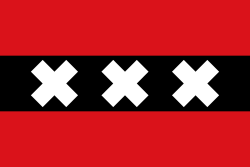
 Flag of Athens, Greece (added placeholder image due to copyright issues)
 Flag of Babrujsk, Belarus


 Flag of Birmingham, England, United Kingdom
 Flag of Bratislava, Slovakia
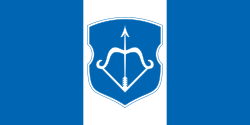 Flag of Brest, Belarus
 Flag of Brno, Czech Republic
 Flag of Bucharest, Romania
 Flag of Cardiff, Wales, United Kingdom
 Flag of Chelyabinsk, Russia
 Flag of Cologne, Germany
 Flag of Dublin, Ireland
 Flag of Düsseldorf, Germany
 Flag of Edinburgh, Scotland
 Flag of Frankfurt, Germany
 Flag of Glasgow, Scotland

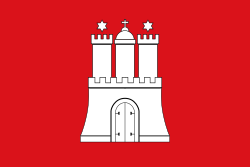
 Flag of Homieĺ, Belarus
 Flag of Hrodna, Belarus
 Flag of Istanbul, Turkey
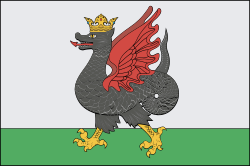 Flag of Kazan, Russia
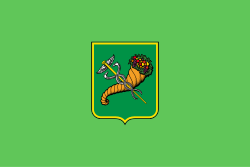 Flag of Kharkiv, Ukraine
 Flag of Kraków, Poland
 Flag of Krasnodar, Russia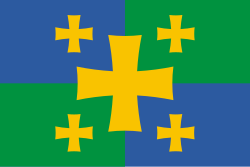


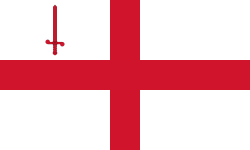
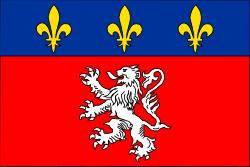

 Flag of Mahilioŭ, Belarus
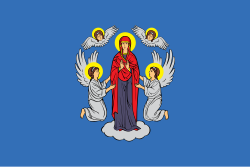 Flag of Minsk, Belarus
 Flag of Munich, Germany
 Flag of Nizhny Novgorod, Russia
 Flag of Novi Sad, Serbia
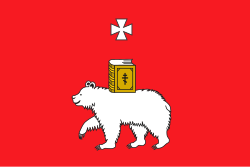 Flag of Perm, Russia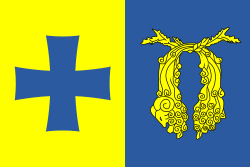
 Flag of Prague, Czech Republic
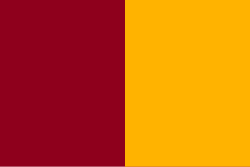 Flag of Rome, Italy
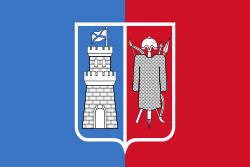 Flag of Rostov-on-Don, Russia
 Flag of Saint Petersburg, Russia
 Flag of Samara, Russia
 Flag of Saratov, Russia
 Flag of Sofia, Bulgaria
 Flag of Stuttgart, Germany
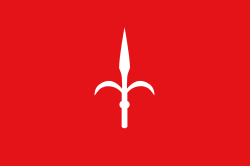 Flag of Trieste, Italy
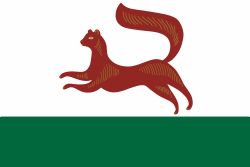 Flag of Ufa, Russia

 Flag of Vienna, Austria
 Flag of Vitebsk, Belarus
 Flag of Volgograd, Russia
 Flag of Voronezh, Russia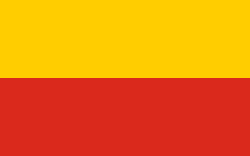



.svg)


.jpg)


.svg)


.jpg)


Flags of European ethnic groups
| Flag | Date | Use | Description |
|---|---|---|---|
 |
1917– | Flag of the Crimean Tatars | |
 |
2022– | Flag of the Forest Finns | |
 |
1919– | Flag of the Ingrians | |
 |
2017– | Flag of the Kven people | |
 |
1923– | Flag of the Livonians | |
 |
1971– | Flag of the Romani people | |
 |
2007– | Flag of the Rusyns | |
 |
1986– | Flag of the Sami people | |
 |
2003– | Flag of the Setos | |
 |
1842– | Flag of the Sorbs | |
 |
2004– | Flag of the Székelys | |
 |
1992– | Flag of the Vepsians | |
 |
2013– | Flag of the Võros | |
 |
2003– | Flag of the Votians |
Historical flags
| Flag | Date | Use as Flag of | Description |
|---|---|---|---|
| Historical British Commonwealth | |||
 |
1398–1489 | Kingdom of Cyprus | The flag was officially adopted on 16 August 1960.
The island is depicted in a copper shade representative of its name: the name Cyprus has roots in the Sumerian word for copper (zubar), from the large deposits of copper found on the island. The crossed green olive branches symbolise the hope for peace between the Turks and the Greeks. It was designed by İsmet Güney, a Turkish Cypriot painter. |
.svg) |
1881–1922 | British Cyprus | |
|
1960– | Cyprus See also: List of Cypriot flags [note 4] | |
.svg) |
1707–1801 | Great Britain | The current flag of the United Kingdom dates from the Act of Union 1800, which merged the Kingdom of Great Britain and the Kingdom of Ireland to form the United Kingdom of Great Britain and Ireland.
The "Union Jack" merges the red cross of Saint George (patron saint of England), edged in white, superimposed on the diagonal red cross of Saint Patrick (patron saint of Ireland), which are superimposed on the saltire of Saint Andrew (patron saint of Scotland). The flag of Wales, the other country of the United Kingdom, is not graphically represented. |
|
1801– | United Kingdom See also: List of United Kingdom flags | |
 |
1815–1864 | United States of the Ionian Islands | |
.svg) |
1918–1944 | Kingdom of Iceland | The flag of Iceland was adopted in June 1915 to represent Iceland. In June 1944 it became the flag of the independent republic of Iceland. Like other Scandinavian flags, it is based on the Nordic cross. It is a reverse colour image of the Flag of Norway. The blue represents the sea, the white represents the snow and glaciers, and the red symbolises volcanic lava. |
|
1915– | Iceland See also: List of Icelandic flags | |
|
1922– | Ireland See also: List of Irish flags |
Although dating from the 19th century, the tricolour flag of Ireland was not popularised until its use by rebels during the 1916 Easter Rising. It was officially adopted by the revolutionary First Dáil (assembly) of the Irish Republic on 21 January 1919, and used thereafter by the Irish Free State. The current 1937 Constitution of Ireland defines it as the national flag.
Modeled after the French tricolour, the colours of the Irish tricolour symbolise two communities. Green represents the Roman Catholic nationalist tradition. Orange represents the Protestant unionist community. White symbolises peace between both. |
.svg) |
1875–1898 | Crown Colony of Malta | The flag of Malta was officially adopted on 21 September 1964. The flag uses the traditional red and white colours which pre-date those of the Knights of Malta and which Government emulate[clarification needed] the arms of the former Universitas of Mdina. The George Cross (upper hoist), outlined in red, was added to the flag in the 1940s, as King George VI of the United Kingdom presented it to islanders for outstanding gallantry during World War II. |
.svg) |
1898–1923 | ||
.svg) |
1923–1943 | ||
.svg) |
1943–1964 | ||
|
1964– | Malta See also: List of flags of Malta | |
| Historical German-Roman Empire | |||
.svg) |
1400–1805 | Holy Roman Empire | The tricolour flag was designed in 1832, and the black, red, and gold colours were taken from the uniforms of German soldiers during the Napoleonic Wars (Out of the blackness (black) of servitude through bloody (red) battles to the golden (gold) light of freedom.[1]) or taken from the coat of arms of the Holy Roman Empire. |
.svg) |
1867–1871 | North German Confederation | |
| 1871–1918 | German Empire | ||
|
1918–1933 | Weimar Republic | |
|
1933–1935 | Nazi Germany | |
.svg) |
1935–1945 | ||
|
1949– | Germany See also: List of German flags | |
| 1949–1959 | East Germany | ||
 |
1959–1990 | ||
 |
1804–1867 | Austrian Empire | Stripes of red and white have been a collective emblem of Austria for over 800 years, and they were first used on the flag in 1191. According to long-established legend, the red and white flag was designed to resemble the bloodstained white coat worn by the Duke of Austria during a fierce battle. |
|
1919–1938 | Austria See also: List of Austrian flags | |
|
1938–1945 | Austria within Nazi Germany | |
|
1945– | Austria See also: List of Austrian flags | |
|
1993– | Czech Republic See also: List of Czech flags |
The first flag of Czechoslovakia was white over red, and those colours are the heraldic colours of Bohemia. The blue triangle was added to the flag to distinguish it from the flag of Poland, and blue is said to represent the State of Moravia. |
 |
1920–1939 | Free City of Danzig | |
|
1957– | Hungary See also: List of Hungarian flags |
The flag of Hungary was officially adopted in 1848.
The dominant crimson red, white, and teal green colours of the tricolour design are taken from the historical Hungarian coat of arms. Crimson red is said to symbolise strength, white faithfulness, and teal green hope. |
.svg) |
1861–1946 | Kingdom of Italy See also: List of Italian flags |
Derived from an original design by Napoleon, it consists of three vertical bands of equal width, displaying the national colours of Italy: green, white, and red. Green stands for hope, white for loyalty, and red represents the blood spread to unify the country. |
|
1948– | Italy | |
.svg) |
1719–1852 | Liechtenstein See also: List of Liechtensteinian flags |
The flag of Liechtenstein consists of two horizontal bands of blue and red with a gold crown in the canton. The crown was added to the flag in 1937 after the country found out at the 1936 Summer Olympics that their flag was identical to the civil flag of Haiti. |
.svg) |
1852–1921 | ||
.svg) |
1921–1937 | ||
.svg) |
1937–1982 | ||
|
1982– | ||
 |
1920–1935 | Territory of the Saar Basin | |
.svg) |
1947–1956 | Saar Protectorate | |
|
2011– | San Marino See also: List of Sammarinese flags |
The flag of San Marino comprises equal horizontal bands of white and light blue with the national coat of arms superimposed in the centre. |
|
1889– | Switzerland See also: List of Swiss flags |
The flag of Switzerland consists of a red square with a bold, equilateral white Greek cross in the centre. It is one of only two square flags, the other being that of the Vatican City or Holy See. It is based on the flag of the Canton of Schwyz, which dates back to 1474 at least. |
 |
1929– | Vatican City/Holy See See also: List of Vatican flags |
The flag of Vatican City or Holy See, adopted in June 1929, consists of two vertical bands of yellow and white with the crossed keys of Saint Peter and the Papal Tiara centred in the white band. It is one of only two square country flags in the world, the other being that of Switzerland. |
| Historical Latin and Benelux Nations | |||
|
1866– | Andorra See also: List of Andorran flags |
The flag of Andorra, adopted in 1866, is a tricolour of blue, yellow, and red with the coat of arms of Andorra in the centre. It is based on the flags of France and Spain. The coat of arms of Andorra is based on the flag of Catalonia (four red ribbons on yellow background). |
|
1830– | Belgium See also: List of Belgian flags |
Black, gold and red are symbolic of the country's coat of arms. The three-striped vertical layout was inspired by the French Tricolour. Black and gold were chosen, being the colours of the Duchy of Brabant where the Belgian Revolution started. Red was added as a symbol of the blood spilled during the uprising. |
.svg) |
1316–1547 | Duchy of Brittany | |
|
1794–1814 1830– |
France See also: List of French flags |
It was officially adopted on 15 February 1794.
The tricolore consists of three vertical bands of equal width, displaying the country's national colours: blue, white, and red. The blue band is positioned nearest the flagstaff, the white in the middle, and the red on the outside. Red, white, and blue have come to represent liberty, equality, and fraternity—the ideals of the French Revolution. Blue and red are also the time-honoured colours of Paris, while white is the colour of the Royal House of Bourbon. |
|
1845– | Luxembourg See also: List of flags of Luxembourg |
The flag of Luxembourg was officially adopted in 1972, although it had been used since 1848 following Luxembourg's independence from the Netherlands in the late 19th century.[dates disagree]
The flag uses a combination of red, white, and blue that dates to the 13th century, and the Grand Duke's coat of arms. |
|
1881– | Monaco See also: List of flags of Monaco |
The flag of Monaco has two horizontal bands of red and white—these have been the heraldic colours of the House of Grimaldi since at least 1339. |
|
1575 (first used) 1937 (officially adopted)– |
Netherlands See also: List of flags of the Netherlands |
The flag of the Netherlands was officially adopted on 19 February 1937.
At one time this tricolour flag was orange, white, and blue, as those were the livery colours of William of Orange, a Dutch prince. In the 17th century, red replaced the orange as a flag colour, because the orange dye used on the flag was unstable, and turned red after exposure to the sun. It is the oldest tricolour flag still in national use[6] and has influenced both the French[3] (1794) and Russian flag[4] (1693); both of these flags have in turn influenced many other European and African flags. |
|
1911– | Portugal See also: List of Portuguese flags |
The flag of Portugal was officially adopted on 30 June 1911.
The design is a rectangular bi-colour (2:3 ratio) with a field vertically divided into two stripes of different widths—a green stripe on the hoist, and a larger red stripe on the fly. A small version of the national coat of arms (armillary sphere and Portuguese shield) is superimposed over the boundary between the colours at equal distance from the upper and lower edges. The field colours, especially the green, originally represented a radical republican-inspired change that broke the bond with the former religious monarchical flag. In the ensuing decades, these colours were popularly propagandised as representing the hope of the nation (green) and the blood (red) of those who died defending it, as a means to endow them with a more patriotic and dignified, therefore less political, sentiment. |
.svg) |
1785–1873, 1875–1931 | Kingdom of Spain | The flag of Spain was officially adopted on 19 July 1927 as the merchant naval flag, and on 29 December 1978 as the national flag under the current Spanish Constitution. However the first original reference dates back to 15 May 1785, when Charles III of Spain adopted one of the designs proposed by Antonio Valdés y Bazán, commissioned by the king himself, in order to easily differentiate his ships from those of other European nations, many of which used the royal coat of arms over a white background, i.e. the French Bourbon royal flag. The red and golden-yellow colours were used from that day with mere changes[clarification needed] on the coat of arms (with the exception of the Spanish Second Republic) and are the original colours found within the coat of arms of the medieval kingdoms of Castile, Aragon and Navarre, first united by King Ferdinand II of Aragon and Queen Isabella I of Castile. |
 |
1873–1874 | First Spanish Republic | |
.svg) |
1931–1939 | Second Spanish Republic | |
.svg) |
1936–1938 | Spanish State | |
.svg) |
1938–1945 | ||
.svg) |
1945–1977 | Spanish State / Kingdom of Spain | |
.svg) |
1977–1981 | Kingdom of Spain | |
|
(1785 original design) 1981– |
Spain See also: List of Spanish flags | |
| Historical Ottoman Empire | |||
|
1912–1946 | Albania See also: List of Albanian flags |
The flag of Albania, adopted in April 1912, is a red flag with a black double-headed eagle in the centre. It is derived from the seal of Gjergj Kastriot Skanderbeg, a 15th-century Albanian who led a revolt against the Ottoman Empire that resulted in brief independence for Albania from 1443 to 1478. |
.svg) |
1946–1992 | People's Socialist Republic of Albania | |
|
1992– | Albania | |
|
1878–1947 | Bulgaria See also: List of Bulgarian flags |
The flag of Bulgaria was adopted in 1989 and consists of three horizontal bands of white, green, and red. |
.svg) |
1947–1948 | People's Republic of Bulgaria | |
.svg) |
1948–1967 | ||
.svg) |
1967–1971 | ||
.svg) |
1971–1990 | ||
|
1991– | Bulgaria | |
|
1822 (civil flag) 1978– |
Greece See also: List of Greek flags |
The current flag of Greece was adopted as a civil flag and ensign in 1822, and as the national flag in 1978.
It features a white cross and a combination of nine (five blue and four white) horizontal stripes. The shade of blue has varied over the years, and darker blue (shown) is now commonly used. The alternating white and blue stripes are said to represent the nine syllables of the phrase "Eleftheria i thanatos" ("Freedom or Death"), a popular motto during the Greek War of Independence. During the Kingdom of Greece, a crown was added in the centre of the cross. Greece's national flag between 1822 and 1970 featured a simple white cross on a blue background. It is not known why this version was adopted, and not a blue cross on a white background as was popular in the War of Independence. During the dictatorship, a navy blue version of the current flag with proportions of 7:12 was used. |
 |
1844–1922 | Ottoman Empire | The flag of Turkey is a red flag with a white crescent moon and a star in its centre. The flag is called Ay Yıldız (literally, moon star) or Albayrak (Red flag). It was adopted in 1844 with the Tanzimat reforms. Though the shape, placement and shade of the colour[clarification needed] vary. The geometric proportions of the flag were legally standardised with the Turkish Flag Law in 1936. |
|
1922– | Turkey See also: List of Turkish flags | |
| Scandinavian Nations | |||
|
1219– | Denmark See also: List of Danish flags |
The world's oldest state flag still in use. Legend has it that it appeared as a sign from heaven to King Valdemar II in 1219.
Known as the Dannebrog ("Danish Cloth"), this blood-red flag with an off-centred white cross (a "Nordic cross") became a model for other regional flags. |
|
1918– | Finland See also: List of Finnish flags |
Officially adopted on 29 May 1918.
The off-centred blue cross is based on the Nordic cross, widely used on Nordic national flags. The blue colour is symbolic of blue skies, and the thousands of lakes in Finland. The white represents the winter snows. |
|
1821–1844 1898– |
Norway See also: List of Norwegian flags |
The flag of Norway is red with a blue Nordic cross outlined in white; the vertical part of the cross is shifted to the hoist side in the style of the Dannebrog, the flag of Denmark. It was adopted in 1821, but a union mark was added in the canton from 1844 to 1898. |
|
(1569–1814) 1906–[5] |
Sweden See also: List of Swedish flags |
The flag of Sweden was officially adopted on 22 June 1906.
The off-centre yellow cross (the Nordic cross) is taken from the Danish flag. The yellow and blue colours are taken from the national coat of arms. It was adopted in 1569, but a union mark was added in the canton from 1844 to 1905. |
| Historical Soviet, and Communist Republics | |||
 |
1921–1922 | Socialist Soviet Republic of Abkhazia | This recently adopted flag is a simple white rectangle, with a central red cross connecting all four sides of the flag; in each of the four corners is a small red cross. The flag is based on a historic five-cross design that dates back to the 14th century. |
 |
1991–1992 | ||
.svg) |
1990–2004 | Georgia See also: List of Georgian flags [note 3] | |
|
2004– | ||
|
1918–1920 | Armenia See also: List of Armenian flags [note 3] |
After gaining independence, the First Republic of Armenia adopted the modern Armenian tricolour. The independent Armenian government selected the colours used during the last period of the Rubenid Dynasty: red, blue, and orange. The red emblematizes the Armenian Highland, the Armenian people's continued struggle for survival, maintenance of the Christian faith, and Armenia's independence and freedom. The blue emblematizes the will of the people of Armenia to live beneath peaceful skies. The orange emblematizes the creative talent and hard-working nature of the people of Armenia. |
.svg) |
1922 | Armenian Soviet Socialist Republic | |
|
1991– | Armenia | |
 | 1992 – 2023 | Artsakh | The flag of Artsakh is based on the Flag of Armenia, and has a white pattern added. |
 |
1918 | Democratic Republic of Azerbaijan | Originally adopted in 1918 as a flag of the Democratic Republic of Azerbaijan, it was officially adopted again in 1991, after Azerbaijan gained its independence. The flag of Azerbaijan is the national ensign of Azerbaijan. It consists of three equal horizontal bands coloured blue, red, and green, with a white crescent and an eight-pointed star centred in the red band. The blue band refers to Turkic heritage, the red is for progress and Europeanisation and the green refers to Islam. |
.svg) |
1920 | Azerbaijan Soviet Socialist Republic | |
.svg) |
1920–1921 | ||
.svg) |
1921–1922 | ||
|
1918–1920 1991– |
Azerbaijan See also: List of Azerbaijani flags [note 3] | |
.svg) |
1991–1995 | Belarus See also: List of Belarusian flags |
Belarus's flag was officially adopted on 10 February 2012. The dominant red-green bicolour was used on its flag when it was a republic within the former Soviet Union. The woven fabric ornament at the hoist uses traditional Belarusian red and white colours. |
.svg) |
1995–2012 | ||
|
1995– | ||
 |
1954–1992 | Dagestan Autonomous Soviet Socialist Republic | |
|
1918–1940 1990– |
Estonia See also: List of Estonian flags |
Officially re-adopted on 8 May 1990. The story of the flag begins on 17 September 1881, when the constituent Assembly of the first Estonian national student Corps "Vironia" (modern Estonian Students Society) in the city of Tartu was also identified in colour; it later became national. The first flag was made in 1884 and this tricolour was accepted in 1918 as the national flag of Estonia. The original flag is still in existence. The first flag of Estonia is kept in Tartu Estonian National Museum.
Blue represents loyalty, and the country's beautiful blue skies, seas, and lakes; black is symbolic of past oppression and the fertile soil; and white represents virtue, winter snows, and Estonia's long struggle for freedom and independence. |
 |
1991–1992 | Kazakhstan See also: List of Kazakh flags [note 5] |
Adopted on 4 June 1992. The flag has a gold sun with 32 rays above a soaring golden steppe eagle, both centred on a teal background; the hoist side displays a national ornamental pattern called "koshkar-muiz" (the horns of the ram) in gold. |
|
1992– | ||
 |
1918–1920 | Kuban People's Republic | |
|
1918–1940 1990– |
Latvia See also: List of Latvian flags |
The flag of Latvia was officially re-adopted on 27 February 1990.
The design is adopted from a 13th-century chronicle where "red divided by white" is said to be a Latvian flag. To distinguish it from the Austrian flag, the proportions 2:1:2 and the "Latvian red" colour have been adopted. |
|
1918–1940 1989– |
Lithuania See also: List of Lithuanian flags |
The flag of Lithuania was officially re-adopted on 20 March 1989, before Lithuania gained independence from the Soviet Union in 1990.
Yellow is symbolic of the country's wheat fields, green symbolic of the forests, and red symbolises patriotism. Collectively the colours represent hope for the future, freedom from oppression, and the courage of the Lithuanian people. |
|
1990– | Moldova See also: List of Moldovan flags |
Moldova's flag was officially adopted on 12 May 1990. Once part of Romania, Moldova's flag reflects that association, as the two countries use almost identical shades of red, yellow, and blue in their national flags. The centred Moldova shield's main feature is a golden eagle holding an Orthodox Christian Cross in its beak. The olive branch is said to symbolise peace. |
 |
1917–1922 | Flag of the Mountainous Republic of the Northern Caucasus | |
.svg) |
1815–1918 | Congress of Poland | |
|
1919– | Flag of Poland See also: List of Polish flags |
The colours red and white have long been associated with Poland and its coat of arms, at least since 3 May 1791. |
|
1867–1948 | Romania | The flag of Romania was officially re-adopted in 1989. The first red-yellow-blue flag dates from 1834 but the colours themselves are thought to have had special significance from earlier times. The current layout dates since 1848. A vertical tricolour of bands of blue, yellow, and red of equal width and overall proportions of 2:3. |
.svg) |
1948 | Romanian People's Republic | |
.svg) |
1948–1952 | ||
.svg) |
1952–1965 | ||
.svg) |
1965–1989 | ||
|
1989– | Romania See also: List of Romanian flags | |
 |
1263–1570 | Grand Duchy of Moscow | The Russian Federation flag was officially adopted on 22 August 1991. The flag was hoisted shortly after the former Soviet Union collapsed. The white, blue, and red are Pan-Slavic colours. |
.svg) |
1570–1668 | Tsardom of Russia | |
.svg) |
1668–1693 | ||
|
1693–1721 | ||
|
1721–1858 | Russian Empire | |
.svg) |
1858–1883 | ||
|
1883–1917 | ||
.svg) |
1918 | Russian Soviet Republic | |
|
1918–1920 | Russian State | |
.svg) |
1920–1922 | Russian Socialist Federative Soviet Republic | |
.svg) |
1922–1923 | Soviet Union | |
.svg) |
1923–1924 | ||
.svg) |
1924–1936 | ||
.svg) |
1936–1955 | ||
 |
1955–1991 | ||
.svg) |
1991–1993 | Russia See also: List of Russian flags [note 6] | |
|
1993– | ||
.svg) |
1440–1500 | Crimean Khanate | Ukraine's flag was adopted on 4 September 1991, shortly after the collapse of the former Soviet Union. This is the country's original flag used by the short-lived Ukrainian People's Republic, but it was banned for many decades under the Soviet regime. The shade of blue is said to be symbolic of the sky, while the yellow represents Ukraine's golden wheat fields. |
 |
1500–1542 | ||
 |
1542–1604 | Grand Duchy of Lithuania | |
 |
1605–1795 | Polish–Lithuanian Commonwealth | |
 |
1654–1655 | Cossack Hetman | |
|
1721–1858 | Russian Empire | |
|
1858–1883 | ||
|
1883–1917 | ||
.svg) |
1917–1919 | Ukrainian People's Republic | |
.svg) |
1919–1922 | Ukrainian Soviet Socialist Republic | |
|
1918–1920 1992– |
Ukraine See also: List of Ukrainian flags | |
| Historical Yugoslavian Republics | |||
.svg) |
1992–1998 | Bosnia and Herzegovina | The flag of Bosnia and Herzegovina consists of a wide medium blue vertical band on the fly side with a yellow isosceles triangle abutting the band and the top of the flag. The remainder of the flag is medium blue with seven five-pointed white stars and two half stars top and bottom along the hypotenuse of the triangle. The three points of the triangle stand for the three nations of Bosnia: Bosniaks, Croats, and Serbs. It is said to represent the map of Bosnia. |
|
1998– | ||
|
1990– | Croatia See also: List of Croatian flags |
The flag of Croatia, adopted in December 1990, consists of three equal horizontal stripes of red, white, and blue and the coat of arms of Croatia in the centre. |
.svg) |
1835–1882 | Principality of Serbia | The flag of Serbia consists of three horizontal bands of red, blue, and white, with the coat-of-arms located towards the hoist of centre. By accident or design the colours are that of the Russian flag reversed. A flag with three horizontal bands of red, blue, and white has been used as the national flag of Serbia and Serbs since 1815. Red, blue, and white are considered Pan-Slavic colours, but red and blue also occur on flags attributed to a 13th-century king of Serbia. The superimposed coat of arms of Serbia is a double-headed white eagle and a red shield with a white cross surrounded by four firesteels (ocila), a symbol that draws roots from Saint Sava Serbian Cross and from the ancient past of the Balkan peninsula, as it can be seen on 7000 years old Vinča culture pottery and many other later traditional Balkan cultural remains.
|
.svg) |
1852–1905 | Principality of Montenegro/ Kingdom of Montenegro | |
.svg) |
1882–1918 | Kingdom of Serbia | |
.svg) |
1905–1918 | Kingdom of Montenegro | |
 |
1918–1943 | Yugoslavia | |
.svg) |
1943–1946 | ||
.svg) |
1946–1992 | ||
 |
1992–2006 | Serbia and Montenegro | |
|
2006– | Montenegro See also: List of flags of Montenegro | |
|
1835 (civil flag) 2006– |
Serbia See also: List of flags of Serbia | |
;_Flag_of_North_Macedonia_(1991-1992).svg) |
1991–1992 | Republic of Macedonia | The flag of North Macedonia depicts a rising yellow sun with eight rays extending to the edges of the red field. It represents "the new sun of liberty", evoked in the Macedonian national anthem Denes nad Makedonija (Today Over Macedonia). |
.svg) |
1992–1995 | ||
|
1995– | North Macedonia See also: List of flags of North Macedonia | |
|
1992– | Slovakia See also: List of Slovak flags |
The flag of Slovakia was officially adopted on 1 September 1992.
White, blue, and red are traditional Pan-Slavic colours. The superimposed Slovakian arms feature a dominant white cross atop a blue symbolic reference to the European country's mountains. |
|
1991– | Slovenia See also: List of Slovenian flags |
The flag of Slovenia was officially adopted on 24 June 1991.
Red, white, and blue are taken from the Carniolan coat of arms. The flag without the coat of arms was in use from 1848 to 1945. The Slovenian coat of arms features three gold stars, symbolizing the Counts of Celje. The mountains shown in white are representative of the Alps, and Mount Triglav, Slovenia's national symbol, in particular; the wavy blue lines across the bottom indicate Slovenia's access to the sea. |
Historical supranational and international flags
| Flag | Date | Use | Description |
|---|---|---|---|
 |
1949–1991 | Flag of the Council for Mutual Economic Assistance | |
 |
1958–1972 | Flag of the European Coal and Steel Community | |
 |
1973–1980 | Flag of the European Coal and Steel Community | |
 |
1981–1985 | Flag of the European Coal and Steel Community | |
 |
1986–2002 | Flag of the European Coal and Steel Community | |
.svg) |
1993–1995 | Flag of the Western European Union | |
 |
1995–2011 | Flag of the Western European Union |
Notes
- The European Parliament adopted the Council of Europe's flag in 1983.
- Adopted by the European Communities in 1986, which became the European Union in 1992, continuing its usage.
- Part of the Caucasus region, at the crossroads of Europe and Asia, the boundaries of which may vary based on definition. Physiographically, Armenia may be considered to fall entirely in Western Asia, whereas Georgia and Azerbaijan are at times deemed transcontinental states spanning both Europe and Asia.
- The island of Cyprus, which includes the Republic of Cyprus, Northern Cyprus and Akrotiri and Dhekelia, is geographically located in Asia, closer to Asian Turkey than to the European mainland. However, the Republic of Cyprus is a member state of the European Union.
- Kazakhstan is a transcontinental country located mainly in Central Asia with a small part of its territory located west of the Ural Mountains in Eastern Europe.
- Russia is a transcontinental country that spans both Eastern Europe and Northern Asia.
- Turkey is a transcontinental country located mainly in Western Asia with a small portion of its territory in Southeastern Europe called East Thrace.
- Controlled by Russia but recognised as part of Ukraine by most of the international community
- Greater London as a whole doesn't have an official flag. The flag of the City of London is displayed here.
- Continental placement may vary depending on geographic convention being followed.
See also


- Vexillology
- Vexillological symbol
- Glossary of vexillology
- Civil flag
- Ensign (flag)
- Ethnic flag
- Flag families
- Maritime flag
- National flag
- National coat of arms
- National emblem
- National seal
- National symbol
- State flag
- Flag of Europe
- Armorial of Europe
- Lists of flags of European countries
- List of Albanian flags
- List of Andorran flags
- List of Armenian flags
- List of Austrian flags
- List of Azerbaijani flags
- List of Belarusian flags
- List of Belgian flags
- List of flags of Bosnia and Herzegovina
- List of Bulgarian flags
- List of Croatian flags
- List of Cypriot flags
- List of Czech flags
- List of Danish flags
- List of Estonian flags
- List of flags of Finland
- List of French flags
- List of flags of Georgia (country)
- List of German flags
- List of Greek flags
- List of Hungarian flags
- List of Icelandic flags
- List of flags of Ireland
- List of Italian flags
- List of Kazakh flags
- List of flags of Kosovo
- List of flags of Latvia
- List of Liechtensteinian flags
- List of flags of Lithuania
- List of flags of Luxembourg
- List of flags of Malta
- List of Moldovan flags
- List of Monégasque flags
- List of flags of Montenegro
- List of flags of the Netherlands
- List of flags of North Macedonia
- List of Norwegian flags
- List of Polish flags
- List of Portuguese flags
- List of Romanian flags
- List of Russian flags
- List of Sammarinese flags
- List of Serbian flags
- List of Slovak flags
- List of Slovenian flags
- List of Spanish flags
- List of flags of Sweden
- List of Swiss flags
- List of Turkish flags
- List of Ukrainian flags
- List of United Kingdom flags
- List of Vatican flags
- Flags of Austria-Hungary
- Flags of the Holy Roman Empire
- List of Soviet flags
- List of Yugoslav flags
- Other pages about European flags
- Galleries and lists
- Gallery of sovereign state flags
- Gallery of flags of dependent territories
- Lists of flags
- List of flags by design
- List of national flags by design
- List of national flags of sovereign states
- List of Japanese flags
- List of United Kingdom flags
- List of Antarctic flags
- List of flags by color combination
- List of sovereign states by date of current flag adoption
- Timeline of national flags
- Gallery pages of flags of country subdivisions
