Noto (train)
From Wikipedia, the free encyclopedia
 A seasonal Noto service formed of a JR East 485 series EMU in May 2010 | |
| Overview | |
|---|---|
| Service type | Express |
| Status | Discontinued |
| Locale | Tōhoku Main Line, Jōetsu Line, Shinetsu Main Line, Hokuriku Main Line |
| First service | 22 September 1959 |
| Last service | 2012 |
| Former operator(s) | JNR (1959–1987) JR West (1987–2010) JR East (2010–2012) |
| Route | |
| Termini | Ueno Kanazawa |
| Service frequency | 1 return working daily (seasonal) |
| On-board services | |
| Class(es) | Green/standard |
| Technical | |
| Rolling stock | 485 series EMUs |
| Track gauge | 1,067 mm (3 ft 6 in) |
| Electrification | 1,500 V DC overhead |
| Operating speed | 120 km/h (75 mph) |
The Noto (能登) was a seasonal overnight express train service in Japan operated by East Japan Railway Company (JR East), which runs between Ueno Station in Tokyo and Kanazawa via the Shinetsu Main Line and Hokuriku Main Line. The journey takes approximately seven hours.[1] The train was operated as a regular daily service by West Japan Railway Company (JR West) until 13 March 2010, with operations transferred to JR East from this date. While JR East has not formally announced its discontinuation, no services have operated since February 2012.[2]
Formation
Trains were formed of 6-car 485 series electric multiple units (EMU) owned by JR East and based at Niigata depot.[3] All seats are reserved.[4]
The 6-car 485 series sets based at Niigata are formed as follows, with car 1 at the Ueno and Kanazawa end (trains reverse en route at Nagaoka).[5]
| Car No. | 1 | 2 | 3 | 4 | 5 | 6 | |
|---|---|---|---|---|---|---|---|
| Numbering | KuRoHa 481 | MoHa 484 | MoHa 485 | MoHa 484 | MoHa 485 | KuHa 481 | |
| Accommodation | Green | Reserved | Reserved | Reserved | Reserved | Reserved | Reserved |
| Facilities | Toilet | Toilet | Toilet | Toilet | Phone / Toilet | Toilet | |
Past rolling stock
From 1982 onward, services were formed of eight 14 series coaches, consisting of three B-type 3-level berth sleeping cars and five seating coaches. These services were hauled by a Tabata-based JNR Class EF62 electric locomotive between Ueno and Naoetsu, and by a Nagaoka-based JNR Class EF81 electric locomotive between Naoetsu and Kanazawa.[6]
From March 1993, the locomotive-hauled trains were replaced by 9-car JR West 489 series EMUs based at Kanazawa depot, formed as shown below.[7][8]
 Noto express hauled by EF62 electric locomotive in 1989
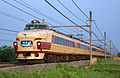 Noto service formed of JR West "bonnet-style" 489 series EMU in May 2007


| Car No. | 1 | 2 | 3 | 4 | 5 | 6 | 7 | 8 | 9 |
|---|---|---|---|---|---|---|---|---|---|
| Numbering | KuHa 489 | MoHa 488 | MoHa 489 | SaRo 489 | MoHa 488 | MoHa 489 | MoHa 488 | MoHa 489 | KuHa 489 |
| Accommodation |  Reserved (Women-only) Reserved (Women-only) | Reserved | .svg) Reserved Reserved | Green | Non-reserved | Non-reserved | Non-reserved | Non-reserved | Non-reserved |
| Facilities | Toilet | Toilet | Toilet | Phone / Toilet | Toilet | Lounge area | Toilet | Toilet | Toilet |

.svg)
.svg)