Koumi Line
From Wikipedia, the free encyclopedia
| Koumi Line | |||
|---|---|---|---|
 JR East KiHa 110 series DMU on the Koumi Line | |||
| Overview | |||
| Native name | 小海線 | ||
| Status | In operation | ||
| Owner | JR East | ||
| Locale | Yamanashi, Nagano prefectures | ||
| Termini | |||
| Stations | 31 | ||
| Service | |||
| Type | Regional rail | ||
| Operator(s) | JR East | ||
| Rolling stock | KiHa E200 DMU, KiHa 110 series DMU | ||
| History | |||
| Opened | August 8, 1919 | ||
| Technical | |||
| Line length | 78.9 km (49.0 mi) | ||
| Number of tracks | Entire line single tracked | ||
| Character | Rural and scenic | ||
| Track gauge | 1,067 mm (3 ft 6 in) | ||
| Electrification | None | ||
| Operating speed | 85 km/h (53 mph) | ||
| |||

The Koumi Line (小海線, Koumi-sen) is a railway line in Japan operated by East Japan Railway Company (JR East). It links Kobuchizawa Station in Hokuto, Yamanashi with Komoro Station in Komoro, Nagano, and extends 78.9 km (49.0 mi) through the mountains with a total of 31 stations. It roughly follows the route of National Route 141, paralleling the road at some places and crossing it twice.
The southern section of the line is also known as the Yatsugatake Kogen Line, as it runs along the southeastern foot of the Yatsugatake Mountains.
All local trains stop at all stations. Extra rapid trains stop at specific stations.
Some of the stations along the Koumi Line are among the highest in Japan, with Nobeyama Station reaching 1,345 meters (4,413 ft) above sea level. Because of the frequent stops and winding route, the full 78.9 kilometers (49.0 mi) journey often takes as long as two and a half hours to traverse. However, the journey is known for its scenery, in which passengers can see nature, highlands, high mountains and one of the most beautiful starlit skies at night.[1][2][3]
Local trains run between Koumi or Nakagomi and Komoro, between Kobuchizawa and Nobeyama or Koumi respectively, excluding local trains running the full length of the line. In 2022, JR East announced the names of railway lines which were failing to make a profit, which included the section of this line between Koumi and Kobuchizawa.[4][5]
Local trains are driver-only operated (one-person operation) between Nakagomi and Kobuchizawa. However, lots of passengers use the stations between Nakagomi and Komoro, so local trains in this section have conductors onboard.
Nakagomi Station is located near the Koumi Line Operation Office, where many train staff are working.
| Station | Japanese | Yatsugatake Kogen Ressha | High Rail 1375 | Distance (km) | Transfers | Location | |||
|---|---|---|---|---|---|---|---|---|---|
| Between stations |
Total | ||||||||
| Kobuchizawa | 小淵沢 | ● | ● | - | 0.0 |  Chūō Main Line Chūō Main Line |
∨ | Hokuto | Yamanashi |
| Kai-Koizumi | 甲斐小泉 | ● | | | 7.1 | 7.1 | | | |||
| Kai-Ōizumi | 甲斐大泉 | ● | | | 5.1 | 12.2 | ◇ | |||
| Kiyosato | 清里 | ● | ● | 5.3 | 17.5 | ◇ | |||
| Nobeyama | 野辺山 | ● | ● | 5.9 | 23.4 | ◇ | Minamimaki, Minamisaku District | Nagano | |
| Shinano-Kawakami | 信濃川上 | ▼ | ◆ | 8.1 | 31.5 | ◇ | Kawakami, Minamisaku | ||
| Saku-Hirose | 佐久広瀬 | ↓ | | | 3.4 | 34.9 | | | Minamimaki, Minamisaku | ||
| Saku-Uminokuchi | 佐久海ノ口 | ↓ | | | 4.8 | 39.7 | | | |||
| Umijiri | 海尻 | ↓ | | | 2.4 | 42.1 | | | |||
| Matsubarako | 松原湖 | ↓ | | | 2.7 | 44.8 | | | Koumi, Minamisaku | ||
| Koumi | 小海 | ▼ | ● | 3.5 | 48.3 | ◇ | |||
| Managashi | 馬流 | ↓ | | | 1.6 | 49.9 | | | |||
| Takaiwa | 高岩 | ↓ | | | 1.8 | 51.7 | | | Sakuho, Minamisaku | ||
| Yachiho | 八千穂 | ↓ | ◆ | 2.2 | 53.9 | | | |||
| Kaize | 海瀬 | ↓ | | | 2.6 | 56.5 | | | |||
| Haguroshita | 羽黒下 | ↓ | | | 1.3 | 57.8 | ◇ | |||
| Aonuma | 青沼 | ↓ | | | 1.7 | 59.5 | | | Saku | ||
| Usuda | 臼田 | ↓ | ◆ | 1.4 | 60.9 | | | |||
| Tatsuokajō | 龍岡城 | ↓ | | | 1.2 | 62.1 | | | |||
| Ōtabe | 太田部 | ↓ | | | 2.0 | 64.1 | | | |||
| Nakagomi | 中込 | ▼ | ● | 1.4 | 65.5 | ◇ | |||
| Namezu | 滑津 | | | 1.0 | 66.5 | | | ||||
| Kita-Nakagomi | 北中込 | | | 1.9 | 68.4 | | | ||||
| Iwamurada | 岩村田 | ◆ | 2.2 | 70.6 | ◇ | ||||
| Sakudaira | 佐久平 | ● | 0.9 | 71.5 |  Hokuriku Shinkansen Hokuriku Shinkansen |
| | |||
| Nakasato | 中佐都 | | | 0.9 | 72.4 | | | ||||
| Misato | 美里 | | | 1.4 | 73.8 | | | Komoro | |||
| Mitsuoka | 三岡 | | | 1.5 | 75.3 | ◇ | ||||
| Otome | 乙女 | | | 1.1 | 76.4 | | | ||||
| Higashi-Komoro | 東小諸 | | | 1.0 | 77.4 | | | ||||
| Komoro | 小諸 | ● | 1.5 | 78.9 |  Shinano Railway Line Shinano Railway Line |
∧ | |||
Legend
- ◇・∨・∧ - passing loop
- | - no passing loop
Rolling stock
- KiHa 110 series DMUs, since November 1991
- KiHa E200 hybrid DMUs, since July 2007
 A two-car KiHa 110 series train on the Koumi Line, April 2008
 A two-car KiHa E200 series train on the Koumi Line, April 2009


Special liveries
In February 2015, to mark the 80th anniversary of the opening of the Koumi Line, a single-car KiHa 110 series unit was repainted into the "Metropolitan" all-over red livery carried by KiHa 52 DMUs formerly used on the line.[6] This was followed in March 2015 by a two-car KiHa 110 series unit repainted into the vermillion and cream livery carried by KiHa 58 series DMUs formerly used on the line.[6]
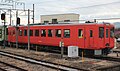 Koumi Line KiHa 110-121 in "Metropolitan" all-over red livery, February 2015


.svg)
.svg)
.svg)


