Paul Wild Observatory
From Wikipedia, the free encyclopedia

 | |
| Alternative names | Narrabri Observatory |
|---|---|
| Named after | Paul Wild |
| Location | Narrabri, New South Wales, Australia |
| Coordinates | 30°18′50″S 149°33′43″E / 30.314°S 149.562°E |
| Website | www |
| Telescopes | |
  Location of Paul Wild Observatory | |
The Paul Wild Observatory, also known as the Narrabri Observatory and Culgoora Observatory,[1] is an astronomical research facility located about 24 km west of Narrabri, New South Wales, Australia.[2] It is the home of the Australia Telescope Compact Array, and the Culgoora Solar Observatory.
The site itself and the Australia Telescope Compact Array are run by Australia's science agency, the CSIRO.[1] The current Solar Observatory is run by the Space Weather Services section of Australia's Bureau of Meteorology.[3][4]
The site is named in honour of Australian radio astronomer Paul Wild, who headed the team that built the instrument that the site was established for – the Culgoora Radioheliograph, the world's first radioheliograph[5] – which ran from 1967 to 1984.[6]
The Australia Telescope Compact Array began operating at the site in 1988.[7]
- The Australia Telescope Compact Array – a six-dish radio telescope interferometer[8]
- The Ionospheric Prediction Service (Space Weather Services) Culgoora Solar Observatory[9][4]
- A node of the Birmingham Solar Oscillations Network (BiSON)[10]
- An element of the Magnetic Data Acquisition System (MAGDAS) global magnetometer array[11][12]
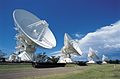 Four antenna dishes of the Compact Array.
 Dishes of the Compact Array, showing track.
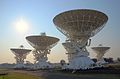 A compact arrangement of dishes, at the north spur junction.
 East-west track of Array, before construction of north spur. 6th dish in far distance.


Past facilities


In the media
The children's/teen's television adventure series Sky Trackers was filmed at the site in 1993,[17] with the antenna dishes of the Australia Telescope Compact Array being prominently featured.
Other sites nearby
In addition to the Paul Wild Observatory, there is a history of astronomical research at other sites in the Narrabri area. The Narrabri Stellar Intensity Interferometer (NSII), the predecessor of SUSI, was located about 10 km north of Narrabri.[18]
At a site south of Narrabri, near the Bohena Creek, Durham University ran gamma ray telescopes[19] from 1986 to 2000.[20] The Bohena Creek site had previously been used for Sydney University's Giant Air Shower Recorder (SUGAR) for the detection of cosmic rays.[19]


