The highway originally bore the name Monaro Highway until 1955, when it received its current name. It originally ran from Tathra to Wagga Wagga but has been shortened to run from Princes Highway to Hume Highway instead. Reservoirs created as a result of dams built in the 1950s and 1960s as part of the Snowy Mountains Scheme required the creation of major realignments to avoid submerged areas. Previous to New South Wales' conversion to alphanumeric route markers, it was signed as National Route 18. (Full article...)
Both teams had played in their regional qualifiers to qualify for the play-off. The Canadians played in twelve matches in North American qualifying across two rounds. After finishing second in their second-round group to El Salvador, they qualified to the final round where they finished second by three points to Mexico. Australia played in six matches across two rounds in Oceania qualifying. After winning their group, they defeated New Zealand across two legs to make it to the play-off. (Full article...)
Image 3
The Glasshouse arts and entertainment centre was central to the dismissal of Port Macquarie-Hastings Council The dismissal of the Port Macquarie-Hastings Council on 27 February 2008 marked the end of a series of events involving a project which was initiated in 2001 in the New South Wales coastal town of Port Macquarie to build a cultural and entertainment centre, known to locals as the Glasshouse. The project, initially a joint venture with the management of the neighbouring shopping centre, Port Central, was originally expected to cost the Council A$7.3 million. However, by late 2007, despite the centre not yet having opened, the costs had blown out to over A$41.7 million, with interest repayments likely to extend the council's liability to A$66 million.
On 27 July 2007, a full public inquiry was announced by the Minister for Local Government, Paul Lynch. The inquiry reported its findings in February 2008. It found that the council had failed to provide appropriate financial and project management and had lost control of the costs, that the project costs had harmed the council's ability to provide services and amenities to the community, and that the council's communications management strategy had resulted in inadequate consultation with the public and inappropriate regard to their concerns. The Minister for Local Government dismissed the council and its mayor, Rob Drew, and appointed an administrator upon receiving the inquiry's report. Drew was critical of the process throughout, maintaining that errors had been made and misinformation had been accepted as fact; however, the New South Wales Urban Task Force, a property development lobby group, believed the sacking served as a warning to other councils to stick to "core responsibilities". (Full article...)
Image 4
Bruxner in 1951
Lieutenant ColonelSir Michael Frederick BruxnerKBE,DSO,JP (25 March 1882 – 28 March 1970) was an Australian politician and soldier, serving for many years as leader of the Country Party (and its predecessors) in New South Wales. Born in the north of the state, Bruxner was educated at The Armidale School and started studies at University of Sydney but later dropped out to take up employment as a grazier and station agent in Tenterfield. After serving in the Citizen Military Forces from 1911, Bruxner enlisted into the Australian Light Horse upon the outbreak of the First World War in 1914. Serving with distinction in Gallipoli, Egypt and Palestine, he was promoted to lieutenant colonel and awarded the Distinguished Service Order.
Returning to Australia in 1919, Bruxner sold his business and joined the Progressive Party, being elected to the Parliament of New South Wales for Northern Tablelands at the 1920 election. Bruxner came to political prominence when he led the rural "True Blues" faction of the Progressive Party that went against their Leader's decision to form a coalition in Sir George Fuller's short-lived government in 1921. Bruxner emerged as the leader of the reduced Progressive Party, which consisted of the members of his faction, but they nevertheless joined with Fuller's Nationalists to form government in 1922. Bruxner also became involved in the New England New State Movement. Bruxner resigned the party leadership, now for the renamed Country Party, at the end of 1925. (Full article...)
Image 5
Blair Wark c.1919
Blair Anderson Wark, VC,DSO (27 July 1894 – 13 June 1941) was an Australian soldier, quantity surveyor, and a recipient of the Victoria Cross, the highest decoration for gallantry "in the face of the enemy" that can be awarded to members of the British and other Commonwealth armed forces. A member of the Citizen Military Forces from 1912, Wark enlisted in the Australian Imperial Force on 5 August 1915 for service in the First World War. After initially being employed in the defence of the Suez Canal, his battalion was shipped to the Western Front; it was here that Wark was twice decorated for his bravery and leadership. Having received the Distinguished Service Order in 1917 for his actions at the Battle of Polygon Wood, Wark was awarded the Victoria Cross in 1918 for his leadership and gallantry when in temporary command of his battalion over a three-day period, while conducting operations against the Hindenburg Line.
Returning to Australia after the war, Wark resumed work as a quantity surveyor and established his own business. He became a respected member of Australian society, holding positions and directorships in several companies and charities until 1940, when he re-enlisted in the Citizen Military Forces for service in the Second World War. Wark was promoted to lieutenant colonel and assumed command of the 1stBattalion (City of Sydney's Own Regiment), but died suddenly at Puckapunyal Camp, Victoria, of coronary heart disease, aged 46. (Full article...)
Image 6
Alloxylon pinnatum, known as Dorrigo waratah, is a tree of the family Proteaceae found in warm-temperate rainforest of south-east Queensland and northern New South Wales in eastern Australia. It has shiny green leaves that are either pinnate (lobed) and up to 30cm (12in) long, or lanceolate (spear-shaped) and up to 15cm (5.9in) long. The prominent pinkish-red flower heads, known as inflorescences, appear in spring and summer; these are made up of 50 to 140 individual flowers arranged in corymb or raceme. These are followed by rectangular woody seed pods, which bear two rows of winged seeds.
Known for many years as Oreocallis pinnata, it was transferred to the new genus Alloxylon by Peter Weston and Mike Crisp in 1991. This genus contains the four species previously classified in Oreocallis that are found in Australasia. Its terminal globular flowers indicate that the species is pollinated by birds. Classified as near threatened under the Queensland Nature Conservation Act 1992, the Dorrigo waratah has proven difficult to keep alive in cultivation. (Full article...)
Image 7
The Pacific blue-eye (Pseudomugil signifer) is a species of fish in the subfamilyPseudomugilinae native to eastern Australia. Described by Austrian naturalist Rudolf Kner in 1866, it comprises two subspecies that have been regarded as separate species in the past and may be once again with further study. It is a common fish of rivers and estuaries along the eastern seaboard from Cape York in North Queensland to southern New South Wales, the Burdekin Gap in central-north Queensland dividing the ranges of the two subspecies.
A small silvery fish averaging around 3.25 cm in total length (1+1⁄8–1+3⁄8 in), the Pacific blue-eye is recognisable by its blue eye-ring and two dorsal fins. It forms loose schools of tens to thousands of individuals. It eats water-borne insects as well as flying insects that land on the water's surface, foraging for them by sight. The Pacific blue-eye adapts readily to captivity. (Full article...)
Image 8
2016 Australian Paralympic team portrait of Elliott
Maddison Gae Elliott, OAM (born 3 November 1998) is an Australian swimmer. At the 2012 Summer Paralympics in London, she became the youngest Australian Paralympic medallist by winning bronze medals in the women's 400m and 100m freestyle S8 events. She then became the youngest Australian gold medallist when she was a member of the women's 4 × 100m freestyle relay 34 points team. At the 2016 Rio Paralympics, she won three gold and two silver medals. (Full article...)
The Mariners were founded in 2004 and are one of the eight original A-League teams. It is the first professional sports club from the Gosford region to compete in a national competition. Despite being one of the smallest clubs in the league, the Central Coast Mariners are one of the most successful clubs in Australian soccer history, having won three A-League Championships from six Grand Final appearances, as well as the A-League Premiership three times. The club has also appeared in the AFC Champions League five times and won the AFC Cup once. (Full article...)
Image 10
Hailstones dropped during the storm, compared to a cricket ball (7cm or 2.8in diameter)
The 1999 Sydney hailstorm was the costliest natural disaster in Australian insurance history, causing extensive damage along the east coast of New South Wales. The storm developed south of Sydney on the afternoon of Wednesday, 14 April 1999, and struck the city's eastern suburbs, including the central business district, later that evening.
The storm dropped an estimated 500,000 tonnes of hailstones in its path. The insured damage bill caused by the storm was over A$1.7billion, which is equivalent to A$3.2billion in 2022 when adjusted for inflation, with the total bill (including uninsured damage) estimated to be around A$2.3billion, or A$4.3billion in 2022. It was the costliest single natural disaster in Australian history in insured damage, surpassing the A$1.1billion in insured damage caused by the 1989 Newcastle earthquake. Lightning killed one person during the storm, and the event caused approximately 50 injuries. (Full article...)
Image 11
Library punchbowl showing beach where Circular Quay is now located The Sydney punchbowls, made in China during the Jiaqing Emperor's reign (1796–1820) over the mid-Qing dynasty, are the only two known examples of Chinese export porcelain hand painted with Sydney scenes and dating from the Macquarie era. The bowls were procured in Canton about three decades after the First Fleet's arrival at Port Jackson where the British settlement at Sydney Cove was established in 1788. They also represent the trading between Australia and China via India at the time. Decorated punchbowls were prestigious items used for drinking punch at social gatherings during the 18th and 19th centuries, but it is not known who commissioned these bowls or what occasion they were made for.
The punchbowls are a 'harlequin pair', similar but not exactly matching. They were donated independently of each other, one to the State Library of New South Wales (SLNSW) in 1926 and the other to the Australian National Maritime Museum (ANMM) in 2006. The Library bowl is the more widely known of the pair. Its earliest provenance places it in England in the late 1840s, where it is said to have been commissioned for William Bligh; another source suggests Henry Colden Antill. It passed through several owners in Britain before it was presented to the State Library. The Museum bowl's first provenance is from England in 1932 and it has been suggested that it was made to the order of Arthur Phillip. Its whereabouts were unknown until it appeared in the Newark Museum, United States, in 1988, on loan from Peter Frelinghuysen Jr. Through donations, the Maritime Museum later acquired the punchbowl from Frelinghuysen. (Full article...)
Image 12
Provisional RAAF area command boundaries, February 1940
The Mariners' record appearance-maker is John Hutchinson, who made 271 appearances over a 10-year playing career, ahead of Matt Simon. Hutchinson also holds the record for the most starts, having started in 232 games. Simon is the club's top goalscorer with 66 goals in his eleven seasons with the club, twenty-three more than next-highest scorer Adam Kwasnik. Nineteen players have made 100 appearances or more, including six members of the 2013 A-League Grand Final winning team and three members of the 2023 A-League Men Grand Final and 2024 A-League Men Grand Final winning teams. Danny Vukovic is the only goalkeeper to have made over 100 appearances for the side. Eight players have held the position of club captain, Alex Wilkinson for the longest period (five years). (Full article...)
Image 14
Charles Green at Wewak, New Guinea, in September 1945
Green performed instructional duties and attended courses until July 1943 when he rejoined the 2/2nd Battalion as its second-in-command. At the time, the unit was training in Queensland. From March to July 1945, Green commanded the 2/11th Battalion during the Aitape-Wewak campaign in New Guinea. For his performance during the campaign, Green was appointed a Companion of the Distinguished Service Order. After the war, Green briefly returned to civilian life and part-time military service as commanding officer of the 41st Battalion. When the Regular Army was formed, Green returned to full-time service in early 1949. (Full article...)
The Riverina (/ˌrɪvəˈriːnə/) is an agricultural region of south-western New South Wales, Australia. The Riverina is distinguished from other Australian regions by the combination of flat plains, a climate with significant seasonal variation and an ample supply of water for irrigation. This combination has allowed the Riverina to develop into one of the most productive and agriculturally diverse areas of Australia. Bordered on the south by the state of Victoria and on the east by the Great Dividing Range, the Riverina covers those areas of New South Wales in the Murray and Murrumbidgee drainage zones to their confluence in the west.
Home to Aboriginal groups including the Wiradjuri people for over 40,000 years, the Riverina was colonised by Europeans in the mid-19th century as a pastoral region providing beef and wool to markets in Australia and beyond. In the 20th century, the development of major irrigation areas in the Murray and Murrumbidgee valleys has led to the introduction of crops such as rice and wine grapes. The Riverina has strong cultural ties to Victoria, and the region was the source of much of the impetus behind the federation of Australian colonies. (Full article...)
The Hoary-headed Grebe, Poliocephalus poliocephalus, is a member of the grebe family common to New South Wales, and across Australia. The bird takes its name from the silvery-white streaking on its black head.
The Murray rises in the Australian Alps, draining the western side of Australia's highest mountains, then meanders northwest across Australia's inland plains, forming the border between the states of New South Wales and Victoria as it flows into South Australia. From an east–west direction it turns south at Morgan for its final 315km (196mi), reaching the eastern edge of Lake Alexandrina, which fluctuates in salinity. The water then flows through several channels around Hindmarsh Island and Mundoo Island. There it is joined by lagoon water from The Coorong to the south-east before emptying into Encounter Bay (a bay of the Southern Ocean) through the Murray Mouth, 10km (6.2mi) east of Goolwa South. Despite discharging considerable volumes of water at times, particularly before the advent of large-scale river regulation, the waters at the Murray Mouth are almost invariably slow and shallow. (Full article...)
Until 1961 the award also included projects in the Australian Capital Territory. The establishment of the ACT Chapter of the Institute of Architects in 1962 and a separate awards program including the Canberra Medallion changed the award to projects in New South Wales only. Before the advent of the NSW Chapter Wilkinson Award in 1961, the Sulman was also awarded to residential housing projects. (Full article...)
The Sydney Opera House is a multi-venue performing arts centre in Sydney, New South Wales, Australia. Located on the foreshore of Sydney Harbour, it is widely regarded as one of the world's most famous and distinctive buildings, and a masterpiece of 20th-century architecture.
Designed by Danish architect Jørn Utzon and completed by an Australian architectural team headed by Peter Hall, the building was formally opened by Queen Elizabeth II on 20 October 1973, 16 years after Utzon's 1957 selection as winner of an international design competition. The Government of New South Wales, led by the premier, Joseph Cahill, authorised work to begin in 1958 with Utzon directing construction. The government's decision to build Utzon's design is often overshadowed by circumstances that followed, including cost and scheduling overruns as well as the architect's ultimate resignation. (Full article...)
Image 8
The Three Sisters sandstone rock formation, one of the region's best-known attractions
The Blue Mountains (Gundungurra/Dharug: Colomatta or Gulumada) are a mountainous region and a mountain range located in New South Wales, Australia. The region is considered to be part of the western outskirts of the Greater Sydney area. The region borders on Sydney's main metropolitan area, its foothills starting about 50 kilometres (31mi) west of centre of the state capital, close to Penrith. The public's understanding of the extent of the Blue Mountains is varied, as it forms only part of an extensive mountainous area associated with the Great Dividing Range. As defined in 1970, the Blue Mountains region is bounded by the Nepean and Hawkesbury rivers in the east, the Coxs River and Lake Burragorang to the west and south, and the Wolgan and Colo rivers to the north. Geologically, it is situated in the central parts of the Sydney Basin.
The Blue Mountains Range comprises a range of mountains, plateau escarpments extending off the Great Dividing Range about 4.8 kilometres (3.0mi) northwest of Wolgan Gap in a generally southeasterly direction for about 96 kilometres (60mi), terminating at Emu Plains. For about two-thirds of its length it is traversed by the Great Western Highway, the Main Western railway line and the proposed Blue Mountains tunnel. Several established towns are situated on its heights, including Katoomba, Blackheath, Mount Victoria, and Springwood. The range forms the watershed between Coxs River to the south and the Grose and Wolgan rivers to the north. The range contains the Explorer Range and the Bell Range. (Full article...)
Taronga Zoo Sydney is a government-run public zoo located in Sydney, New South Wales, Australia, in the Lower North Shore suburb of Mosman, on the shores of Sydney Harbour. It offers great views of Sydney Harbour and the city. The opening hours are between 9:30a.m. to 4:30p.m. (May to August) and 9:30 am to 5:00 pm (September to April). Taronga is an Aboriginal word meaning "beautiful view".
View south from Byron Bay, the most easterly point on mainland Australia
The Northern Rivers is the most northeasterly region of the Australian state of New South Wales, located between 590 and 820 kilometres (370 and 510mi) north of the state capital, Sydney, and encompasses the catchments and fertile valleys of the Clarence, Richmond, and Tweed rivers. It extends from Tweed Heads in the north (adjacent to the Queensland border) to the southern extent of the Clarence river catchment which lies between Grafton and Coffs Harbour, and includes the main towns of Tweed Heads, Byron Bay, Ballina, Kyogle, Lismore, Casino and Grafton. At its most northern point, the region is 102 kilometres (63mi) south-southeast of the Queensland capital, Brisbane.
As with all regions of New South Wales, it has no official status, although state government department offices and local governments in the area work together for purposes such as tourism, education, water catchment management and waste management. This area has a mild, sub-tropical climate. Major industries are agriculture, fisheries, public services (particularly health) and tourism; the region is also popular for niche crops, hobby farmers, and retirees from life in the larger cities. (Full article...)
The first phase was approved for development in October 2013. A new depot was constructed at Taff's Well and new trains were built by Stadler Rail in Switzerland. The first few of the new Stadler trains entered service late 2024, and the first tram-trains will enter service in the second half of 2025. The first phase of the service is expected to be fully in operation by the start of 2026. (Full article...)
Visitors interacting with Wedding Cake Rock, pictured in December 2014, prior to the landmark’s closure to the public.Wedding Cake Rock, also known as White Rock, is a sandstone rock formation located in the Royal National Park near Bundeena in Sydney, New South Wales, Australia, accessible via the Royal National Park Coast Track. The rock is one of many formations that appear north of Marley Beach, and is suspended 25 metres (82ft) above sea level. Wedding Cake Rock is noted for its scenic location and popularity with bushwalkers and tourists, as an attractive location for photography. Its reputation, however, was damaged after the landmark saw a sudden spike in popularity in 2015, and subsequently fell victim to vandalism. The rock was closed off from public access in May 2015 by the New South Wales National Parks and Wildlife Service, citing the dangerous behavior of recent visitors, and later, safety concerns, after a survey conducted the following month determined that the rock was unstable, and that it would collapse into the Tasman Sea within the next decade. (Full article...)
... that the jury of matrons who assessed whether Ann Davis was pregnant after she was sentenced to death were the first civilian jurors for a criminal trial in New South Wales?
Image 2Mr E.H. Hargraves, The Gold Discoverer of Australia, returning the salute of the gold miners - Thomas Tyrwhitt Balcombe, 1851 (from History of New South Wales)
Image 15A General Chart of New Holland including New South Wales & Botany Bay with The Adjacent Countries and New Discovered Lands, published in An Historical Narrative of the Discovery of New Holland and New South Wales, London, Fielding and Stockdale, November 1786 (from History of New South Wales)


 Recognized content -


.jpg)


_Johnsons_Building.JPG)


 Mr E.H. Hargraves, The Gold Discoverer of Australia, returning the salute of the gold miners - Thomas Tyrwhitt Balcombe, 1851 (from History of New South Wales)
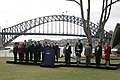 World leaders with Prime Minister John Howard in Sydney for the 2007 APEC conference (from History of New South Wales)
 Köppen climate types in New South Wales (from Geography of New South Wales)
 William Wentworth was key in the establishment of self-governance in New South Wales (from History of New South Wales)
 Bondi Beach circa 1900 (from History of New South Wales)
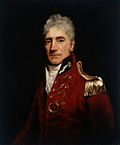 The 5th Governor of New South Wales, Lachlan Macquarie, was influential in establishing civil society in Australia (from History of New South Wales)
 Hyde Park, Sydney with the Australian Museum under construction in the distance, 1842 (from History of New South Wales)
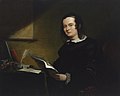 Humanitarian Caroline Chisholm provided support to poverty-stricken women migrants (from History of New South Wales)
 Murray Grey cows and calves (from Economy of New South Wales)
 Tumut 3 Power Station was constructed as part of the vast Snowy Mountains Scheme in New South Wales (1949–1974). Construction necessitated the expansion of Australia's immigration program. (from History of New South Wales)
 Dry paddocks in the Riverina region during the 2007 drought (from History of New South Wales)
 A General Chart of New Holland including New South Wales & Botany Bay with The Adjacent Countries and New Discovered Lands, published in An Historical Narrative of the Discovery of New Holland and New South Wales, London, Fielding and Stockdale, November 1786 (from History of New South Wales)
 Autumn colour at Mount Wilson (from Geography of New South Wales)
 Ribbon ceremony to open the Sydney Harbour Bridge on 20 March 1932. Breaking protocol, the soon to be dismissed Premier Jack Lang cuts the ribbon while Governor Philip Game looks on. (from History of New South Wales)
 Landing of Lieutenant James Cook at Botany Bay, 29 April 1770 by E. Phillips Fox (1902) (from History of New South Wales)
 A chart of part of the interior of New South Wales by John Oxley, Surveyor General, 1822 (from History of New South Wales)
 Sydney Opera House was opened in 1973. (from History of New South Wales)
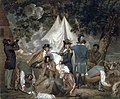 Founding of the settlement of Port Jackson at Botany Bay in New South Wales in 1788, by Thomas Gosse (1799) (from History of New South Wales)
 A 630 lb gold specimen from Hill End, unearthed in 1872 (from History of New South Wales)
 Olympic colours on the Sydney Harbour Bridge in the year 2000 (from History of New South Wales)
 Early expeditions of Charles Sturt (from History of New South Wales)
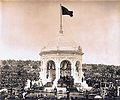 Federation Pavilion, Centennial Park, Sydney, 1 January 1901. (from History of New South Wales)
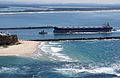 A bulk carrier entering the Port of Newcastle, New South Wales, 2009 (from Economy of New South Wales)


.jpg)


.jpg)


.jpg)


 Commons
 Wikidata
 Wikiquote
 Wikisource
 Wikiversity
 Wikivoyage
 Wiktionary


