Portal:Minerals
Wikipedia portal for content related to Minerals
From Wikipedia, the free encyclopedia

The Minerals Portal

In geology and mineralogy, a mineral or mineral species is, broadly speaking, a solid substance with a fairly well-defined chemical composition and a specific crystal structure that occurs naturally in pure form.
The geological definition of mineral normally excludes compounds that occur only in living organisms. However, some minerals are often biogenic (such as calcite) or chemically organic compounds (such as mellite). Moreover, living organisms often synthesize inorganic minerals (such as hydroxylapatite) that also occur in rocks.
The concept of mineral is distinct from rock, which is any bulk solid geologic material that is relatively homogeneous at a large enough scale. A rock may consist of one type of mineral or may be an aggregate of two or more different types of minerals, spacially segregated into distinct phases.
Some natural solid substances without a definite crystalline structure, such as opal or obsidian, are more properly called mineraloids. If a chemical compound occurs naturally with different crystal structures, each structure is considered a different mineral species. Thus, for example, quartz and stishovite are two different minerals consisting of the same compound, silicon dioxide. (Full article...)
Mineralogy is a subject of geology specializing in the scientific study of the chemistry, crystal structure, and physical (including optical) properties of minerals and mineralized artifacts. Specific studies within mineralogy include the processes of mineral origin and formation, classification of minerals, their geographical distribution, and their utilization. (Full article...)
Selected articles

Andesite (/ˈændəzaɪt/) is a volcanic rock of intermediate composition. In a general sense, it is the intermediate type between silica-poor basalt and silica-rich rhyolite. It is fine-grained (aphanitic) to porphyritic in texture, and is composed predominantly of sodium-rich plagioclase plus pyroxene or hornblende.
Andesite is the extrusive equivalent of plutonic diorite. Characteristic of subduction zones, andesite represents the dominant rock type in island arcs. The average composition of the continental crust is andesitic. Along with basalts, andesites are a component of the Martian crust.
The name andesite is derived from the Andes mountain range, where this rock type is found in abundance. It was first applied by Christian Leopold von Buch in 1826. (Full article...)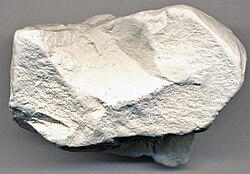
Kaolinite (/ˈkeɪ.ələˌnaɪt, -lɪ-/ KAY-ə-lə-nyte, -lih-; also called kaolin) is a clay mineral, with the chemical composition Al2Si2O5(OH)4. It is a layered silicate mineral, with one "tetrahedral" sheet of silicate tetrahedra (SiO4) linked to one "octahedral" sheet of aluminate octahedrons (AlO2(OH)4) through oxygen atoms on one side, and another such sheet through hydrogen bonds on the other side.
Kaolinite is a soft, earthy, usually white, mineral (dioctahedral phyllosilicate clay), produced by the chemical weathering of aluminium silicate minerals like feldspar. It has a low shrink–swell capacity and a low cation-exchange capacity (1–15 meq/100 g).
Rocks that are rich in kaolinite, and halloysite, are known as kaolin (/ˈkeɪ.əlɪn/) or china clay. In many parts of the world kaolin is colored pink-orange-red by iron oxide, giving it a distinct rust hue. Lower concentrations of iron oxide yield the white, yellow, or light orange colors of kaolin. Alternating lighter and darker layers are sometimes found, as at Providence Canyon State Park in Georgia, United States.
Kaolin is an important raw material in many industries and applications. Commercial grades of kaolin are supplied and transported as powder, lumps, semi-dried noodle or slurry. Global production of kaolin in 2021 was estimated to be 45 million tonnes, with a total market value of US $4.24 billion. (Full article...)
Hematite (/ˈhiːməˌtaɪt, ˈhɛmə-/), also spelled as haematite, is a common iron oxide compound with the formula Fe2O3 and is widely found in rocks and soils. Hematite crystals belong to the rhombohedral lattice system which is designated the alpha polymorph of Fe
2O
3. It has the same crystal structure as corundum (Al
2O
3) and ilmenite (FeTiO
3). With this crystal structure geometry it forms a complete solid solution at temperatures above 950 °C (1,740 °F).
Hematite occurs naturally in black to steel or silver-gray, brown to reddish-brown, or red colors. It is mined as an important ore mineral of iron. It is electrically conductive. Hematite varieties include kidney ore, martite (pseudomorphs after magnetite), iron rose and specularite (specular hematite). While these forms vary, they all have a rust-red streak. Hematite is not only harder than pure iron, but also much more brittle. The term kidney ore may be broadly used to describe botryoidal, mammillary, or reniform hematite. Maghemite is a polymorph of hematite (γ-Fe
2O
3) with the same chemical formula, but with a spinel structure like magnetite.
Large deposits of hematite are found in banded iron formations. Gray hematite is typically found in places that have still, standing water, or mineral hot springs, such as those in Yellowstone National Park in North America. The mineral may precipitate in the water and collect in layers at the bottom of the lake, spring, or other standing water. Hematite can also occur in the absence of water, usually as the result of volcanic activity.
Clay-sized hematite crystals also may occur as a secondary mineral formed by weathering processes in soil, and along with other iron oxides or oxyhydroxides such as goethite, which is responsible for the red color of many tropical, ancient, or otherwise highly weathered soils. (Full article...)
Galena, also called lead glance, is the natural mineral form of lead(II) sulfide (PbS). It is the most important ore of lead and an important source of silver.
Galena is one of the most abundant and widely distributed sulfide minerals. It crystallizes in the cubic crystal system often showing octahedral forms. It is often associated with the minerals sphalerite, calcite and fluorite.
As a pure specimen held in the hand, under standard temperature and pressure, galena is insoluble in water and so is almost non-toxic. Handling galena under these specific conditions (such as in a museum or as part of geology instruction) poses practically no risk; however, as lead(II) sulfide is reasonably reactive in a variety of environments, it can be highly toxic if swallowed or inhaled, particularly under prolonged or repeated exposure. (Full article...)
Gypsum is a soft sulfate mineral composed of calcium sulfate dihydrate, with the chemical formula CaSO4·2H2O. It is widely mined and is used as a fertilizer and as the main constituent in many forms of plaster, drywall and blackboard or sidewalk chalk. Gypsum also crystallizes as translucent crystals of selenite. It forms as an evaporite mineral and as a hydration product of anhydrite. The Mohs scale of mineral hardness defines gypsum as hardness value 2 based on scratch hardness comparison.
Fine-grained white or lightly tinted forms of gypsum known as alabaster have been used for sculpture by many cultures including Ancient Egypt, Mesopotamia, Ancient Etruscans, Ancient Rome, the Byzantine Empire, and the Nottingham alabasters of Medieval England. (Full article...)
Apatite is a group of phosphate minerals, usually hydroxyapatite, fluorapatite and chlorapatite, with high concentrations of OH−, F− and Cl− ion, respectively, in the crystal. The formula of the admixture of the three most common endmembers is written as Ca10(PO4)6(OH,F,Cl)2, and the crystal unit cell formulae of the individual minerals are written as Ca10(PO4)6(OH)2, Ca10(PO4)6F2 and Ca10(PO4)6Cl2.
The mineral was named apatite by the German geologist Abraham Gottlob Werner in 1786, although the specific mineral he had described was reclassified as fluorapatite in 1860 by the German mineralogist Karl Friedrich August Rammelsberg. Apatite is often mistaken for other minerals. This tendency is reflected in the mineral's name, which is derived from the Greek word ἀπατάω (apatáō), which means to deceive.
As hydroxyapatite, it forms a major part of the teeth and bones of vertebrate animals. (Full article...)
Tourmaline (/ˈtʊərməlɪn, -ˌliːn/ ⓘ TOOR-mə-lin, -leen) is a crystalline silicate mineral group in which boron is compounded with elements such as aluminium, iron, magnesium, sodium, lithium, or potassium. This gemstone comes in a wide variety of colors.
The name is derived from the Sinhalese tōramalli (ටෝරමල්ලි), which refers to the carnelian gemstones. (Full article...)
Zircon (/ˈzɜːrkɒn, -kən/) is a mineral belonging to the group of nesosilicates and is a source of the metal zirconium. Its chemical name is zirconium(IV) silicate, and its corresponding chemical formula is ZrSiO4. An empirical formula showing some of the range of substitution in zircon is (Zr1–y, REEy)(SiO4)1–x(OH)4x–y. Zircon precipitates from silicate melts and has relatively high concentrations of high field strength incompatible elements. For example, hafnium is almost always present in quantities ranging from 1 to 4%. The crystal structure of zircon is tetragonal crystal system. The natural color of zircon varies between colorless, yellow-golden, red, brown, blue, and green.
The name derives from the Persian zargun, meaning "gold-hued". This word is changed into "jargoon", a term applied to light-colored zircons. The English word "zircon" is derived from Zirkon, which is the German adaptation of this word. Yellow, orange, and red zircon is also known as "hyacinth", from the flower hyacinthus, whose name is of Ancient Greek origin. (Full article...)
Green fluorite with prominent cleavage
Cleavage, in mineralogy and materials science, is the tendency of crystalline materials to split along definite crystallographic structural planes. These planes of relative weakness are a result of the regular locations of atoms and ions in the crystal, which create smooth repeating surfaces that are visible both in the microscope and to the naked eye. If bonds in certain directions are weaker than others, the crystal will tend to split along the weakly bonded planes. These flat breaks are termed "cleavage". The classic example of cleavage is mica, which cleaves in a single direction along the basal pinacoid, making the layers seem like pages in a book. In fact, mineralogists often refer to "books of mica".
Diamond and graphite provide examples of cleavage. Each is composed solely of a single element, carbon. In diamond, each carbon atom is bonded to four others in a tetrahedral pattern with short covalent bonds. The planes of weakness (cleavage planes) in a diamond are in four directions, following the faces of the octahedron. In graphite, carbon atoms are contained in layers in a hexagonal pattern where the covalent bonds are shorter (and thus even stronger) than those of diamond. However, each layer is connected to the other with a longer and much weaker van der Waals bond. This gives graphite a single direction of cleavage, parallel to the basal pinacoid. So weak is this bond that it is broken with little force, giving graphite a slippery feel as layers shear apart. As a result, graphite makes an excellent dry lubricant.
While all single crystals will show some tendency to split along atomic planes in their crystal structure, if the differences between one direction or another are not large enough, the mineral will not display cleavage. Corundum, for example, displays no cleavage. (Full article...)
Graphite (/ˈɡræfaɪt/) is a crystalline allotrope (form) of the element carbon. It consists of many stacked layers of graphene, typically in excess of hundreds of layers. Graphite occurs naturally and is the most stable form of carbon under standard conditions. Synthetic and natural graphite are consumed on a large scale (1.3 million metric tons per year in 2022) for uses in many critical industries including refractories (50%), lithium-ion batteries (18%), foundries (10%), and lubricants (5%), among others (17%). Graphite converts to diamond under extremely high pressure and temperature. Graphite's low cost, thermal and chemical inertness and characteristic conductivity of heat and electricity finds numerous applications in high energy and high temperature processes. (Full article...)
Amethyst is a violet variety of quartz. Ancient Greeks wore amethyst and carved drinking vessels from it in the belief that it would prevent intoxication. Amethyst, a semiprecious stone, is often used in jewelry. It occurs mostly in association with calcite, quartz, smoky quartz, hematite, pyrite, fluorite, goethite, agate, and chalcedony. (Full article...)
Fluorite (also called fluorspar) is the mineral form of calcium fluoride, CaF2. It belongs to the halide minerals. It crystallizes in isometric cubic habit, although octahedral and more complex isometric forms are not uncommon.
The Mohs scale of mineral hardness, based on scratch hardness comparison, defines value 4 as fluorite.
Pure fluorite is colourless and transparent, both in visible and ultraviolet light, but impurities usually make it a colorful mineral and the stone has ornamental and lapidary uses. Industrially, fluorite is used as a flux for smelting, and in the production of certain glasses and enamels. The purest grades of fluorite are a source of fluoride for hydrofluoric acid manufacture, which is the intermediate source of most fluorine-containing fine chemicals. Optically clear transparent fluorite has anomalous partial dispersion, that is, its refractive index varies with the wavelength of light in a manner that differs from that of commonly used glasses, so fluorite is useful in making apochromatic lenses, and particularly valuable in photographic optics. Fluorite optics are also usable in the far-ultraviolet and mid-infrared ranges, where conventional glasses are too opaque for use. Fluorite also has low dispersion, and a high refractive index for its density. (Full article...)
Dolomite (/ˈdɒl.əˌmaɪt, ˈdoʊ.lə-/) is an anhydrous carbonate mineral composed of calcium magnesium carbonate, ideally CaMg(CO3)2. The term is also used for a sedimentary carbonate rock composed mostly of the mineral dolomite (see Dolomite (rock)). An alternative name sometimes used for the dolomitic rock type is dolostone. (Full article...)
Frameworks of LTA-type (left) and FAU-type zeolites (right)
Zeolites are a group of several microporous, crystalline aluminosilicate minerals commonly used as commercial adsorbents and catalysts. They mainly consist of silicon, aluminium, and oxygen, and have the general formula Mn+
1/n(AlO
2)−
(SiO
2)
x・yH
2O where Mn+
1/n is either a metal ion or H+.
The term was originally coined in 1756 by Swedish mineralogist Axel Fredrik Cronstedt, who observed that rapidly heating a material, believed to have been stilbite, produced large amounts of steam from water that had been adsorbed by the material. Based on this, he called the material zeolith (changed later to zeolite in English, to fit the naming scheme for minerals in -ite) from the Greek ζέω (zéō), meaning "to boil" and λίθος (líthos), meaning "stone". (Full article...)
Sapphire is a precious gemstone, a variety of the mineral corundum, consisting of aluminium oxide (α-Al2O3) with trace amounts of elements such as iron, titanium, cobalt, lead, chromium, vanadium, magnesium, boron, and silicon. The name sapphire is derived from the Latin word sapphirus, itself from the Greek word sappheiros (σάπφειρος, itself from a Semitic origin), which referred to lapis lazuli. Sapphire with colors other than its typical blue is referred to as "fancy sapphire", and can be in yellow, purple, orange, and green colors; "parti sapphires" show two or more colors. Red corundum stones also occur, but are called rubies rather than sapphires. Pink-colored corundum may be classified either as ruby or sapphire depending on the locale. Commonly, natural sapphires are cut and polished into gemstones and worn in jewelry. They also may be created synthetically in laboratories for industrial or decorative purposes in large crystal boules. It occurs in association with ruby, zircon, biotite, muscovite, calcite, dravite and quartz.
Sapphire has a remarkable hardness, with a score of 9 on the Mohs scale, the third-hardest mineral after diamond at 10 and moissanite at 9.5. Non-ornamental applications include infrared optical components, high-durability windows, wristwatch crystals and movement bearings, and very thin electronic wafers, which are used as the insulating substrates of special-purpose solid-state electronics such as integrated circuits and GaN-based blue LEDs. (Full article...)
Halite (/ˈhælaɪt, ˈheɪlaɪt/ HAL-yte, HAY-lyte), commonly known as rock salt, is a type of salt, the mineral (natural) form of sodium chloride (NaCl). Halite forms isometric crystals. The mineral is typically colorless or white, but may also be light blue, dark blue, purple, pink, red, orange, yellow or gray depending on inclusion of other materials, impurities, and structural or isotopic abnormalities in the crystals. It commonly occurs with other evaporite deposit minerals such as several of the sulfates, halides, and borates. The name halite is derived from the Ancient Greek word for "salt", ἅλς (háls). (Full article...)
Magnetite is a mineral and one of the main iron ores, with the chemical formula Fe2+Fe3+2O4. It is one of the oxides of iron, and is ferrimagnetic; it is attracted to a magnet and can be magnetized to become a permanent magnet itself. With the exception of extremely rare native iron deposits, it is the most magnetic of all the naturally occurring minerals on Earth. Naturally magnetized pieces of magnetite, called lodestone, will attract small pieces of iron, which is how ancient peoples first discovered the property of magnetism.
Magnetite is black or brownish-black with a metallic luster, has a Mohs hardness of 5–6 and leaves a black streak. Small grains of magnetite are very common in igneous and metamorphic rocks.
The chemical IUPAC name is iron(II,III) oxide and the common chemical name is ferrous-ferric oxide. (Full article...)
The diamond crystal structure belongs to the face-centered cubic lattice, with a repeated two-atom pattern.
In crystallography, a crystal system is a set of point groups (a group of geometric symmetries with at least one fixed point). A lattice system is a set of Bravais lattices (an infinite array of discrete points). Space groups (symmetry groups of a configuration in space) are classified into crystal systems according to their point groups, and into lattice systems according to their Bravais lattices. Crystal systems that have space groups assigned to a common lattice system are combined into a crystal family.
The seven crystal systems are triclinic, monoclinic, orthorhombic, tetragonal, trigonal, hexagonal, and cubic. Informally, two crystals are in the same crystal system if they have similar symmetries (though there are many exceptions). (Full article...)
Quartz is a hard mineral composed of silica (silicon dioxide). Its atoms are linked in a continuous framework of SiO4 silicon–oxygen tetrahedra, with each oxygen atom being shared between two tetrahedra, giving an overall chemical formula of SiO2. Therefore, quartz is classified structurally as a framework silicate mineral and compositionally as an oxide mineral. Quartz is the second most common mineral or mineral group in Earth's lithosphere, comprising about 12% by mass.
Quartz exists in two forms, the normal α-quartz and the high-temperature β-quartz, both of which are chiral. The transformation from α-quartz to β-quartz takes place abruptly at 573 °C (846 K; 1,063 °F). Since the transformation is accompanied by a significant change in volume, it can easily induce microfracturing of ceramics or rocks passing through this temperature threshold.
There are many different varieties of quartz, several of which are classified as gemstones. Since antiquity, varieties of quartz have been the most commonly used minerals in the making of jewelry and hardstone carvings, especially in Europe and Asia.
Quartz is the mineral defining the value of 7 on the Mohs scale of hardness, a qualitative scratch method for determining the hardness of a material. (Full article...)
A crystalline solid: atomic resolution image of strontium titanate. Brighter spots are columns of strontium atoms and darker ones are titanium-oxygen columns.
Crystallography is the branch of science devoted to the study of molecular and crystalline structure and properties. The word crystallography is derived from the Ancient Greek word κρύσταλλος (krústallos; "clear ice, rock-crystal"), and γράφειν (gráphein; "to write"). In July 2012, the United Nations recognised the importance of the science of crystallography by proclaiming 2014 the International Year of Crystallography.
Crystallography is a broad topic, and many of its subareas, such as X-ray crystallography, are themselves important scientific topics. Crystallography ranges from the fundamentals of crystal structure to the mathematics of crystal geometry, including those that are not periodic or quasicrystals. At the atomic scale it can involve the use of X-ray diffraction to produce experimental data that the tools of X-ray crystallography can convert into detailed positions of atoms, and sometimes electron density. At larger scales it includes experimental tools such as orientational imaging to examine the relative orientations at the grain boundary in materials. Crystallography plays a key role in many areas of biology, chemistry, and physics, as well as in emerging developments in these fields. (Full article...)
Mineralogy applies principles of chemistry, geology, physics and materials science to the study of minerals
Mineralogy is a subject of geology specializing in the scientific study of the chemistry, crystal structure, and physical (including optical) properties of minerals and mineralized artifacts. Specific studies within mineralogy include the processes of mineral origin and formation, classification of minerals, their geographical distribution, and their utilization. (Full article...)
Malachite (/ˈmæl.əˌkaɪt/) is a copper carbonate hydroxide mineral, with the formula Cu2CO3(OH)2. This opaque, green-banded mineral crystallizes in the monoclinic crystal system, and most often forms botryoidal, fibrous, or stalagmitic masses, in fractures and deep, underground spaces, where the water table and hydrothermal fluids provide the means for chemical precipitation. Individual crystals are rare, but occur as slender to acicular prisms. Pseudomorphs after more tabular or blocky azurite crystals also occur. (Full article...)
Beryl (/ˈbɛrəl/ BERR-əl) is a mineral composed of beryllium aluminium silicate with the chemical formula Be3Al2(SiO3)6. Well-known varieties of beryl include emerald and aquamarine. Naturally occurring hexagonal crystals of beryl can be up to several meters in size, but terminated crystals are relatively rare. Pure beryl is colorless, but it is frequently tinted by impurities; possible colors are green, blue, yellow, pink, and red (the rarest). It is an ore source of beryllium. (Full article...)
Chalcopyrite (/ˌkælkəˈpaɪˌraɪt, -koʊ-/ KAL-kə-PY-ryte, -koh-) is a copper iron sulfide mineral and the most abundant copper ore mineral. It has the chemical formula CuFeS2 and crystallizes in the tetragonal system. It has a brassy to golden yellow color and a hardness of 3.5 to 4 on the Mohs scale. Its streak is diagnostic as green-tinged black.
On exposure to air, chalcopyrite tarnishes to a variety of oxides, hydroxides, and sulfates. Associated copper minerals include the sulfides bornite (Cu5FeS4), chalcocite (Cu2S), covellite (CuS), digenite (Cu9S5); carbonates such as malachite and azurite, and rarely oxides such as cuprite (Cu2O). It is rarely found in association with native copper. Chalcopyrite is a conductor of electricity.
Copper can be extracted from chalcopyrite ore using various methods. The two predominant methods are pyrometallurgy and hydrometallurgy, the former being the most commercially viable. (Full article...)
Opal is a hydrated amorphous form of silica (SiO2·nH2O); its water content may range from 3% to 21% by weight, but is usually between 6% and 10%. Due to the amorphous (chemical) physical structure, it is classified as a mineraloid, unlike crystalline forms of silica, which are considered minerals. It is deposited at a relatively low temperature and may occur in the fissures of almost any kind of rock, being most commonly found with limonite, sandstone, rhyolite, marl, and basalt.
The name opal is believed to be derived from the Sanskrit word upala (उपल), which means 'jewel', and later the Greek derivative opállios (ὀπάλλιος).
There are two broad classes of opal: precious and common. Precious opal displays play-of-color (iridescence); common opal does not. Play-of-color is defined as "a pseudo chromatic optical effect resulting in flashes of colored light from certain minerals, as they are turned in white light." The internal structure of precious opal causes it to diffract light, resulting in play-of-color. Depending on the conditions in which it formed, opal may be transparent, translucent, or opaque, and the background color may be white, black, or nearly any color of the visual spectrum. Black opal is considered the rarest, while white, gray, and green opals are the most common. (Full article...)


.jpg)


_-_Kopalnia_soli_Wieliczka,_Polska.jpg)


Selected mineralogist

Teachers of the Forestry Academy in Eberswalde (ca. 1868); Adolf Remelé, 3rd figure from the right (standing).
Adolf Karl Remelé (17 July 1839, Uerdingen – 16 November 1915, Eberswalde) was a German geologist and mineralogist.
He received his education at the University of Bonn, at the École des Mines in Paris and from the University of Berlin, receiving his doctorate in 1864 with the dissertation "De rubro uranico". In 1867 he qualified as a lecturer at Berlin, and during the following year, succeeded Lothar Meyer at the Forestry Academy in Eberswalde, where he taught classes in chemistry, geognosy and mineralogy. (Full article...)
Gerardus Troost (March 5, 1776 – August 14, 1850) was a Dutch-American medical doctor, naturalist, mineralogist, and founding member and first president of the Philadelphia Academy of Natural Sciences. (Full article...)- W. Gary Ernst (born December 14, 1931) is an American geologist specializing in petrology and geochemistry. He currently is the Benjamin M. Page Professor Emeritus in Stanford University's department of geological sciences. (Full article...)
Johann Friedrich August Breithaupt (May 16, 1791 – September 22, 1873) was a German mineralogist and professor at Freiberg Mining Academy in Freiberg, Saxony. (Full article...)- Stanley Hay Umphray Bowie FRS (born 24 March 1917, in Bixter, Shetland - died 3 September 2008) was a Scottish geologist. He was considered a "world authority on uranium geology and a leader in the field of geochemistry and mineralogy". He developed methods and tools to identify opaque minerals using micro-indentation hardness and optical reflectance. He worked for the British Geological Survey between 1946 and 1977. The mineral bowieite was so named in recognition of his work on identification of opaque minerals. (Full article...)

Image of Otto Erdmannsdörffer
Otto Heinrich Erdmannsdörffer (11 March 1876, Heidelberg – 19 April 1955, Heidelberg) was a German mineralogist and petrographer, known for his analysis of rocks and minerals found in the Odenwald, the Black Forest and the Harz Mountains. He was the son of historian Bernhard Erdmannsdörffer.
He studied natural sciences at the universities of Heidelberg and Strasbourg, receiving his doctorate in 1900. For the next twelve years he worked as a research assistant at the Prussian Geological Survey, and in the meantime, obtained his habilitation in mineralogy and petrology from the University of Berlin (1908). In 1912 he was appointed chair of mineralogy and petrology at the Technical University of Hannover, and in 1926 returned to Heidelberg, where he succeeded Ernst Anton Wülfing as director of the mineralogical-petrographic institute. In 1932 he was named academic rector at Heidelberg. (Full article...)- Waldemar Theodore Schaller (August 3, 1882 – September 28, 1967) was an American mineralogist and longtime employee of the United States Geological Survey (USGS). (Full article...)
- Joseph (Joe) Anthony Mandarino, FRSC (20 April 1929 in Chicago, Illinois – 19 September 2007) was an American-Canadian mineralogist and crystallographer. (Full article...)
- William James Lewis F.R.S. (10 January 1847 – 16 April 1926) was a Welsh mineralogist. (Full article...)
- Matthew Forster Heddle FRSE (28 April 1828 – 19 November 1897) was a Scottish physician and amateur mineralogist active through the 19th century. (Full article...)
Sten Anders Hjalmar Sjögren (13 June 1856, Färnebo, Värmland – 23 March 1922, Stockholm) was a Swedish geologist and mineralogist. (Full article...)
Eugen Geinitz
Franz Eugen Geinitz (15 February 1854, Dresden – 9 March 1925, Rostock) was a German geologist and mineralogist best known for his geological studies of the Mecklenburg region. He was the son of geologist Hanns Bruno Geinitz. (Full article...)
Vasily Mikhailovich Severgin (Russian: Василий Михайлович Севергин; 19 September 1765 – 29 November 1826) was a Russian academician, chemist, mineralogist, and geologist. For three decades, he was the only academician elected to the Geological Society of London. He has been described as being among the most influential pioneers of geology in Russia. (Full article...)- Johannes Otto Conrad Mügge (4 March 1858, Hannover – 9 June 1932, Göttingen) was a German mineralogist and crystallographer.
From 1875 to 1879 he studied mathematics and sciences at the Technical University of Hannover and at the University of Göttingen. After graduation, he spent three years as an assistant to Harry Rosenbusch at the mineralogical-geological institute of the University of Heidelberg. From 1882 he worked as curator of the mineralogical and geological department at the Natural History Museum in Hamburg, and in 1886 became an associate professor at the academy in Münster. Later on, he served as a full professor at the University of Königsberg, where in 1903/04 he was named dean to the faculty of philosophy. In 1908 he relocated as a professor to the University of Göttingen. (Full article...)
Nikolay Vasilyevich Belov (Russian: Никола́й Васи́льевич Бело́в; December 14, 1891 – March 6, 1982) was a Soviet and Russian crystallographer, geochemist, academician (1953), and Hero of Socialist Labour (1969).
Belov worked primarily in the fields of mineralogy (particularly silicates), determination of crystal structures using X-ray crystallography, and the theory of symmetry, specifically dichromatic, and polychromatic symmetry, a field which Belov founded. (Full article...)
James Tennant (8 February 1808 – 23 February 1881) was an English mineralogist, the master of the Worshipful Company of Turners and mineralogist to Queen Victoria. (Full article...)
Philip Rashleigh FRS FSA (28 December 1729 – 26 June 1811) of Menabilly, Cornwall, was an antiquary and Fellow of the Royal Society and a Cornish squire. He collected and published the Trewhiddle Hoard of Anglo-Saxon treasure, which still gives its name to the "Trewhiddle style" of 9th century decoration. (Full article...)
Giuseppe Giovanni Antonio Meneghini (30 July 1811, Padua – 29 January 1889, Pisa) was an Italian botanist, geologist and paleontologist. (Full article...)
Li Shizhen (3 July 1518 – 1593), courtesy name Dongbi, was a Chinese acupuncturist, herbalist, naturalist, pharmacologist, physician, and writer of the Ming dynasty. He is the author of a 27-year work, the Compendium of Materia Medica (Bencao Gangmu; Chinese: 本草綱目). He developed several methods for classifying herb components and medications for treating diseases.
The Compendium is a pharmacology text with 1,892 entries, with details about more than 1,800 traditional Chinese medicines, including 1,100 illustrations and 11,000 prescriptions. It also described the type, form, flavor, nature and application in disease treatments of 1,094 herbs. The book has been translated into several languages. The treatise included various related subjects such as botany, zoology, mineralogy, and metallurgy. Five original editions still exist. (Full article...)- József Sándor Krenner or Joseph Krenner (3 March 1839 – 6 January 1920) was a Hungarian mineralogist. He discovered several new minerals.
Krenner was born in Buda and studied at the University of Pest, Vienna and Tübingen mineralogy and geology. He received his Ph.D. in 1865 for work with Friedrich August Quenstedt in Tübingen. Krenner worked in the mineralogy section of the Hungarian National Museum. From 1870 on he also lectured at the Technical University of Budapest. In 1888 he became a member of the Hungarian Academy of Science.
Krenner discovered several new minerals, for example, Krennerite which he discovered in 1877 in Sacaramb, Romania. The mineral is obviously named after himself. Another mineral he discovered was Semseyite, the lead antimony sulfide discovered in 1881 was named after Andor Semsey (1833–1923), a Hungarian nobleman and mineralogist. He also discovered and described kornelite (1888), szomolnokite (1891) and rhomboclase (1891), all hydrated iron sulfates from Szomolnok (present-day Smolník, Slovakia). (Full article...) 
George Robert Rossman (August 3, 1944 – February 6, 2026) was an American mineralogist and academic who was the Professor of Mineralogy at the California Institute of Technology. (Full article...)
Hartvig Caspar Christie in 1873
Hartvig Caspar Christie (1 December 1826 – 3 March 1873) was a Norwegian mineralogist and physicist. (Full article...)
Nils Adolf Erik Nordenskiöld (; 18 November 1832 – 12 August 1901) was a Finland-Swedish aristocrat, geologist, mineralogist and Arctic explorer. He was a member of the noble Nordenskiöld family of scientists and held the title of a friherre (baron).
Born in the Grand Duchy of Finland in the Russian Empire, he was forced to move to Sweden in 1857 due to his political activity, where he became a member of the Parliament of Sweden and of the Swedish Academy. He led the Vega Expedition along the northern coast of Eurasia in 1878–1879. This was the first complete crossing of the Northeast Passage. Initially a troubled enterprise, the successful expedition is considered to be among the highest achievements in the history of Swedish science. (Full article...)
Alexander Rose, FRSA: a portrait published in Transactions of the Edinburgh Geological Society Vol. XIII, 1934 for EGS’s centenary celebrations
Alexander Rose (1781 – 1860) of Edinburgh was a wood and ivory turner, following in the footsteps of his father, John, who came from Cromarty. He developed an interest in minerals and began a mineral collection, becoming a dealer in minerals. He later became a lecturer in geology and mineralogy at Queen's College, Edinburgh and was eventually nominated as a Fellow of the Royal Scottish Academy.He was educated at the Royal High School and in 1816, he married Isabella Boyne. They had three sons and six daughters. (Full article...)
Niels Steensen (Danish: Niels Steensen; Latinized to Nicolas Steno or Nicolaus Stenonius; 1 January 1638 – 25 November 1686 [NS: 11 January 1638 – 5 December 1686]) was a Danish scientist, a pioneer in both anatomy and geology who became a Catholic bishop in his later years. He has been beatified by the Catholic Church.
Steensen was trained in the classical texts on science; however, by 1659, he seriously questioned accepted knowledge of the natural world. Importantly he questioned explanations for tear production, the idea that fossils grew in the ground and explanations of rock formation. His investigations and his subsequent conclusions on fossils and rock formation have led scholars to consider him one of the founders of modern stratigraphy and modern geology. The importance of Steensen's foundational contributions to geology may be gauged from the fact that half of the twenty papers in a 2009 miscellany volume on The Revolution in Geology from the Renaissance to the Enlightenment focus on Steensen, the "preeminent Baroque polymath and founder of modern geologic thought". (Full article...)


.jpg)


_p311_Adolf_Erik_Nordenskiöld.jpg)


Related portals


Did you know...
- ... that nine days after his heart transplant, J. C. Walter Jr. merged his company Houston Oil & Minerals with Tenneco, then retired to his ranch and shortly after founded Walter Oil & Gas?
Get involved
For editor resources and to collaborate with other editors on improving Wikipedia's Minerals-related articles, see WikiProject Rocks and minerals.
General images
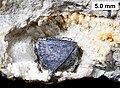 Sphalerite crystal partially encased in calcite from the Devonian Milwaukee Formation of Wisconsin (from Mineral)
 Mohs hardness kit, containing one specimen of each mineral on the ten-point hardness scale (from Mohs scale)
 Epidote often has a distinctive pistachio-green colour. (from Mineral)
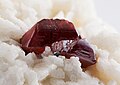 Red cinnabar (HgS), a mercury ore, on dolomite. (from Mineral)
 Mohs scale along the horizontal axis matched with the absolute hardness of each of the Mohs reference-minerals along the vertical; notice that the vertical scale is logarithmic. (from Mohs scale)
 Muscovite, a mineral species in the mica group, within the phyllosilicate subclass (from Mineral)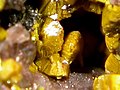

 Gypsum desert rose (from Mineral)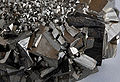
 Schist is a metamorphic rock characterized by an abundance of platy minerals. In this example, the rock has prominent sillimanite porphyroblasts as large as 3 cm (1.2 in). (from Mineral)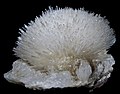

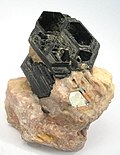 Perfect basal cleavage as seen in biotite (black), and good cleavage seen in the matrix (pink orthoclase). (from Mineral)
 Native gold. Rare specimen of stout crystals growing off of a central stalk, size 3.7 x 1.1 x 0.4 cm, from Venezuela. (from Mineral)
 Mohs Scale versus Absolute Hardness (from Mineral)
 Black andradite, an end-member of the orthosilicate garnet group. (from Mineral)
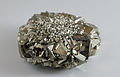 Pyrite (from Lustre (mineralogy))
 Hübnerite, the manganese-rich end-member of the wolframite series, with minor quartz in the background (from Mineral)
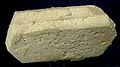 When minerals react, the products will sometimes assume the shape of the reagent; the product mineral is termed a pseudomorph of (or after) the reagent. Illustrated here is a pseudomorph of kaolinite after orthoclase. Here, the pseudomorph preserved the Carlsbad twinning common in orthoclase. (from Mineral)
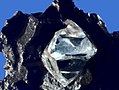 Diamond is the hardest natural material, and has a Mohs hardness of 10. (from Mineral)
 An example of elbaite, a species of tourmaline, with distinctive colour banding. (from Mineral)
 Pink cubic halite (NaCl; halide class) crystals on a nahcolite matrix (NaHCO3; a carbonate, and mineral form of sodium bicarbonate, used as baking soda). (from Mineral)


Did you know ...?

- ... that while manganese-bearing vesuvianite has been studied since 1883, manganvesuvianite (pictured) was not described until 2002?
- ... that the mineral rapidcreekite was discovered in Yukon, Canada, in 1983?
- ... that collinsite was discovered in British Columbia and named for the director of the Geological Survey of Canada?
Subcategories

- Select [►] to view subcategories
Associated Wikimedia
The following Wikimedia Foundation sister projects provide more on this subject:
-
 Commons
Free media repository -
 Wikidata
Free knowledge base -
 Wikiquote
Collection of quotations -
 Wikisource
Free-content library -
 Wikiversity
Free learning tools -
 Wiktionary
Dictionary and thesaurus


References


