Portal:Myths
Wikipedia portal for content related to Myths
From Wikipedia, the free encyclopedia

The Myths Portal


Myth is a genre of folklore consisting primarily of narratives that play a fundamental role in a society. For scholars, this is totally different from the ordinary sense of the term myth, meaning a belief that is not true, as the veracity of a piece of folklore is entirely irrelevant to determining whether it constitutes a myth.
Myths are often endorsed by religious and secular authorities, and may be natural or supernatural in character. Many societies group their myths, legends, and history together, considering myths and legends to be factual accounts of their remote past. In particular, creation myths take place in a primordial age when the world had not achieved its later form. Origin myths explain how a society's customs, institutions, and taboos were established and sanctified. National myths are narratives about a nation's past that symbolize the nation's values. There is a complex relationship between recital of myths and the enactment of rituals. (Full article...)
Selected article -

According to Tacitus's Germania (AD 98), Tuisto (or Tuisco) is the legendary divine ancestor of the Germanic peoples. The figure remains the subject of some scholarly discussion, largely focused upon etymological connections and comparisons to figures in later (particularly Norse) Germanic mythology. (Full article...)
Did you know? -
- ... that the demon Maha Sohona, whose head has been replaced with that of a bear, haunts graveyards and feasts on human flesh?

- ...that the Two Ladies was a euphemism used for the Ancient Egyptian deities Wadjet and Nekhbet, represented on the royal crowns of the merged Upper and Lower Egypt as a cobra and a vulture, respectively?
- ... that human sacrifices to the K'iche' Maya patron deity Tohil had their severed heads placed on a rack in front of the temple?
- ...that according to Greek mythology, Adonis was slain by a boar at the foot of the waterfall in Apheca in modern-day Lebanon?
Recognised content
Featured Articles:
 Ahalya, Ancient Egyptian literature, King Arthur, Ganesha, Iravan, Orion (mythology), Vampire, Vithoba
Featured Lists:
List of valkyrie names in Norse mythology
Good Articles:
 2012 phenomenon,
Æsir–Vanir War,
Ala (demon),
Anu,
Aphrodite,
Athena,
Ardhanarishvara,
Battle of Barry,
Bhikshatana,
Catalogue of Women,
Chamunda,
Chhinnamasta,
Consorts of Ganesha,
Cú Chulainn,
Dhumavati,
Dumuzid,
Einherjar,
Eir,
Enlil,
Fairy Flag,
Fenrir,
Gerðr,
Hel (being),
Huginn and Muninn,
Iðunn,
Ila (Hinduism),
Inanna,
Kabandha,
Kali,
Kamadhenu,
Kangiten,
Keshi (demon),
Khandoba,
Kratos (mythology)
Krishna,
Kubera,
LGBT themes in Hindu mythology,
Manasa,
Mandodari,
Matangi,
Matrikas,
Maya Sita,
Mohini,
Myrrha,
Mythology of Carnivàle,
Naraka (Hinduism),
Ninurta,
Prester John,
Prithu,
Putana,
Rati,
Ratatoskr,
Revanta,
Satyavati,
Satyr,
Sharabha,
Shashthi,
Shiva,
Sif,
Tara (Ramayana),
Troilus,
Tuisto,
Valhalla,
Valkyrie,
Vampire folklore by region,
Varaha,
Varahi,
Veðrfölnir and eagle
Zduhać
2012 phenomenon,
Æsir–Vanir War,
Ala (demon),
Anu,
Aphrodite,
Athena,
Ardhanarishvara,
Battle of Barry,
Bhikshatana,
Catalogue of Women,
Chamunda,
Chhinnamasta,
Consorts of Ganesha,
Cú Chulainn,
Dhumavati,
Dumuzid,
Einherjar,
Eir,
Enlil,
Fairy Flag,
Fenrir,
Gerðr,
Hel (being),
Huginn and Muninn,
Iðunn,
Ila (Hinduism),
Inanna,
Kabandha,
Kali,
Kamadhenu,
Kangiten,
Keshi (demon),
Khandoba,
Kratos (mythology)
Krishna,
Kubera,
LGBT themes in Hindu mythology,
Manasa,
Mandodari,
Matangi,
Matrikas,
Maya Sita,
Mohini,
Myrrha,
Mythology of Carnivàle,
Naraka (Hinduism),
Ninurta,
Prester John,
Prithu,
Putana,
Rati,
Ratatoskr,
Revanta,
Satyavati,
Satyr,
Sharabha,
Shashthi,
Shiva,
Sif,
Tara (Ramayana),
Troilus,
Tuisto,
Valhalla,
Valkyrie,
Vampire folklore by region,
Varaha,
Varahi,
Veðrfölnir and eagle
Zduhać
Wikiversity
Selected creature -

The stoor worm, or Mester Stoor Worm, was a gigantic evil sea serpent of Orcadian folklore, capable of contaminating plants and destroying animals and humans with its putrid breath. It is probably an Orkney variant of the Norse Jörmungandr, also known as the Midgard Serpent, or world serpent, and has been described as a sea dragon.
The king of one country threatened by the beast's arrival was advised to offer it a weekly sacrifice of seven virgins. In desperation, the king eventually issued a proclamation offering his kingdom, his daughter's hand in marriage, and a magic sword to anyone who could destroy the monster. Assipattle, the youngest son of a local farmer, defeated the creature; as it died its teeth fell out to become the islands of Orkney, Shetland and the Faroes, and its body became Iceland. (Full article...)
General images
 Edith Hamilton's Mythology has been a major channel for English speakers to learn classical Greek and Roman mythology (from Myth)
 "The Fall of Man" by Lucas Cranach the Elder and the Tree of Knowledge is on the right (from List of mythological objects)
 Ancient Sumerian cylinder seal impression showing the god Dumuzid being tortured in the Underworld by galla demons (from Comparative mythology)
 The Deluge, frontispiece to Gustave Doré's illustrated edition of the Bible. Based on the story of Noah's Ark, this engraving shows humans and a tiger doomed by the flood futilely attempting to save their children and cubs. (from Comparative mythology)
 Ancient Roman relief from the Cathedral of Maria Saal showing the infant twins Romulus and Remus being suckled by a she-wolf (from Comparative mythology)
 Fountain of Youth (from List of mythological objects)
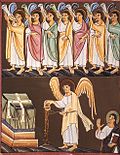 seven angels with seven trumpets (from List of mythological objects)
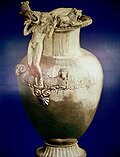 Jug from Lydian Treasure Usak (from List of mythological objects)
 The famous sword of Excalibur painted by Howard Pyle (from List of mythological objects)
 The Celestial Chariot, Pushpaka Vimana from Ramayana (from List of mythological objects)
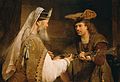 Ahimelech giving the sword of Goliath to David, by Aert de Gelder. (from List of mythological objects)
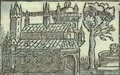 Image showing the sacred tree to the right of the temple, from Olaus Magnus' Historia de Gentibus Septentrionalibus (1555). To the right of the tree is a depiction of a man being sacrificed in the spring (from List of mythological objects)
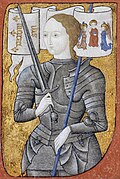 Joan of Arc with her famous sword (from List of mythological objects)
 Hand of God (from List of mythological objects)
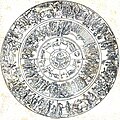 Shield of Achilles (illustration) (from List of mythological objects)
 The Flying Dutchman (from List of mythological objects)
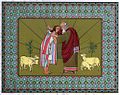 Jacob blesses Joseph and gives him the coat of many colors (from List of mythological objects)
 Golem and Loew (from List of mythological objects)
 Aura, a field of luminous radiation surrounding a person or object (from List of mythological objects)
 Dietrich von Bern and Hildebrand fight against dragons (from List of mythological objects)
 Jason returns with Golden fleece (from List of mythological objects)
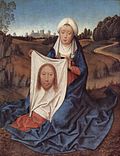 Veronica holding her veil, Hans Memling, c. 1470 (from List of mythological objects)
 Several legendary creatures from Bilderbuch für Kinder (lit. 'picture book for children') between 1790 and 1822, by Friedrich Justin Bertuch (from Legendary creature)
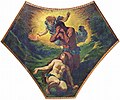 An angel (Camael) expelling Adam and Eve with a flaming sword (from List of mythological objects)
 Houyi, the God of Archery (from List of mythological objects)
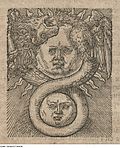 Azoth, a universal medicine or universal solvent sought in alchemy. (Medieval legend) (from List of mythological objects)
 Vishnu holding his legendary sword Nandaka (from List of mythological objects)
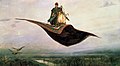 Riding a Flying Carpet, an 1880 painting by Viktor Vasnetsov (from List of mythological objects)
 Killing of Ravana Painting by Brahmstra of Arrow of Brahma (from List of mythological objects)
 Lord Vishnu took the form of Beauty Mohini and distributed the Amrita (Ambrosia, Elixir) to Devas. When Rahu (snake dragon) tried to steal the Amrita, his head was cut off (from List of mythological objects)
 Prometheus (1868) by Gustave Moreau. In the mythos of Hesiodus and possibly Aeschylus (the Greek trilogy Prometheus Bound, Prometheus Unbound and Prometheus Pyrphoros), Prometheus is bound and tortured for giving fire to humanity. (from Myth)
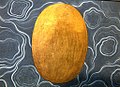 Golden cosmic egg Hiranyagarbha by Manaku (from List of mythological objects)
 Odysseus Overcome by Demodocus' Song, a mythological painting by Francesco Hayez, 1813–1815 (from Myth)
 Erlang Shen (二郎神), or Erlang is a Chinese God with his spear (from List of mythological objects)
 Vishnu with his Panchajanya (from List of mythological objects)
 Adam's Bridge also called as Rama Setu (from List of mythological objects)
 The Crown of Immortality, held by the allegorical figure Eterna (Eternity) (from List of mythological objects)
 Achilles wearing his armor (from List of mythological objects)
 Longinus with his famous Spear (from List of mythological objects)
 Hop-o'-My-Thumb stealing the Seven-league boots from the Ogre, by Gustave Doré (from List of mythological objects)
 Shiva with his Trishula (from List of mythological objects)
 Yama with his famous Yama Pasha (from List of mythological objects)
 Holy Robe in Trier (from List of mythological objects)
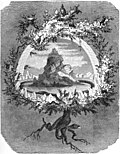 The Ash Yggdrasil by Friedrich Wilhelm Heine (from List of mythological objects)
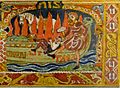 Thor kicks Litr onto Baldr's Hringhorni, illustration by Emil Doepler (ca. 1905) (from List of mythological objects)
 Perillos being forced into the brazen bull that he built for Phalaris (from List of mythological objects)

_-_Adam_and_Eve-Paradise_-_Kunsthistorisches_Museum_-_Detail_Tree_of_Knowledge.jpg)


_(14801987593).jpg)

.jpg)


.jpg)


.jpg)

.jpg)


.jpg)


.jpg)


_to_Devas._When_Rahu_(snake_dragon)_tried_to_steal_the_Amrita,_his_head_was_cut_off.jpg)


_(15949358169).jpg)


.jpg)


-late.14c.jpg)

Subcategories

WikiProjects

Things you can do
- Help with the myth and folklore missing articles project.
- Help create requested articles.
- Help assessment at Wikipedia:WikiProject Mythology/Assessment.
- Place the project banner {{WikiProject Mythology}} on the talk pages of all relevant articles.
- Check the recent changes for recent improvements, vandalism, and other changes.
- Answer requests for mythology articles needing attention: Category:Mythology articles needing attention
- Answer requests for mythology articles needing expert attention: Category:Mythology articles needing expert attention
- Expand articles tagged as mythology stubs: Category:Mythology stubs
- Assist mythology subprojects.
- Add requested photographs of mythology subjects: Category:Wikipedia requested photographs of mythology subjects
Associated Wikimedia
The following Wikimedia Foundation sister projects provide more on this subject:
-
 Commons
Free media repository -
 Wikidata
Free knowledge base -
 Wikiquote
Collection of quotations -
 Wikisource
Free-content library -
 Wikiversity
Free learning tools -
 Wiktionary
Dictionary and thesaurus


