Portal:Phoenicia
Wikimedia portal
From Wikipedia, the free encyclopedia

THE PHOENICIA PORTAL

The Phoenicians were an ancient Semitic people who inhabited city-states in Canaan along the Levantine coast of the eastern Mediterranean, primarily in present-day Lebanon. Their maritime civilization expanded and contracted over time, with its cultural core stretching from Arwad to Mount Carmel. Through trade and colonization, the Phoenicians extended their influence across the Mediterranean, from Cyprus to the Maghreb and Iberian Peninsula, leaving behind thousands of inscriptions.
The Phoenicians emerged directly from the Bronze Age Canaanites, and their cultural traditions survived the Late Bronze Age collapse, continuing into the Iron Age with little interruption. They referred to themselves as Canaanites and their land as Canaan, though the territory they occupied was smaller than that of earlier Bronze Age Canaan. The name Phoenicia is a Greek exonym that did not correspond to a unified native identity. Modern scholarship generally views the distinction between Canaanites and Phoenicians after c. 1200 BC as artificial.
Renowned for seafaring and trade, the Phoenicians established one of antiquity's most extensive maritime networks, active for over a millennium. This network facilitated exchanges among cradles of civilization such as Mesopotamia, Egypt, and Greece. They founded colonies and trading posts throughout the Mediterranean; among these, Carthage in the Mediterranean Maghreb developed into a major power by the 7th century BC.
Phoenician society was organized into independent city-states, notably Byblos, Sidon, and Tyre. Each retained political autonomy, and there is no evidence of a shared national identity. While kingship was common, powerful merchant families likely exercised influence through oligarchies. The Phoenician cities flourished most in the 9th century BC, but subsequently declined under the expansion of empires such as the Neo-Assyrian and Achaemenid. Their influence nevertheless endured in the western Mediterranean until the Roman destruction of Carthage in the mid-2nd century BC. — Read more about Phoenicia, its mythology and language
 Featured article
•
Featured article
•
A Featured article represents some of the best content on Wikipedia

The Battle of Panormus was fought in Sicily in 250 BC during the First Punic War between a Roman army led by Lucius Caecilius Metellus and a Carthaginian force led by Hasdrubal, son of Hanno. The Roman force of two Roman and two allied legions defending the city of Panormus defeated the much larger Carthaginian army of 30,000 men and between 60 and 142 war elephants.
The war had commenced in 264 BC with Carthage in control of much of Sicily, where most of the fighting took place. In 256–255 BC the Romans attempted to strike at the city of Carthage in North Africa, but suffered a heavy defeat by a Carthaginian army strong in cavalry and elephants. When the focus of the war returned to Sicily, the Romans captured the large and important city of Panormus in 254 BC. Thereafter they avoided battle for fear of the war elephants which the Carthaginians had shipped to Sicily. In late summer 250 BC Hasdrubal led out his army to devastate the crops of the cities of Rome's allies. The Romans withdrew to Panormus and Hasdrubal pressed on to the city walls. (Full article...)
Phoenician mythology •
Taautus of Byblos (Ancient Greek: Τάαυτος, Táautos), according to the Phoenician writer Sanchuniathon, was the son of Misor and the inventor of writing, who was bequeathed the land of Egypt by Cronus.
Sanchuniathon's writings, through the translation of Philo, were transmitted to us by Eusebius in his work Praeparatio evangelica. Eusebius says that Philo placed Sanchuniathon's works into nine books. In the introduction to the first book, he makes this preface concerning Sanchuniathon:
(Full article...)“These things being so, Sanchuniathon, who was a man of much learning and great curiosity, and desirous of knowing the earliest history of all nations from the creation of the world, searched out with great care the history of Taautus, knowing that of all men under the sun Taautus was the first who thought of the invention of letters, and began the writing of records: and he laid the foundation, as it were, of his history, by beginning with him, whom the Egyptians called Thouth, and the Alexandrians Thoth, translated by the Greeks into Hermes.”
Images
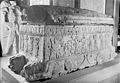 Sarcophagus of Ahiram, which bears the oldest inscription of the Phoenician alphabet. National Museum of Beirut. (from Phoenicia)
 Tomb of King Hiram I of Tyre, located in the village of Hanaouay, in southern Lebanon (from Phoenicia)
 Putative statuette of El (c. 1400–1200 BCE) from Tel Megiddo in northern Israel (from Canaanite religion)
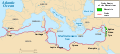 Major Phoenician trade networks (c. 1200–800 BC) (from Phoenicia)
 Reconstruction of the Young Man of Byrsa (from Punic people)
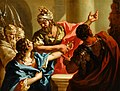 Young Hannibal Swears Enmity to Rome by Giovanni Antonio Pellegrini (1731) (from Punic people)
 Achaemenid-era coin of Abdashtart I of Sidon, who is seen at the back of the chariot, behind the Persian King (from Phoenicia)
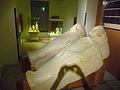 Phoenician sarcophagi found in Cádiz, Spain, thought to have been imported from the Phoenician homeland around Sidon. Archaeological Museum of Cádiz. (from Phoenicia)
 Phoenicians build pontoon bridges for Xerxes I of Persia during the second Persian invasion of Greece in 480 BC (1915 drawing by A. C. Weatherstone). (from Phoenicia)
 Female figurines from Tyre (c. 1000–550 BC). National Museum of Beirut. (from Phoenicia)
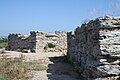
 Mortise and tenon joinery in the Mazarron 1 Phoenician shipwreck. Phoenicians pioneered the pegged mortise and tenon joinery, which came to be known as Phoenician joints (from Phoenicia)
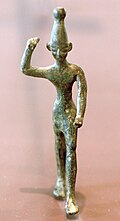 Figure of Ba'al with raised arm, 14th–12th century BC, found at ancient Ugarit (Ras Shamra site), a city at the far north of the Phoenician coast. Musée du Louvre. (from Phoenicia)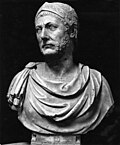
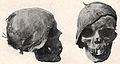 Skull of King Tabnit of Sidon (reigned c. 549 BC – c. 539 BC), now in the Istanbul Archaeology Museums (from Phoenicia)
 Map of Phoenician (yellow labels) and Greek (red labels) colonies around 8th to 6th century BC (with German legend) (from Phoenicia)
 Approximate extent of Phoenician settlements and trade routes c. 800 BC. (from Phoenicia)
 aDNA of ancient Mediterranean (incl. 30 Punic) samples clustering with contemporary populations (from Punic people)
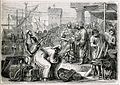 19th-century depiction of Phoenician sailors and merchants. The importance of trade to the Phoenician economy led to a gradual sharing of power between the King and assemblies of merchant families. (from Phoenicia)
 Ba'al with Thunderbolt stele from Ugarit, c. 15th century BCE (from Canaanite religion)
 Phoenician faces. Glass from Olbia, 4th century BC. The bold pools of color and detailed hair give a Greek impression. (from Phoenicia)
 Phoenician metal bowl with hunting scene (8th century BC). The clothing and hairstyle of the figures are Egyptian. At the same time, the subject matter of the central scene conforms with the Mesopotamian theme of combat between man and beast. Phoenician artisans frequently adapted the styles of neighboring cultures. (from Phoenicia)
 Ruins of the Punic and then Roman town of Tharros (from Punic people)
 Sicily at the beginning of the Peloponnesian War (from Punic people)
 Face bead; mid-4th–3rd century BC; glass; height: 2.7 cm; Metropolitan Museum of Art (from Phoenicia)
 Oinochoe; 800–700 BC; terracotta; height: 24.1 cm; Metropolitan Museum of Art (New York City, US) (from Phoenicia)
 Revadim Asherah figurine (c. 1400–1200 BCE), discovered in southern Israel (from Canaanite religion)
 A naval action during Alexander the Great's Siege of Tyre (332 BC). Drawing by André Castaigne, 1888–89. (from Phoenicia)
 Earring from a pair, each with four relief faces; late fourth–3rd century BC; gold; overall: 3.5 x 0.6 cm; Metropolitan Museum of Art (from Phoenicia)


.svg)


.jpg)


._2_sides._Paris,_1892.jpg)


.jpg)

 Good article
•
Good article
•
A Good article meets a core set of high editorial standards

Gisco was a Carthaginian general who served during the closing years of the First Punic War (264–239 BCE) and took a leading part in the events which sparked the Mercenary War. He was a citizen of the city state of Carthage, which was located in what is now Tunisia. His date of birth and age at death are both unknown, as are his activities prior to his rise to prominence towards the end of the First Punic War.
When the Carthaginians conceded defeat in the war in 241 BCE, Gisco was commander of the major base of Lilybaeum (modern Marsala) on Sicily, subordinate to Hamilcar Barca, the overall Carthaginian commander on the island. On being ordered to negotiate a peace treaty, Hamilcar retired to Carthage in a rage, leaving Gisco, as the next most senior commander, in charge of negotiations with the Romans. These resulted in the Treaty of Lutatius, which ended the war. By this time the troops whom he had sent from Sicily to Africa to be repatriated were in a mutinous state over a pay dispute, and Gisco, who had a good reputation with them, was hastily recalled to deal with the situation. The discontent seemed to have abated when, for some unknown reason, discipline broke down. Several soldiers insisted that no deal with Carthage was acceptable, a riot broke out and dissenters were stoned to death. Gisco and his staff were taken prisoner and his treasury was seized. (Full article...)
Phoenician inscriptions & language •
The Osorkon Bust, also known as the Eliba'l Inscription is a bust of Egyptian pharaoh Osorkon I, discovered in Byblos (in today's Lebanon) in the 19th century. Like the Tabnit sarcophagus from Sidon, it is decorated with two separate and unrelated inscriptions – one in Egyptian hieroglyphics and one in Phoenician script. It was created in the early 10th century BC, and was unearthed c. 1881, very likely in the Temple of Baalat Gebal.
The Egyptian writing is the prenomen of Osorkon, and the Phoenician is a dedication to Elibaal, the king of Byblos.
The details of the find were published in by French archaeologist René Dussaud in 1925.
The bust is made of quartzite, and is 60 cm × 36 cm × 37.5 cm. (Full article...)
Did you know (auto-generated) •

- ... that archaeological excavations in the historic town of Kharayeb revealed a rural settlement with a complex system of cisterns and a Phoenician temple?
- ... that the deity of the Phoenician sanctuary of Kharayeb remains unidentified due to the absence of names of specific gods in unearthed inscriptions?
- ... that the Mazarrón I shipwreck combines Phoenician and local Iberian shipbuilding techniques?
- ... that according to second-century AD Greek rhetorician Athenaeus, the Phoenicians played a flute-like instrument called the gingras in their mourning rituals?
- ... that Muhammad Khaznadar's museum was said to have "surpassed every other museum in the world" in Phoenician and Carthaginian antiquities?
- ... that the sarcophagus of Eshmunazar II, the Phoenician king of Sidon, is one of only three ancient Egyptian sarcophagi unearthed outside Egypt?
Related portals


Categories

Wikiproject
Other Wikimedia and Wikiportals
The following Wikimedia Foundation sister projects provide more on this subject:
-
 Commons
Free media repository -
 Wikidata
Free knowledge base -
 Wikiquote
Collection of quotations -
 Wikisource
Free-content library -
 Wikiversity
Free learning tools -
 Wikivoyage
Free travel guide -
 Wiktionary
Dictionary and thesaurus


Parent portal: Lebanon


