Portal:Rock music
Wikipedia portal for content related to Rock music
From Wikipedia, the free encyclopedia

The Rock Music Portal
Rock music is a genre of popular music that originated in the United States as "rock and roll" in the late 1940s and early 1950s, developing into a range of styles from the mid-1960s, primarily in the United States and United Kingdom. It has its roots beginning as classic rock and roll, a style that drew from the African-American musical genres of blues and rhythm and blues, as well as from country music. Rock also drew strongly from genres such as electric blues and folk, and incorporated influences from jazz and other styles. Rock is typically centered on the electric guitar, usually as part of a rock group with electric bass guitar, drums, and one or more singers.
Usually, rock is song-based music with a 4
4 time signature and using a verse–chorus form; however, the genre has become extremely diverse. Like pop music, lyrics often stress romantic love but also address a wide variety of other themes that are frequently social or political. Rock was the most popular genre of music in the U.S. and much of the western world from the 1960s up to the 2010s.
Rock musicians in the mid-1960s began to advance the album ahead of the single as the dominant form of recorded music expression and consumption, with the Beatles at the forefront of this development. Their contributions lent the genre a cultural legitimacy in the mainstream and initiated a rock-informed album era in the music industry for the next several decades. By the late 1960s "classic rock" period, a few distinct rock music subgenres had emerged, including hybrids like blues rock, folk rock, country rock, southern rock, raga rock, and jazz rock, which contributed to the development of psychedelic rock, influenced by the countercultural psychedelic and hippie scene. New genres that emerged included progressive rock, which extended artistic elements, heavy metal, which emphasized an aggressive thick sound, and glam rock, which highlighted showmanship and visual style. In the second half of the 1970s, punk rock reacted by producing stripped-down, energetic social and political critiques. Punk was an influence in the 1980s on new wave, post-punk and eventually alternative rock. (Full article...)
General images -
 Chuck Berry in 1957 (from Rock and roll)
 Golden Earring receives a gold record in 1970. (from Hard rock)
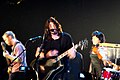 Foo Fighters performing an acoustic show in 2007 (from Hard rock)
 LaVern Baker was an R&B singer who was influential on rock and roll (from Rock and roll)
 Tommy Steele, one of the first British rock and rollers, performing in Stockholm in 1957 (from Rock and roll)
 Wolfmother, 2007 (from Hard rock)
 Aerosmith performing at Quilmes Rock in Buenos Aires, Argentina, on April 15, 2007 (from Hard rock)
 The transistor radio (1958 Emerson pictured) introduced FM radio and rock and roll music to baby boomer children in American households. (from Rock and roll)
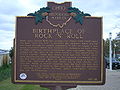 Sign commemorating the role of Alan Freed and Cleveland, Ohio, in the origins of rock and roll (from Rock and roll)
 Big Joe Turner and Pete Johnson's record "Roll 'Em Pete" is regarded as a precursor to rock and roll. (from Rock and roll)
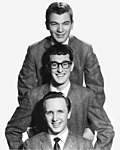
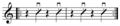


 Little Richard in 1957 (from Rock and roll)
 Cliff Richard became an early British rock and roll star with his 1958 hit "Move It". (from Rock and roll)
 Bill Haley and his Comets performing in the 1954 Universal International film Round Up of Rhythm (from Rock and roll)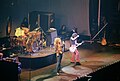

 "There's No Romance in Rock and Roll" made the cover of True Life Romance in 1956. (from Rock and roll)
 Disc jockey Alan Freed is credited with popularizing the term "rock and roll" and introducing the genre across racial barriers in the 1950s (from Rock and roll)
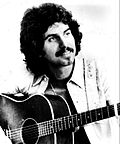 Johnny Rivers was a key 1960s rock artist known for hits like "Memphis" and his "Go-go" style. (from Rock and roll)
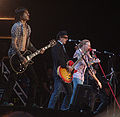 Original member Izzy Stradlin' on stage with Guns N' Roses in 2006 (from Hard rock)


.jpg)


.JPG)


Selected article

The band spent its first four years signed to the independent record label Fat Wreck Chords, on which they released two studio albums, The Unraveling (2001) and Revolutions per Minute (2003). Both the albums were met with underground success, and in 2003 the band signed with the major label DreamWorks, which was absorbed by Geffen. Rise Against's major label debut Siren Song of the Counter Culture (2004) brought the band mainstream success, largely in part to the popularity of the singles "Give It All" and "Swing Life Away". The band's next album, The Sufferer & the Witness (2006), peaked at number ten on the Billboard 200 in the United States, and was Rise Against's first album to chart in countries outside of North America.
With the release of Appeal to Reason (2008), Rise Against's music shifted toward a more accessible and radio-friendly sound, with greater emphasis on production value. The album's third single, "Savior", broke the record for the most consecutive weeks spent on both the Hot Rock Songs and Alternative Songs charts. Rise Against's popularity grew with the release of Endgame (2011), which peaked at number two on the Billboard 200, and charted highly worldwide. The band's seventh and eighth albums, The Black Market (2014) and Wolves (2017), continued the trend of commercial success, and both peaked with the top ten on the Billboard 200, while their ninth album, Nowhere Generation (2021) failed to do the same. The band's tenth album, Ricochet, released on August 15, 2025.
Rise Against is also known for their advocacy of progressivism, supporting organizations such as Amnesty International and the It Gets Better Project. The band actively promotes animal rights and most of the members are straight edge, PETA supporters and vegans. (Full article...)

Selected biography

As a mostly self-taught composer and performer, Zappa had diverse musical influences that led him to create music that was sometimes difficult to categorize. While in his teens, he acquired a taste for 20th-century classical modernism, African-American rhythm and blues, and doo-wop music. He began writing classical music in high school, while simultaneously playing drums in rhythm-and-blues bands, later switching to electric guitar. His debut studio album with the Mothers of Invention, Freak Out! (1966), combined satirical but seemingly conventional rock-and-roll songs with extended sound collages. He continued this eclectic and experimental approach throughout his career.
Zappa's output is unified by a conceptual continuity he termed "Project/Object", with numerous musical phrases, ideas and characters reappearing throughout his albums. His lyrics reflected his iconoclastic views of established social and political processes, structures and movements, often humorously so, and he has been described as the "godfather" of comedy rock. He was a strident critic of mainstream education and organized religion, and a forthright and passionate advocate for freedom of speech, self-education, political participation and the abolition of censorship. Unlike many other rock musicians of his generation, he disapproved of recreational drug use, but supported decriminalization and regulation.
Zappa was a highly productive and prolific musician with a controversial critical standing; supporters of his music admired its compositional complexity, while detractors found it lacking emotional depth. He had greater commercial success outside the U.S., particularly in Europe. Though he worked as an independent artist, Zappa mostly relied on distribution agreements he had negotiated with the major record labels. He remains a major influence on musicians. His many honors include his posthumous 1995 induction into the Rock and Roll Hall of Fame and the 1997 Grammy Lifetime Achievement Award. (Full article...)

Selected album
Bat Out of Hell II: Back into Hell is the sixth studio album by American rock singer Meat Loaf and the second in the Bat Out of Hell trilogy, which was written and produced by Jim Steinman. It was released on September 14, 1993, sixteen years after Meat Loaf's first solo album Bat Out of Hell. The album reached number 1 in the United States, United Kingdom and Canada. Three tracks were released as singles, including "I'd Do Anything for Love (But I Won't Do That)", which reached number 1 in 28 countries.
The album was released by MCA in North America, and Virgin Records internationally. The third part of the Bat trilogy, Bat Out of Hell III: The Monster Is Loose, was released in 2006. Like the first album of the trilogy, Bat Out of Hell II was a commercial success, selling over 14 million copies worldwide. (Full article...)
Selected song
"No One Knows" is a song by American rock band Queens of the Stone Age, written by band members Josh Homme and Mark Lanegan. It was the first single and second track from their third album, Songs for the Deaf, and was released on November 26, 2002. "No One Knows" was a chart success, becoming the band's first single to chart on the Billboard Hot 100 and their only single to top the US Alternative charts. The song was also critically acclaimed, receiving a nomination for Best Hard Rock Performance at the 2003 Grammy Awards. (Full article...)
Selected picture
.jpg)
(Then) Cat Stevens in Boeblingen, Germany in 1976.
Did you know (auto-generated)

- ... that director Abel Ferrara "delayed" the 64th Locarno Film Festival by singing rock and roll songs?
- ... that during his tenure as Governor of Central Java, Muhammad Ismail banned rock music concerts and car rallies?
- ... that before charting on the UK Albums Chart with Are We There Yet?, the indie rock musician James Marriott had made a career of mocking other YouTubers' music?
- ... that the British rock musician Hannah Grae went viral online with an anti-sexual harassment parody of Aqua's "Barbie Girl"?
- ... that Canadian punk rock musician Talli Osborne had only briefly spoken to the frontman of NOFX before the band wrote a song about her?
- ... that raw material waste from the West influenced a generation of rock music in China?
Selected genre
Progressive rock (shortened to prog rock or simply prog) is a broad genre of rock music that primarily developed in the United States and United Kingdom through the mid- to late 1960s. Initially termed "progressive pop", the style emerged from psychedelic bands who abandoned standard pop or rock traditions in favour of instrumental and compositional techniques more commonly associated with jazz, folk, or classical music, while retaining the instrumentation typical of rock music. Additional elements contributed to its "progressive" label: lyrics were more poetic, technology was harnessed for new sounds, music approached the condition of "art", and the studio, rather than the stage, became the focus of musical activity, which often involved creating music for listening rather than dancing. (Full article...)
Selected audio

Related portals


WikiProjects
Things you can do
Expand: College rock, Electronic rock, Pop rock
Clean Up: Instrumental rock, Rap rock, New wave, Industrial rock, Progressive metal, Southern rock, Folk rock, Funk rock, Space rock
Add Sources: Pagan rock
Join one of the many WikiProjects pertaining to Rock music.
News
- 18 April 2026 – Reactions to the 2026 Iran war, Coachella 2026
- At the Coachella festival in Empire Polo Club, Indio, California, American rock band The Strokes shows videos accusing the Central Intelligence Agency of enforcing regime change through violence while performing "Oblivius" and also denounce the U.S.-Israel strikes against Iran. (The Independent)
More articles -
"R U Professional" is a 2009 satirical song by the American indie rock band The Mae Shi, inspired by a July 2008 outburst by actor Christian Bale on the set of Terminator Salvation. Bale was filming with actress Bryce Dallas Howard when he berated director of photography, Shane Hurlbut, for walking into his line of sight. An audio recording of the incident appeared on website TMZ on February 2, 2009. The Mae Shi composed and recorded the song later in the same day, and released it the next day. The group stated that the piece was created to honor Bale. The song parodies Bale by sampling his voice from the 2008 diatribe. The chorus incorporates Bale's use of the word professional from his flare-up. The lyrics reference several films the actor starred in, including Newsies, Swing Kids, American Psycho, and The Dark Knight.
The song was made available on YouTube and via download on MediaFire the next day. "R U Professional" received a generally positive reception, and was praised as an effective parody of Bale's on-set disturbance. MTV compared its style to new wave groups like Devo. The Los Angeles Times described it as a lively pop music tribute to the actor. USA Today categorized the song as fun dance music and called it creatively motivated. The Toronto Sun wrote positively of its creative lyrics and use of audio from the Bale oration. El País classed the piece as an electropop song that contributed to the viral spread of the Bale rant online. Dose placed the song within the genre of an electro jam session. Publications including The A.V. Club and Pitchfork Media were impressed with the group's ability to compose and release the song twenty-four hours after the audio of the incident appeared online. The Irish Independent wrote that they thought the group may have used a melody they already had and adapted it for the song to release it so quickly. (Full article...)
More did you know...
- ... that David Bowie's first gig as lead singer was at the Green Man, Blackheath?
- ... that Carlton le Willows Academy alumni include cricketer Mark Footitt, Air Supply singer/guitarist Graham Russell, and balloonist Janet Folkes?
- ... that the video for Marilyn Manson's soft-rock ballad "Running to the Edge of the World" was widely condemned for its depiction of violence against women?
- ... that Susan Beschta was a punk rocker and federal judge?
.jpg)
- ... that the FM Non-Duplication Rule adopted by the FCC 61 years ago led to the creation of the album-oriented and classic rock radio formats?
- ... that The Elvis Dead, a retelling of Evil Dead II in the style of Elvis Presley, features songs such as "Standing in a State of Shock", "I've Been Possessed", and "Wrapped Up in Vines"?
Major topics
Subcategories

Associated Wikimedia
The following Wikimedia Foundation sister projects provide more on this subject:
-
 Commons
Free media repository -
 Wikibooks
Free textbooks and manuals -
 Wikidata
Free knowledge base -
 Wikiquote
Collection of quotations -
 Wikisource
Free-content library -
 Wikiversity
Free learning tools -
 Wikivoyage
Free travel guide -
 Wiktionary
Dictionary and thesaurus


