Portal:Tsunamis
Wikipedia portal for content related to Tsunamis
From Wikipedia, the free encyclopedia

The Tsunami portal

A tsunami (/(t)suːˈnɑːmi, (t)sʊˈ-/ (t)soo-NAH-mee, (t)suu-; from Japanese: 津波, lit. 'harbour wave', pronounced [tsɯnami]) is a series of waves in a water body caused by the displacement of a large volume of water, generally in an ocean or a large lake. Earthquakes, volcanic eruptions, underwater explosions, landslides, glacier calvings, meteorite impacts and other disturbances above or below water all have the potential to generate a tsunami. Unlike normal ocean waves, which are generated by wind, or tides, which are in turn generated by the gravitational pull of the Moon and the Sun, a tsunami is generated by the displacement of water from a large event.
Selected article
Tsunami: The Aftermath is a 2006 American disaster drama television miniseries that dramatizes the events in the aftermath of the 2004 Indian Ocean earthquake and tsunami. (Full article...)
Events that can cause a tsunami

An impact event is a collision between astronomical objects causing measurable effects. Impact events have been found to regularly occur in planetary systems, though the most frequent involve asteroids, comets or meteoroids and have minimal effect. When large objects impact terrestrial planets such as the Earth, there can be significant physical and biospheric consequences, as the impacting body is usually traveling at several kilometres per second (km/s). The minimum impact speed for bodies striking Earth is 11.2 km/s (25,054 mph; 40,320 km/h), the Escape velocity of the Earth. While planetary atmospheres can mitigate some of these impacts through the effects of atmospheric entry, many large bodies retain sufficient energy to reach the surface and cause substantial damage. This results in the formation of impact craters and structures, shaping the dominant landforms found across various types of solid objects found in the Solar System. Their prevalence and ubiquity present the strongest empirical evidence of the frequency and scale of these events. (Full article...)
List of events articles |
|---|
Did you know...
- ... that the Aitape Skull may be part of the remains of the oldest known tsunami victim?
- ... that the Yonezawa Shokai Building is the only building left in the former city center of Rikuzentakata after it was destroyed by a tsunami?
- ... that the village office on the islet of Koja Doi was destroyed by a tsunami in 1992, after which it was rebuilt across a causeway on the larger Besar Island?
- ... that Souraja survived the 2018 Sulawesi earthquake and tsunami unscathed?
Related portals


Need help?
Do you have a question about Tsunamis that you can't find the answer to?
Consider asking it at the Wikipedia reference desk.
General images
 Over-riding plate bulges under strain, causing tectonic uplift. (from Tsunami)
 Japanese Tsunami warning sign (from Tsunami warning system)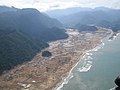
 Diagram showing several measures to describe a tsunami size, including height, inundation and run-up (from Tsunami)
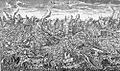 Lisbon earthquake and tsunami in November 1755 (from Tsunami)
 The wave further slows and amplifies as it hits land. Only the largest waves crest. (from Tsunami)
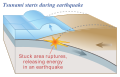 Plate slips, causing subsidence and releasing energy into water. (from Tsunami)
 Diagram showing how earthquakes can generate a tsunami (from Tsunamis in lakes)
 Tsunami warning system in East Timor (from Tsunami warning system)
 Satellite image of Lake Kivu (from Tsunamis in lakes)
 Evacuation route sign in a low-lying coastal area on the West Coast of the United States (from Tsunami warning system)
 An illustration of the rhythmic "drawback" of surface water associated with a wave. It follows that a very large drawback may herald the arrival of a very large wave. (from Tsunami)
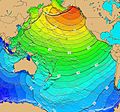 Calculated travel time map for the 1964 Alaska tsunami (in hours) (from Tsunami)
 Evacuation route sign on the pavement in Kamakura, Japan (from Tsunami warning system)
 Tsunami Early Warning Tower board in Hikkaduwa, Sri Lanka (from Tsunami warning system)
 When the wave enters shallow water, it slows down and its amplitude (height) increases. (from Tsunami)
 Mast with warning system, and sign detailing escape routes, on the coast of Okumatsushima, Miyagi prefecture, Japan (this coast was severely hit by the 2011 tsunami) (from Tsunami warning system)
 The energy released produces tsunami waves. (from Tsunami)


.jpg)


Selected tsunami article
Satoshi Tsunami (都並 敏史, Tsunami Satoshi; born 14 August 1961) is a Japanese football manager and former player. He is currently manager of Japan Football League club, Briobecca Urayasu. He last played for Japan national team until 1995. (Full article...)
In the news
- 8 June 2026 – 2026 Mindanao earthquake
- Tsunamis are recorded in Guam, Palau and parts of Indonesia, Japan, and the Philippines. The Pacific Tsunami Warning Center (PTWC) cancels its tsunami advisory issued for Guam and the Northern Mariana Islands; while agencies in Australia, Malaysia, and New Zealand lift their respective warnings. The PTWC later confirms that the tsunami threat passes hours following its issuance of the warning for parts of the Pacific. (BBC News) (NHK) (The Straits Times) (RNZ) (tsunami.gov)
- 20 April 2026 – Earthquakes in 2026
- An earthquake on a scale of 7.7 is measured off the coast of Sanriku, Japan. A subsequent 80-centimetre (2.6 ft) high tsunami is reported in Kuji, Iwate prefecture. (AP) (Kyodo News)
Subcategories

- Select [►] to view subcategories
Topics
- List of tsunamis
- Tsunami earthquake
- Tsunami warning system
- Tsunamis in lakes
- Tsunami deposit
- Deep-ocean Assessment and Reporting of Tsunamis
- Tsunami Advisory Center of the Ministry of National Resources
- Tsunami bomb
- Meteotsunami
- NOAA Center for Tsunami Research
- Indian Ocean Tsunami Warning System
- Pacific Tsunami Warning Center
- Submarine earthquake
- UNMAI
Associated Wikimedia
The following Wikimedia Foundation sister projects provide more on this subject:
-
 Commons
Free media repository -
 Wikidata
Free knowledge base -
 Wikiquote
Collection of quotations -
 Wikisource
Free-content library -
 Wikiversity
Free learning tools -
 Wiktionary
Dictionary and thesaurus


