Section 18 of the Constitution Act, 1867
From Wikipedia, the free encyclopedia
| Constitution Act, 1867 |
|---|
| Part of the Constitution of Canada |
| PREAMBLE |
| I. PRELIMINARY |
| 1, 2 |
| II. UNION |
| 3, 4, 5, 6, 7, 8 |
| III. EXECUTIVE POWER |
| 9, 10, 11, 12, 13, 14, 15, 16 |
| IV. LEGISLATIVE POWER |
| 17, 18, 19, 20 |
| The Senate |
| 21, 22, 23, 24, 25, 26, 27, 28, 29, 30, 31, 32, 33, 34, 35, 36 |
| The House of Commons |
| 37, 38, 39, 40, 41, 42, 43, 44, 45, 46, 47, 48, 49, 50, 51(1), 51(2), 51A, 52 |
| Money Votes; Royal Assent |
| 53, 54, 55, 56, 57 |
|
V. PROVINCIAL CONSTITUTIONS Executive Power |
| 58, 59, 60, 61, 62, 63, 64, 65, 66, 67, 68 |
| Legislative Power |
| 69, 70, 71, 72, 73, 74, 75, 76, 77, 78, 79, 80, 81, 82, 83, 84, 85, 86, 81, 82, 83, 84, 85, 86, 87, 88, 89, 90, 90Q, 90S |
| VI. DISTRIBUTION OF LEGISLATIVE POWERS |
| 91, 92, 92A, 93, 93A, 94, 94A, 95 |
| VII. JUDICATURE |
| 96, 97, 98, 99, 100, 101 |
| VIII. REVENUES; DEBTS; ASSETS; TAXATION |
| 102, 103, 104, 105, 106, 107, 108, 109, 110, 111, 112, 113, 114, 115, 116, 117, 118, 119, 120, 121, 122, 123, 124, 125, 126 |
| IX. MISCELLANEOUS PROVISIONS |
| 127, 128, 128Q, 129, 130, 131, 132, 133, 134, 135, 136, 137, 138, 139, 140, 141, 142, 143, 144 |
| X. INTERCOLONIAL RAILWAY |
| 145 |
| XI. ADMISSION OF OTHER COLONIES |
| 146, 147 |
| SCHEDULES |
|
First: Electoral Districts of Ontario Second: Electoral Districts of Quebec Third: Property of Canada Fourth: Property of Ontario and Quebec Fifth: Allegiance and Senate Qualification Sixth: Natural Resources |
| COMING INTO FORCE |
| Proclamation of the Constitution Act, 1867 |
Section 18 of the Constitution Act, 1867 (French: article 18 de la Loi constitutionnelle de 1867) is a provision of the Constitution of Canada relating to parliamentary privilege.
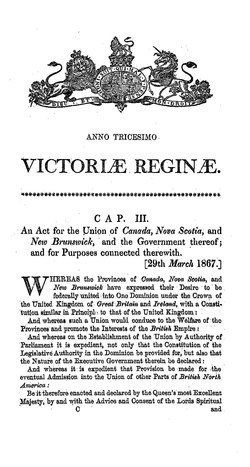
The Constitution Act, 1867 is the constitutional statute which established Canada. Originally named the British North America Act, 1867, the Act continues to be the foundational statute for the Constitution of Canada, although it has been amended many times since 1867. It is now recognised as part of the supreme law of Canada.
The Constitution Act, 1867 is part of the Constitution of Canada and thus part of the supreme law of Canada.[1][2] The Act sets out the constitutional framework of Canada, including the structure of the federal government and the powers of the federal government and the provinces. It was the product of extensive negotiations between the provinces of British North America at the Charlottetown Conference in 1864, the Quebec Conference in 1864, and the London Conference in 1866.[3][4] Those conferences were followed by consultations with the British government in 1867.[3][5] The Act was then enacted in 1867 by the British Parliament under the name the British North America Act, 1867.[6][7] In 1982 the Act was brought under full Canadian control through the Patriation of the Constitution, and was renamed the Constitution Act, 1867.[2][6] Since Patriation, the Act can only be amended in Canada, under the amending formula set out in the Constitution Act, 1982.[8][9][10]
Text of section 18
Section 18 reads:
Privileges, etc., of Houses
18 The privileges, immunities, and powers to be held, enjoyed, and exercised by the Senate and by the House of Commons, and by the members thereof respectively, shall be such as are from time to time defined by Act of the Parliament of Canada, but so that any Act of the Parliament of Canada defining such privileges, immunities, and powers shall not confer any privileges, immunities, or powers exceeding those at the passing of such Act held, enjoyed, and exercised by the Commons House of Parliament of the United Kingdom of Great Britain and Ireland, and by the members thereof.[11]
Section 18 is found in Part IV of the Constitution Act, 1867, dealing with the legislative powers of the federal Parliament. This version of section 18 was enacted in 1875, as an amendment to the original version.[11][12]
Legislative history
Original version: 1867 to 1875

As originally enacted in 1867, section 18 provided:
18 The Privileges, Immunities, and Powers to be held, enjoyed, and exercised by the Senate and by the House of Commons and by the Members thereof respectively shall be such as are from Time to Time defined by Act of the Parliament of Canada, but so that the same shall never exceed those at the passing of this Act held, enjoyed, and exercised by the Commons House of Parliament of the United Kingdom of Great Britain and Ireland and by the Members thereof.[7]
Resolutions and drafts relating to parliamentary privilege

There was no mention of parliamentary privilege in the Quebec Resolutions. The issue first appeared in the London Resolutions, as Resolution 30:
30. The powers and privileges of the House of Commons of the United Kingdom of Great Britain and Ireland shall be held to appertain to the House of Commons of the Confederation, and the powers and privileges appertaining to the House of Lords in its legislative capacity, shall be held to appertain to the Legislative Council [ie the Senate].[13][14]
The issue of parliamentary privilege was included in the very first draft of the bill, prepared by the delegates to the London Conference. It continued the proposal that the Legislative Council would have the same privileges as the House of Lords, and the Canadian House of Commons would have the same privileges as the British House of Commons.[15]
The issue of privilege was omitted from the next draft, prepared by the British drafters, with a note that privilege "may be provided for by colonial legislation."[16] It reappeared in the third draft, with a proposal that both houses would have the same privileges as the British House of Commons.[17]
The fourth draft also provided that both Canadian houses would have the same privileges and powers as the British House of Commons, with the addition that the Canadian powers and privileges would not "... exceed those now held" by the British House of Commons and its members.[18] With some minor modifications in wording, that became the final form of section 18, as passed by the British Parliament in 1867.[19]
Current version, 1875 onwards

The original 1867 version was repealed and replaced in 1875 as a result of the Pacific Scandal of 1873, which had resulted in the fall of the Conservative government of Sir John A. Macdonald, and the installation of the Liberal government of Alexander Mackenzie.[20] The events of the Pacific Scandal had shown that the grant of parliamentary privileges in section 18 was limited, and the new Mackenzie government asked the British government to amend section 18 to give broader powers to the Canadian Parliament.[21] In response to that request, the British Parliament enacted the Parliament of Canada Act, 1875, which repealed the original version of section 18 and enacted the current version.[12][22]
The difference between the two versions was that the original version provided that the federal Parliament could not enact legislation relating to privilege that exceeded the powers of the British House of Commons as of the date of the Constitution Act, 1867 coming into force, namely July 1, 1867.[7] The 1875 version provides that the federal Parliament can enact laws relating to parliamentary privilege, provided the laws do not exceed the powers of the British House of Commons, as of the date the federal laws are enacted.[11][21][23]


.jpg)
.jpg)