Section 25 of the Constitution Act, 1867
From Wikipedia, the free encyclopedia
| Constitution Act, 1867 |
|---|
| Part of the Constitution of Canada |
| PREAMBLE |
| I. PRELIMINARY |
| 1, 2 |
| II. UNION |
| 3, 4, 5, 6, 7, 8 |
| III. EXECUTIVE POWER |
| 9, 10, 11, 12, 13, 14, 15, 16 |
| IV. LEGISLATIVE POWER |
| 17, 18, 19, 20 |
| The Senate |
| 21, 22, 23, 24, 25, 26, 27, 28, 29, 30, 31, 32, 33, 34, 35, 36 |
| The House of Commons |
| 37, 38, 39, 40, 41, 42, 43, 44, 45, 46, 47, 48, 49, 50, 51(1), 51(2), 51A, 52 |
| Money Votes; Royal Assent |
| 53, 54, 55, 56, 57 |
|
V. PROVINCIAL CONSTITUTIONS Executive Power |
| 58, 59, 60, 61, 62, 63, 64, 65, 66, 67, 68 |
| Legislative Power |
| 69, 70, 71, 72, 73, 74, 75, 76, 77, 78, 79, 80, 81, 82, 83, 84, 85, 86, 81, 82, 83, 84, 85, 86, 87, 88, 89, 90, 90Q, 90S |
| VI. DISTRIBUTION OF LEGISLATIVE POWERS |
| 91, 92, 92A, 93, 93A, 94, 94A, 95 |
| VII. JUDICATURE |
| 96, 97, 98, 99, 100, 101 |
| VIII. REVENUES; DEBTS; ASSETS; TAXATION |
| 102, 103, 104, 105, 106, 107, 108, 109, 110, 111, 112, 113, 114, 115, 116, 117, 118, 119, 120, 121, 122, 123, 124, 125, 126 |
| IX. MISCELLANEOUS PROVISIONS |
| 127, 128, 128Q, 129, 130, 131, 132, 133, 134, 135, 136, 137, 138, 139, 140, 141, 142, 143, 144 |
| X. INTERCOLONIAL RAILWAY |
| 145 |
| XI. ADMISSION OF OTHER COLONIES |
| 146, 147 |
| SCHEDULES |
|
First: Electoral Districts of Ontario Second: Electoral Districts of Quebec Third: Property of Canada Fourth: Property of Ontario and Quebec Fifth: Allegiance and Senate Qualification Sixth: Natural Resources |
| COMING INTO FORCE |
| Proclamation of the Constitution Act, 1867 |
Section 25 of the Constitution Act, 1867 (French: article 25 de la Loi constitutionnelle de 1867) is a repealed provision of the Constitution of Canada relating to the appointment of the first members of the Senate of Canada in 1867.
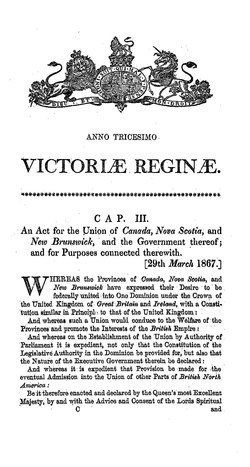
The Constitution Act, 1867 is the constitutional statute which established Canada. Originally named the British North America Act, 1867, the Act continues to be the foundational statute for the Constitution of Canada, although it has been amended many times since 1867. It is now recognised as part of the supreme law of Canada.
The Constitution Act, 1867 is part of the Constitution of Canada and thus part of the supreme law of Canada.[1][2] The Act sets out the constitutional framework of Canada, including the structure of the federal government and the powers of the federal government and the provinces. It was the product of extensive negotiations between the provinces of British North America at the Charlottetown Conference in 1864, the Quebec Conference in 1864, and the London Conference in 1866.[3][4] Those conferences were followed by consultations with the British government in 1867.[3][5] The Act was then enacted in 1867 by the British Parliament under the name the British North America Act, 1867.[6][7] In 1982 the Act was brought under full Canadian control through the Patriation of the Constitution, and was renamed the Constitution Act, 1867.[2][6] Since Patriation the Act can only be amended in Canada, under the amending formula set out in the Constitution Act, 1982.[8][9][10]
Text of section 25
Section 25 read:
Summons of First Body of Senators
25 Such Persons shall be first summoned to the Senate as the Queen by Warrant under Her Majesty's Royal Sign Manual thinks fit to approve, and their Names shall be inserted in the Queen's Proclamation of Union.[11]
Section 25 was found in Part IV of the Constitution Act, 1867, dealing with the legislative power of the federal government. It was repealed in 1893 as part of a general statute law revision.[12]
Purpose and interpretation
The Senate of Canada is the upper house of the Parliament of Canada. Its members are appointed, not elected.[13] Section 25 was the initial step to provide for the appointment of the first group of senators for the new Parliament of Canada in 1867. The list of nominees for the Senate was put forward by the governments of the Province of Canada, Nova Scotia and New Brunswick, approved by the Queen, and then set out in the royal proclamation which brought the Constitution Act, 1867 came into force on July 1, 1867.[14][15]
Section 127 of the Act provided the mechanism for offers of Senate positions to be made to incumbent members of the provincial legislative councils.
Legislative history
Origins

Prior to Confederation, the Province of Canada, New Brunswick and Nova Scotia all had bicameral parliaments, with the upper houses termed the legislative councils. The Fathers of Confederation agreed in the Quebec Resolutions that the first senators in the new Parliament of Canada would be nominated by the provincial governments. The seats would be offered to current members of the provincial legislative councils, in proportion to the representation of the government and opposition members in each legislative council, so that "all political parties may as nearly as possible be fairly represented."[16][17]
The London Conference confirmed that approach in the London Resolutions, which finalised the agreement for Confederation.[18][19]
This principle of proportionate political representation was not expressly included in the Act itself, but was implemented in the initial appointments to the Senate, which were largely drawn from the provincial legislative councils.[14]
Drafts of section 25

Section 25, setting out the method for the appointment of the initial group of senators, went through a number of drafts in the lead-up to the introduction of the bill in the British Parliament:
- The earliest rough draft of the bill proposed that the executive governments of each of the provinces would nominate individuals who were members of the legislative councils, and the governor general would appoint those individuals;[20]
- The next draft proposed that the first senators would be named in a schedule to the bill;[21]
- The third and fourth drafts proposed that prior to the first meeting of Parliament, the Governor General could summon to the Senate "such persons as Her Majesty may think fit"; [22][23]
- The final draft provided that the first group would be summoned, after the Queen's approval, signified under the royal sign manual.[24]
At some point between the final draft bill on February 7, 1867 and its introduction in Parliament on February 12, section 25 took its final form, with the addition of the words "... and their names shall be inserted in the Queen's proclamation of union." The decision to list the new senators in the Proclamation was apparently at the insistence of the British government, over the opposition of John A. Macdonald, the future prime minister of Canada. Macdonald had a very pragmatic reason for his opposition, as explained in a letter to the Colonial Secretary, Lord Carnarvon: "... if the list were settled now, every man ... who is omitted, rightly or wrongly, would vote against the government." Nonetheless, the decision of the British government stood.[25]
Repeal
Section 25 was repealed by the British Parliament in 1893, in the Statute Law Revision Act 1893. The law was of a housekeeping nature, repealing statutory provisions which no longer had any purpose. Since the initial senators had been appointed in 1867, section 25 was no longer needed.[12]
There is no indication that the British government consulted the government of Canada about the amendment.[26]
