Section 69 of the Constitution Act, 1867
From Wikipedia, the free encyclopedia
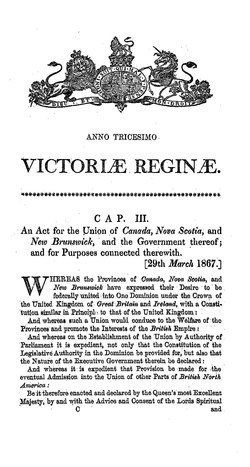
| Constitution Act, 1867 |
|---|
| Part of the Constitution of Canada |
| PREAMBLE |
| I. PRELIMINARY |
| 1, 2 |
| II. UNION |
| 3, 4, 5, 6, 7, 8 |
| III. EXECUTIVE POWER |
| 9, 10, 11, 12, 13, 14, 15, 16 |
| IV. LEGISLATIVE POWER |
| 17, 18, 19, 20 |
| The Senate |
| 21, 22, 23, 24, 25, 26, 27, 28, 29, 30, 31, 32, 33, 34, 35, 36 |
| The House of Commons |
| 37, 38, 39, 40, 41, 42, 43, 44, 45, 46, 47, 48, 49, 50, 51(1), 51(2), 51A, 52 |
| Money Votes; Royal Assent |
| 53, 54, 55, 56, 57 |
|
V. PROVINCIAL CONSTITUTIONS Executive Power |
| 58, 59, 60, 61, 62, 63, 64, 65, 66, 67, 68 |
| Legislative Power |
| 69, 70, 71, 72, 73, 74, 75, 76, 77, 78, 79, 80, 81, 82, 83, 84, 85, 86, 81, 82, 83, 84, 85, 86, 87, 88, 89, 90, 90Q, 90S |
| VI. DISTRIBUTION OF LEGISLATIVE POWERS |
| 91, 92, 92A, 93, 93A, 94, 94A, 95 |
| VII. JUDICATURE |
| 96, 97, 98, 99, 100, 101 |
| VIII. REVENUES; DEBTS; ASSETS; TAXATION |
| 102, 103, 104, 105, 106, 107, 108, 109, 110, 111, 112, 113, 114, 115, 116, 117, 118, 119, 120, 121, 122, 123, 124, 125, 126 |
| IX. MISCELLANEOUS PROVISIONS |
| 127, 128, 128Q, 129, 130, 131, 132, 133, 134, 135, 136, 137, 138, 139, 140, 141, 142, 143, 144 |
| X. INTERCOLONIAL RAILWAY |
| 145 |
| XI. ADMISSION OF OTHER COLONIES |
| 146, 147 |
| SCHEDULES |
|
First: Electoral Districts of Ontario Second: Electoral Districts of Quebec Third: Property of Canada Fourth: Property of Ontario and Quebec Fifth: Allegiance and Senate Qualification Sixth: Natural Resources |
| COMING INTO FORCE |
| Proclamation of the Constitution Act, 1867 |
Section 69 of the Constitution Act, 1867 (French: article 69 de la Loi constitutionnelle de 1867) is a provision of the Constitution of Canada creating the Legislature of the province of Ontario, which did not exist prior to 1867. The Constitution Act, 1867 created Ontario, including the institutions of the new provincial government, such as the Legislature.
The Legislature was unicameral, consisting of the Lieutenant Governor of Ontario and the elected Legislative Assembly. Ontario operates on the Westminster parliamentary system of responsible government, with the government drawn from, and responsible to, the Legislative Assembly.
The Constitution Act, 1867 is the constitutional statute which established Canada. Originally named the British North America Act, 1867, the Act continues to be the foundational statute for the Constitution of Canada, although it has been amended many times since 1867. It is now recognised as part of the supreme law of Canada.
The Constitution Act, 1867 is part of the Constitution of Canada and thus part of the supreme law of Canada.[1][2] The Act sets out the constitutional framework of Canada, including the structure of the federal government and the powers of the federal government and the provinces. It was the product of extensive negotiations between the provinces of British North America at the Charlottetown Conference in 1864, the Quebec Conference in 1864, and the London Conference in 1866.[3][4] Those conferences were followed by consultations with the British government in 1867.[3][5] The Act was then enacted by the British Parliament under the name the British North America Act, 1867.[6][7] In 1982 the Act was brought under full Canadian control through the Patriation of the Constitution, and was renamed the Constitution Act, 1867.[2][6] Since Patriation, the Act can only be amended in Canada, under the amending formula set out in the Constitution Act, 1982.[8][9][10]
Text of section 69
Section 69 reads:
Legislature for Ontario
69 There shall be a Legislature for Ontario consisting of the Lieutenant Governor and of One House, styled the Legislative Assembly of Ontario.[11]
Section 69 is found in Part V of the Constitution Act, 1867, dealing with provincial constitutions. It has not been amended since the Act was enacted in 1867.[11]
Legislative history
At the Quebec Conference, the Quebec Resolutions provided that the Province of Canada would be divided into two new provinces, Ontario and Quebec. The conference delegates left the constitutional structure of the two new provinces to the government of the Province of Canada to determine.[12][13]


In July 1866, the Parliament of the Province of Canada considered an additional set of resolutions, to set out the framework for the constitutions of the two new provinces.[14][15] The additional resolutions were introduced in the Legislative Assembly on July 13, 1866, by the joint premiers, John A. Macdonald and George-Étienne Cartier. The fifth resoution provided that Upper Canada (the old name for what would become Ontario), would have a legislature composed of one chamber, the Legislative Assembly.[14][15][16]
At the London Conference in December 1866, the delegates adopted the same approach as in the Quebec Resolutions: the local governments would be as determined by the Province of Canada.[17][18]
The first rough draft of the British North America bill was prepared by the four provincial attorneys general present at the London Conference.[a] That draft simply provided that the provincial governments would be constituted by the provincial legislatures, "subject to the provisions of this act".[19] It was not until the third draft that provision was made for the legislature of Ontario, composed of one chamber, although the name had not yet been determined.[20] The provision took final form in the fourth draft: the Legislature would consist of the lieutenant governor and one chamber, called the legislative assembly.[21]
Purpose and interpretation

.jpg)
The province of Ontario did not exist prior to 1867. In 1841, the British government had merged Lower Canada and Upper Canada to form the Province of Canada.[22] In the negotiations leading to Confederation twenty years later, the Canadians agreed from the start that the Province of Canada would be split into two separate provinces in the new federation.[23][24] Each of the new provinces would need completely new government structures, including legislatures, because the old Parliament of the Province of Canada would cease to exist.[25]
Section 69 of the Act created the Legislature of Ontario as a unicameral legislature, consisting of the elected Legislative Assembly and the appointed Lieutenant Governor of Ontario, the representative of the Crown. The Assembly originally had 82 seats, the same as the new federal House of Commons. The Legislative Assembly also used the same electoral map as the House of Commons, set out in the First Schedule of the Constitution Act, 1867.
The unicameral legislature was the first in British North America.[25] In the 1866 debates in the Legislative Assembly of the Province of Canada on the proposed constitution for the new province of Ontario, some of the members thought it a risky experiment, others saw it as a cost-saving measure. John A. Macdonald explained that it was sufficient to have a unicameral legislature for what he considered to be a "subordinate Legislature", in the nature of a municipal body.[14][15][25]
Not everyone agreed with the proposed legislature. On the one hand, George Brown agreed with Macdonald's conception of the local governments as being similar to large municipalities or counties. He suggested that the new province did not need a full-fledged parliamentary government, and suggested that their executive officers should be elected separately from the assembly. On the other hand, one Conservative member from Canada West, John Hillyard Cameron, proposed that Ontario should have a bicameral legislature, but his motion was defeated (13–86).[14][15]
The unicameral Ontario legislature was in contrast to the proposal for Quebec, which would have a bicameral legislature, with an appointed upper house. Nova Scotia and New Brunswick would retain their bicameral legislatures. All four legislatures would continue to operate under the principle of responsible government, with the government drawn from the elected legislative assemblies.[14][15][25]
.svg)
