Talk:0.999...
From Wikipedia, the free encyclopedia
| This is the talk page for discussing improvements to the 0.999... article itself. This is not a forum for general discussion of the article's subject. Please place discussions on the underlying mathematical issues on the arguments page. For questions about the mathematics involved, try posting to the reference desk instead. |
Article policies
|
Archives (index): 1, 2, 3, 4, 5, 6, 7, 8, 9, 10, 11, 12, 13, 14, 15, 16, 17, 18, 19, 20Auto-archiving period: 31 days  |
| Arguments Archives: Index, 1, 2, 3, 4, 5, 6, 7, 8, 9, 10, 11, 12 |
 | 0.999... is a former featured article. Please see the links under Article milestones below for its original nomination page (for older articles, check the nomination archive) and why it was removed. | |||||||||||||||||||||
 | This article appeared on Wikipedia's Main Page as Today's featured article on October 25, 2006. | |||||||||||||||||||||
| ||||||||||||||||||||||
 | This article is rated B-class on Wikipedia's content assessment scale. It is of interest to multiple WikiProjects. | ||||||||||||||||||||||||||||||
| |||||||||||||||||||||||||||||||


|


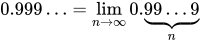



Yet another anon
Moved to Arguments subpage
"An alternative way of writing"
No, 0.9999... is not merely "an alternative way of writing 1", any more so than 437/437 is "an alternative way of writing 1." The infinite repeating decimal encompasses a number of advanced concepts, which happen to arguably be equal to 1. Equality is not the same as "another way of writing." We agree that 0.999.. is interchangeable with 1, in some mathematical contexts. Qualification and context is required on this article. --John Byrd (talk) 04:21, 9 January 2026 (UTC)
- Uh, well, no, basically. You might try reading the "Arguments" archives, and see if you have anything new to offer. Imaginatorium (talk) 10:30, 9 January 2026 (UTC)
- I don't think John is challenging the equality here. The wording is in fact a little strange; it's not like there's any normal context where you want to express the number, and you say let's see, should I write it as 1 or should I write it as 0.999...? Just because someone expresses discomfort with the wording is not a reason to put them in a bin with those who don't follow the argument.
- It's a numeral whose value is exactly 1. Maybe we could discuss alternative wordings based on that? There are difficulties there too; that means hitting the reader right up front with the number–numeral distinction, which is something not everyone has internalized. Also we run into the problem of whether the numeral is the literal eight-byte string "0.999..." or the infinite string that it represents. --Trovatore (talk) 23:03, 9 January 2026 (UTC)
- As Trovatore follows my commentary exactly, and Imaginarium is not even trying to follow it, I will copy his phraseology. 0.9 repeating is an infinite numeral whose value is precisely equal to 1. That is true. 0.999... t is *not* "another way of writing 1," and you may not convolute the artistic concept of writing and the mathematical concept of equality; you have elected to make the argument about "a way of writing", which prima facie has nothing to do with mathematics. John Byrd (talk) 00:27, 15 January 2026 (UTC)
- I think "another way of representing 1" would work a lot better. --jpgordon𝄢𝄆𝄐𝄇 00:57, 15 January 2026 (UTC)
- The concept you are reaching for is called equality. "There are many ways to prove that 0.99.. is equal to 1." Done and done. I cannot understand why so many laymen are reaching for more and more grandiose ways of pushing 0.99.. and 1 closer together metaphorically on Wikipedia: "0.99... is precisely totally extremely the same as writing 1, and you had better write 0.99... anytime anyone asks you to write a 1, they are so the same number." If you want to be simultaneously correct and convincing, then I'd suggest you rewrite this rather breathless article with the authorial we. https://academia.stackexchange.com/questions/2945/choice-of-personal-pronoun-in-single-author-papers John Byrd (talk) 00:12, 20 January 2026 (UTC)
- I think "another way of representing 1" would work a lot better. --jpgordon𝄢𝄆𝄐𝄇 00:57, 15 January 2026 (UTC)
- As Trovatore follows my commentary exactly, and Imaginarium is not even trying to follow it, I will copy his phraseology. 0.9 repeating is an infinite numeral whose value is precisely equal to 1. That is true. 0.999... t is *not* "another way of writing 1," and you may not convolute the artistic concept of writing and the mathematical concept of equality; you have elected to make the argument about "a way of writing", which prima facie has nothing to do with mathematics. John Byrd (talk) 00:27, 15 January 2026 (UTC)
any more so than 437/437 is "an alternative way of writing 1."
Yes, this is also a good alternative. –jacobolus (t) 22:57, 9 January 2026 (UTC)- Indeed, alternative ways of writing the number 1 in the form are useful in simplifying expressions, like in this case if we were to evaluate . And more sophisticated alternative ways of writing the number 1 are used in, e.g., clearing radicals from denominators. An alternative can be less common, or useful in fewer contexts, but it's still an alternative. Stepwise Continuous Dysfunction (talk) 21:04, 10 January 2026 (UTC)
- 437/437 is an expression that is equal to 1, whereas 0.999... is not just equal to 1, it is an alternative notation for one. We want to avoid any thought in the reader's mind that 0.999.. is
an expression ora process of any kind. Hawkeye7 (discuss) 21:20, 10 January 2026 (UTC)- I agree about "process", but I disagree about "expression". Any
group of symbols which together represent a numeric, algebraic, or other mathematical quantity or function
(OED) is an expression. Even "1" by itself is an expression, like all other numerals. Stepwise Continuous Dysfunction (talk) 21:33, 10 January 2026 (UTC)
- I agree about "process", but I disagree about "expression". Any
- 437/437 is an expression that is equal to 1, whereas 0.999... is not just equal to 1, it is an alternative notation for one. We want to avoid any thought in the reader's mind that 0.999.. is
- Indeed, alternative ways of writing the number 1 in the form are useful in simplifying expressions, like in this case if we were to evaluate . And more sophisticated alternative ways of writing the number 1 are used in, e.g., clearing radicals from denominators. An alternative can be less common, or useful in fewer contexts, but it's still an alternative. Stepwise Continuous Dysfunction (talk) 21:04, 10 January 2026 (UTC)


- 0.999... is not notation for the number 1. The definition of this notation is a specific limit. It is a theorem that this limit equals 1. But 0.999... and 1 are not notationally equal. That flattens the subject of the article 5o a tautology. Tito Omburo (talk) 07:57, 18 January 2026 (UTC)
- @Hawkeye7:, you appear still to be confused that 0.999... is defined syntactically as 1. I propose to remove that confusion for other readers by rewriting the first sentence to say that "0.999... is a repeating decimal equal to 1", not that it is an alternative syntax for 1. Indeed, the semantic definition of 0.999... is the limit of an infinite sequence (or, equivalently, the least upper bound of an increasing sequence of partial sums). It is not defined as 1, and I believe that the first sentence of the article has possibly caused or reinformed your misunderstanding. I note that this is not the first time that you have made this error on the talk page (or article). Tito Omburo (talk) 13:51, 18 January 2026 (UTC)
- It seems to me that the same objections could be raised against saying, for example, that "0.142857..." is an alternative way of writing 1/7. So, they're not particularly good objections. Stepwise Continuous Dysfunction (talk) 21:07, 10 January 2026 (UTC)
- If there are no sources that describe 0.999... as an "alternative way of writing 1", then this article must not, per WP:OR/WP:NPOV. I strongly suspect that, to the contrary, there are zero sources that do this. Mathematical sources typically avoid loose language like "way of writing" in favor of "representation". Moreover, the existimg woring is confusing on its face. Who would "write" 1 on this way? Taking this sentence literally is ontologically wrong too, 0.999... is not a numeral (way of writing a number). It is a theorem that the object represented by this notation, which has a precise definition independent of how it is written down on a page, is equal to 1. This is not something that is true by fiat. Obviously, we are supposed to interpret this sentence metaphorically, right? Tito Omburo (talk) 06:59, 18 January 2026 (UTC)
- I do not understand your objection. This is a straightforward bit of plain English description: every bit of mathematical notation is a "way of writing" the object which it represents. We do not need a list of sources for every phrase we use in every Wikipedia article, but it's also trivial to find hundreds of sources which use the phrase "way of writing" as a description of the function/nature of mathematical notation. Ontology (e.g. the extent to which the number 1 can be said to "exist", etc.) is beyond the scope of this article; you can take that up at philosophy of mathematics or whatever. –jacobolus (t) 07:22, 18 January 2026 (UTC)
- "Way of writing" is not a synonym of "represents". One of them involves the act of writing, the other does not. These are literally not synonymous. Representation may or may not involve "writing". You are saying we must interpret the sentence *metaphorically*. Different ontology! But since this is apparently difficult for you, establish that a preponderance of sources discuss 0.999... in the context of "ways of writing" the numeral 1, and add it to a section about writing in the article establish its weight in relation to the topic. (Fwiw, I think "denotes a number equal to 1" would be the least objectionable on ontological grounds.) Tito Omburo (talk) 07:33, 18 January 2026 (UTC)
- Can you explain what "metaphor" you are talking about? You might be having some problem with the variety of possible definitions of the word "writing" (e.g. Wiktionary has as one of the definitions, "Writing: The process of representing a language with symbols or letters.")
"apparently difficult"
– Now you are just being rude. But I'd say the opposite. It seems quite simple to me, a plain English phrase whose meaning is not really ambiguous, but you seem to be having great difficulty with it. –jacobolus (t) 08:31, 18 January 2026 (UTC)- The phrase "way of writing" is ambiguous in ordinary English: many readers interpret it as referring to a syntactic or notational variant (like "1/2" vs "0.5"). In the case of 0.999... that interpretation is misleading, because the notation is defined via a limit and the equality with 1 is a theorem, not a notational convention. This ambiguity matters here because confusion between notational identity and numerical equality is the reason this topic is controversial for readers (and even editors in this very thread). Using language that suggests notational synonymy risks reinforcing exactly that misunderstanding. If there is strong sourcing that explicitly frames 0.999... as a “way of writing 1” (rather than as a notation whose value equals 1 as a theorem), I'm happy to see it and reconsider. Absent that, I think the more precise wording is preferable for clarity and accuracy. Tito Omburo (talk) 08:36, 18 January 2026 (UTC)
- Yes, these are notational variants, analogous to 1/2 vs. 0.5. That's what the = sign means in this context. The equality of 1/2 vs. 0.5 (as indicated by the equation 1/2 = 0.5) could likewise be considered a "theorem" if you like, which could be proven using a simpler bit of arithmetic (namely, showing that 5 × 2 is equal to 10).
- None of the sources I can see "frame" the expression "0.999..." at all, because they are about the statement "0.999... = 1" per se rather than only its left-hand side. If you wanted to most closely follow the sources, you could conceiveably re-title this article 0.999... = 1 and make this equation (or "theorem" if you like) the primary subject. –jacobolus (t) 08:43, 18 January 2026 (UTC)
- As you note, the sources primarily discuss the statement 0.999...=1, not the expression 0.999...in isolation or as a "way of writing" 1. That suggests the lead should describe what the notation means or evaluates to, rather than introducing an unsourced characterization of it as an alternative notation. Given that, a formulation like "0.999... is a repeating decimal whose value is equal to 1" or "0.999... denotes a number equal to 1" seems to follow the sources most closely, avoids ambiguity about notational identity, and keeps the focus on the equality that the article is actually about. Tito Omburo (talk) 08:51, 18 January 2026 (UTC)
- That's almost exactly redundant with the immediately following text, which is also pretty confusing. Instead of trying to make knee-jerk changes to one phrase at a time and then edit warring when people revert it, why don't you try reading the whole lead section, formulating a clear alternative version, and then proposing a change in a new discussion topic presenting both possibilities and explaining why you think the new proposal would be better. If you want you can check on past discussions about this.
- Unfortunately user:XOR'easter isn't still here to advocate for / explain their change in special:diff/1269064888. I think it seems like a good goal though: to be more accessible and legible in the first sentence, instead of jumping immediately into technicalities. –jacobolus (t) 20:17, 18 January 2026 (UTC)
- Saying the repeating decimal equals one is not too technical. It has the advantage of being supported by sources, as you earlier agreed, unlike emphasizing the act of writing for which no sources have yet been produced. Tito Omburo (talk) 06:56, 19 January 2026 (UTC)
- As you note, the sources primarily discuss the statement 0.999...=1, not the expression 0.999...in isolation or as a "way of writing" 1. That suggests the lead should describe what the notation means or evaluates to, rather than introducing an unsourced characterization of it as an alternative notation. Given that, a formulation like "0.999... is a repeating decimal whose value is equal to 1" or "0.999... denotes a number equal to 1" seems to follow the sources most closely, avoids ambiguity about notational identity, and keeps the focus on the equality that the article is actually about. Tito Omburo (talk) 08:51, 18 January 2026 (UTC)
- The phrase "way of writing" is ambiguous in ordinary English: many readers interpret it as referring to a syntactic or notational variant (like "1/2" vs "0.5"). In the case of 0.999... that interpretation is misleading, because the notation is defined via a limit and the equality with 1 is a theorem, not a notational convention. This ambiguity matters here because confusion between notational identity and numerical equality is the reason this topic is controversial for readers (and even editors in this very thread). Using language that suggests notational synonymy risks reinforcing exactly that misunderstanding. If there is strong sourcing that explicitly frames 0.999... as a “way of writing 1” (rather than as a notation whose value equals 1 as a theorem), I'm happy to see it and reconsider. Absent that, I think the more precise wording is preferable for clarity and accuracy. Tito Omburo (talk) 08:36, 18 January 2026 (UTC)
- Can you explain what "metaphor" you are talking about? You might be having some problem with the variety of possible definitions of the word "writing" (e.g. Wiktionary has as one of the definitions, "Writing: The process of representing a language with symbols or letters.")
- "Way of writing" is not a synonym of "represents". One of them involves the act of writing, the other does not. These are literally not synonymous. Representation may or may not involve "writing". You are saying we must interpret the sentence *metaphorically*. Different ontology! But since this is apparently difficult for you, establish that a preponderance of sources discuss 0.999... in the context of "ways of writing" the numeral 1, and add it to a section about writing in the article establish its weight in relation to the topic. (Fwiw, I think "denotes a number equal to 1" would be the least objectionable on ontological grounds.) Tito Omburo (talk) 07:33, 18 January 2026 (UTC)
- I do not understand your objection. This is a straightforward bit of plain English description: every bit of mathematical notation is a "way of writing" the object which it represents. We do not need a list of sources for every phrase we use in every Wikipedia article, but it's also trivial to find hundreds of sources which use the phrase "way of writing" as a description of the function/nature of mathematical notation. Ontology (e.g. the extent to which the number 1 can be said to "exist", etc.) is beyond the scope of this article; you can take that up at philosophy of mathematics or whatever. –jacobolus (t) 07:22, 18 January 2026 (UTC)
I had hoped to stay out of this, but putting a dubious tag in the first sentence does not help anyone. I've removed it, and my reading of wiki policy is that the previous stable version should remain until there is consensus to change it. Seeing no consensus as of yet, I'd suggest stopping the edit war until we reach some agreement. Mr. Swordfish (talk) 03:55, 19 January 2026 (UTC)
- It seems like the way forward is to remove the disputed phrase, pending a reference being supplied so we can be sure that this isn't an original claim. Anyway, saying what is the repeating decimal first is less misleading than suggesting it is an alternative syntax for the numeral 1, something invented (as far as I can tell) out of whole cloth. Sources would clarify this, but none have been forthcoming, for reasons that are obvious (to me at least): 0.999... is not syntactically the same object as the numeral 1. And it is very misleading to suggest that readers should write 1 as 0.999..., something virtually no one does in reality. Tito Omburo (talk) 07:04, 19 January 2026 (UTC)
- From WP:OUROWNWORDS:
- ...when editors get into a dispute over word choice, someone may shout that we must WP:STICKTOSOURCES. They will do that because they believe that the cited sources (or most reliable potential sources) agree with their word preferences, and they assert that this policy compels us to do likewise. This misleadingly elevates that editor's opinion to one having the backing of policy or wide community consensus. It is a fallacy...
- I think it is possible to go to any random Wikipedia article, find a short phrase, and insist that since it doesn't appear verbatum in some reliable source it must be removed. This seems to be an instance of that.
- I'm not wedded to the "disputed" phrase, but the argument is over the best presentation, not whether the various options are right or wrong. In particular, it is not "an invented phrase".
- To reiterate what's been said many times already - any number that has a terminating decimal representation can be expressed in two ways: with an infinite sequence of trailing zeroes or an infinite sequence of trailing nines. Thus, an "alternate way of writing". Similarly, the rational number equal to 1 divided by 3 can be written as 1/3 or alternatively written as 0.333... Mr. Swordfish (talk) 14:51, 19 January 2026 (UTC)
- You are convoluting two unrelated concepts: the notion of "can be written as" as mathematical equality, and "can be written as" as rendering words into text. Your "can be written as" already assumes common definitions of limit, infinity, and algebraic transformation. That's fine if you are writing a proof, but it is not fine if you are writing a Wikipedia article. John Byrd (talk) 23:56, 19 January 2026 (UTC)
- You continuing to edit war about this to impose your personal preference rather than seeking consensus is not really in keeping with Wikipedia norms, and I'm frankly pretty mystified. –jacobolus (t) 04:23, 20 January 2026 (UTC)
- Back to your substantive comments: "very misleading to suggest that readers should write 1 as 0.999... [in a general context]" – this is not being suggested by anyone, anywhere, and it seems like a very dramatic intentional misreading to infer this from the text as written. In the same way, I wouldn't recommend writing as any of , , , or , but these are all "alternative ways of writing " in mathematical notation, and using one or another of them as an expression for is sometimes convenient in the appropriate context. But you asked for a source for similar phrasing, and here are some:
- JSTOR 20720128 "Nonstandard Student Conceptions About Infinitesimals", which says "the standard way [..] would have students believe that '0.999...' is just another way of writing '1'." The paper contrasts this with one student's non-standard interpretation which it considers equally "reasonable".
- " is another way of writing " (doi:10.1080/02603599108050601)
- "the sum above for [namely, ] is quite reasonable as a clumsy way of writing " doi:10.1145/96877.96895
- "A conversion factor is essentially a clever way of writing 1." (JSTOR 10.5951/mathteacher.107.8.0586)
- "The Faddeev-Popov trick is a way of writing 1 in an adequate way" (doi:10.1016/0550-3213(87)90580-3)
- ", which, of course, is just another way of writing " (from Tabak 2014).
- –jacobolus (t) 04:25, 20 January 2026 (UTC)
- Ok, so here are sources that are actually about the subject of this article, which happen to be cited in the article. As far as I have been able to determine, they frame things in terms of equality, rather than suggesting that the symbol "0.999..." is a way of writing the numeral "1":
- Stillwell, p 42: 0.999... = 1.
- Tall, conflicts and castrophes: 0.999... = 1.
- Denominators and Doppelgängers: 0.999… = 1
- Katz and Katz, Zooming in on infinitesimal 1 − .9.. in a post-triumvirate era: 0.999... = 1
- Petkovšek, Marko (May 1990). "Ambiguous Numbers are Dense". American Mathematical Monthly. 97 (5): 408–411. doi:10.2307/2324393. JSTOR 2324393. 0.999... = 1
- Richman, "Is 0.999... equal to 1?"
- Apostol: 1/8 = 0.1249999...
- Rosenlicht: 5.13999.... = 5.14000...
- Tall and Schwarzenberger, "Is 0.999... equal to one?"
- Beswick "Why does 0.999... = 1?"
- Burn "A case of conflict", 0.999... = 1.
- Eisenmann "Why it is not true that 0.999... < 1", 0.999... = 1.
- Smith and Harrington, 0.9(dot) = 1
- Mazur "Euclid in the rainforest", 9.999... = 10.
- Tito Omburo (talk) 15:38, 20 January 2026 (UTC)
- You moved your own goalpost and are still entirely missing the point. If you really want, feel free to advocate that we should change the title to 0.999... = 1 to better reflect the common framing found in sources, few of which really discuss "0.999..." as a subject in itself. –jacobolus (t) 17:14, 20 January 2026 (UTC)
- Yes, the article should reflect the common framing. We look at sources to determine the common framing. If you think the article should be moved, go ahead. That's a suggestion that no one except you is making. The first sentence of the article currently lacks a high-quality citation, and is unsupported by the text of the article itself. The string of symbols "0.999..." is not syntactically identical to the numeral "1". To suggest otherwise isn't just unsupported, but is actively misleading (not just to readers, but to some editors). Moreover, we have a perfectly good word, equals, which is not misleading and not technical. What is wrong with it? Tito Omburo (talk) 18:34, 20 January 2026 (UTC)
- As I just demonstrated, saying that something is a "way of writing 1" does not at all mean "syntactically identical to the numeral 1", but is in fact a quite common plain English summary of an equation with 1 on one side. Your strained pedantic mis-reading of this straightforward English sentence is really mystifying to me, relying on an unusually strict and idiosyncratic definition of "writing". –jacobolus (t) 19:26, 20 January 2026 (UTC)
- The article goes out of its way to avoid leaving any room in the readers' minds that 0.999.. = 1. That it is somehow less than 1. The article is about pedagogy, not just mathematics. And equals is technical and sometimes misleading; 2/2 = 1 but two halves of a valuable Ming Dynasty vase is not as valuable as a whole one. Decimals were long used in logarithm tables (now obsolete) but came into everyday use with the introduction of decimal currency and the replacement of the old imperial measurements by the metric system. So being able to deal with decimals is an important life skill. Unfortunately, underlying it is the definition of real numbers and the concept of infinity, which may not not familiar to readers. Hawkeye7 (discuss) 19:34, 20 January 2026 (UTC)
- Yes, the article should reflect the common framing. We look at sources to determine the common framing. If you think the article should be moved, go ahead. That's a suggestion that no one except you is making. The first sentence of the article currently lacks a high-quality citation, and is unsupported by the text of the article itself. The string of symbols "0.999..." is not syntactically identical to the numeral "1". To suggest otherwise isn't just unsupported, but is actively misleading (not just to readers, but to some editors). Moreover, we have a perfectly good word, equals, which is not misleading and not technical. What is wrong with it? Tito Omburo (talk) 18:34, 20 January 2026 (UTC)
- You moved your own goalpost and are still entirely missing the point. If you really want, feel free to advocate that we should change the title to 0.999... = 1 to better reflect the common framing found in sources, few of which really discuss "0.999..." as a subject in itself. –jacobolus (t) 17:14, 20 January 2026 (UTC)
- Ok, so here are sources that are actually about the subject of this article, which happen to be cited in the article. As far as I have been able to determine, they frame things in terms of equality, rather than suggesting that the symbol "0.999..." is a way of writing the numeral "1":
- From WP:OUROWNWORDS:


@Hawkeye7 and Jacobolus: I've changed the lead wording to "0.999... is a repeating decimal that represents the number 1." The intent is exactly the pedagogical one you mention (no "almost", no "process"), while avoiding the ambiguity of "a way of writing 1", which many readers (and even editors here) naturally parse as a mere notational variant/convention rather than a claim about numerical value.
"Represents" is also closer to the way the article's sources actually frame the topic: they overwhelmingly discuss the equality statement "0.999... = 1", i.e. that the repeating decimal has value 1 in the real numbers. So this wording keeps the lead accessible without suggesting any syntactic identity between the strings "0.999..." and "1", and without inviting the "it's true by fiat" misunderstanding that has been showing up in this very thread. Tito Omburo (talk) 08:32, 28 January 2026 (UTC)
Weak or strong inequality
This is a revival of the discussion Talk:0.999.../Archive 20#Greater than or equal to. Ping to previously interested parties: @Tito Omburo:, @D.Lazard:, @Mr swordfish:, @Trovatore:
The lead says (at the moment):
- Following the standard rules for representing real numbers in decimal notation, its value is the smallest number greater than every number in the increasing sequence 0.9, 0.99, 0.999, and so on.
While it is true in a sense, it may be read as implying (or relying on) the following "standard rule for representing real numbers in decimal notation":
- The value of the decimal 0.abcdefgh... is the smallest number greater than every number in the sequence 0.a, 0.ab, 0.abc, and so on.
which is incorrect. It is (and should be, in my opinion) fixed by writing the following instead:
- Following the standard rules for representing real numbers in decimal notation, its value is the smallest number greater than or equal to every number in the sequence 0.9, 0.99, 0.999, and so on.
I see no serious reason not to do this. "Greater than or equal to" may seem slightly more complicated than "greater than" (though mathematicians may beg to differ on that), but it actually strengthens the argument, and would be less confusing for a reader who happen to speculate "How would that work for a decimal like e.g. 0.25?" Such a reader might conclude the reasoning in the current lead is unconvincing.
One might say the lead does not need to reason at all; it just need to sitpulate facts (borne out by sources and by the article in its entirety). If so, we should leave the reasoning out, saying, e.g.:
- According to the standard rules for representing real numbers in decimal notation, its value is exactly 1.
In my suggested version I left out the word "increasing". I'm not sure it had a function, but I may miss something here.
I've made this change more than once, but been reverted, or it has been edited out - therefore this post.Nø (talk) 11:59, 19 January 2026 (UTC)
- Which part is "incorrect"? 0.999... is provably strictly greater than every number in the sequence 0.9, 0.99, 0.999, .... I don't believe in the existence of your hypothetical reader who has no trouble with the phrase "greater than or equal to" but finds the phrase "greater than" to be so confusing that they can't continue reading beyond it. –jacobolus (t) 16:33, 19 January 2026 (UTC)
- "Greater than or equal to" is only necessary in the special case of a terminating decimal when expressed as an infinite string of zeroes. I don't see the need to add unnecessary verbiage to address that special case, and find it distracting.
- I do think that it's worth keeping the "greater than part" as it explains the "standard rule" being cited. Mr. Swordfish (talk) 17:29, 19 January 2026 (UTC)
- My view continues to be (I think I've said this before but I don't see it in the linked discussion) that we should say "greater than or equal to" because it corresponds to the correct general rule, but we should not say why. Going into why would definitely be distracting. Some readers may wonder why we say "or equal to", and those readers should figure it out for themselves. That exercise may be the greatest value they get from this article. --Trovatore (talk) 20:37, 19 January 2026 (UTC)
- This is not the second part of the sentence that can be confusing, but the first one, which refers to vaguely specified rules. I suggest to change the sentence into:
Following the definition of non-terminating decimals, its value is the smallest number greater than every number in the increasing sequence 0.9, 0.99, 0.999, and so on.
This change would prevent readers to try to applu the sentence to terminating decimals. So "greater than" would be always correct. "Greater than or equal to" would be also correct, but, in the lead, simpler is better. D.Lazard (talk) 22:07, 19 January 2026 (UTC)- No, I don't agree with that. The interpretation of decimal representations doesn't need a special case for "terminating" decimals. Really we should de-emphasize the whole notion of "terminating decimals"; they're really just infinite decimals that happen to have a final segment consisting of zeroes. --Trovatore (talk) 22:20, 19 January 2026 (UTC)
- I think we are closer to consensus on "greater than or equal to" than on "greater than" (which is fewer words but mathematically the less simple concept, and in disagreement with the general meaning of decimal strings even if it holds in this case). I will now change it one more time. Nø (talk) 11:52, 28 January 2026 (UTC)
- No, I don't agree with that. The interpretation of decimal representations doesn't need a special case for "terminating" decimals. Really we should de-emphasize the whole notion of "terminating decimals"; they're really just infinite decimals that happen to have a final segment consisting of zeroes. --Trovatore (talk) 22:20, 19 January 2026 (UTC)
Simpler is better
Having read through the various threads above, I would propose the following simple version of the first paragraph:
- 0.999... is a repeating decimal, where the three dots represent an infinite list of "9" digits.[a] Its value is the smallest number greater than every number in the increasing sequence 0.9, 0.99, 0.999, and so on. It can be proved that this number is 1; that is,

While I think it is fine to say it's an "alternative way of writing" or to reference the "standard rules for representing real numbers" or to include "or equal to", none of this is necessary and seems to provoke more questions than answers. If we want to address those issues, that can wait until later in the article.
KISS. Comments? Mr. Swordfish (talk) 15:37, 20 January 2026 (UTC) Mr. Swordfish (talk) 15:37, 20 January 2026 (UTC)
- Looks good to me. Tito Omburo (talk) 15:39, 20 January 2026 (UTC)
- I think omitting "or equal to" raises questions. If we won't give the correct argument in the lead, we should refrain from arguing, and just state the fact ("equal to 1"). Nø (talk) 16:40, 20 January 2026 (UTC)
- Why do we need to say "or equal to" when referring to a sequence where no two terms are equal? Mr. Swordfish (talk) 17:47, 20 January 2026 (UTC)
- I think omitting "or equal to" raises questions. If we won't give the correct argument in the lead, we should refrain from arguing, and just state the fact ("equal to 1"). Nø (talk) 16:40, 20 January 2026 (UTC)
- I think this version is significantly worse for accessibility than the current version: it dodges the point of the article and jumps straight into jargon and technicalities. –jacobolus (t) 17:18, 20 January 2026 (UTC)
- What, is the " point of the article"? Isn't it that
- This is reinforced by the second paragraph, which I am not proposing to change:
- Despite common misconceptions, 0.999... is not "almost exactly 1" or "very, very nearly but not quite 1"; rather, "0.999..." and "1" represent exactly the same number.
- My take is that any reader who gets that far has gotten the necessary point. Or is there some other point that is so important that it needs to be in the lead?
- And I'm not seeing the "jargon and technicalities". Seems to me that this proposal removes some of the jargon and technicalities. What am I missing here? Mr. Swordfish (talk) 17:43, 20 January 2026 (UTC)
- When you immediately jump to phrasing like "... smallest number greater than every number in the increasing sequence ...", a huge proportion of readers will immediately have their eyes glaze over. –jacobolus (t) 17:54, 20 January 2026 (UTC)
- That's a fair criticism, but it's what's there currently.
- I'd be on board for removing that sentence, or moving the idea to later in the article. i.e. for the first two paragraphs:
- 0.999... is a repeating decimal where the three dots represent an infinite list of "9" digits.[b] It can be proved that this number is 1; that is,
-
- Despite common misconceptions, 0.999... is not "almost exactly 1" or "very, very nearly but not quite 1"; rather, "0.999..." and "1" represent exactly the same number.
- Mr. Swordfish (talk) 18:34, 20 January 2026 (UTC)
- When you immediately jump to phrasing like "... smallest number greater than every number in the increasing sequence ...", a huge proportion of readers will immediately have their eyes glaze over. –jacobolus (t) 17:54, 20 January 2026 (UTC)
Wiki Education assignment: Proofs and Problem Solving
 This article is currently the subject of a Wiki Education Foundation-supported course assignment, between 13 January 2026 and 17 April 2026. Further details are available on the course page. Student editor(s): Hasan Paul (article contribs).
— Assignment last updated by Hasan Paul (talk) 17:31, 7 February 2026 (UTC)
Many of these proofs...
... compare infinite series to real numbers which is an oversight and cannot result in equivalence. Others require us to suspend our knowledge of advances in mathematics in the past 300 years post Euler. In his time this was accurate, however algebra cannot handle infinity properly which was addressed around 100 years after Euler’s passing. Your page doesn’t address either of these assumptions when making claims of proof which continues to give rise to the debate. Either claim your limited universe or replace equivalence with convergence.
Assumptions are not declared ~2026-13994-61 (talk) 12:54, 4 March 2026 (UTC)