Tin(IV) nitrate
From Wikipedia, the free encyclopedia
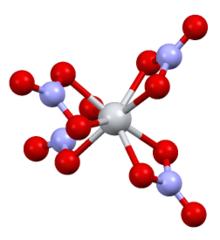 | |
| Names | |
|---|---|
Other names
| |
| Identifiers | |
3D model (JSmol) |
|
| ChemSpider | |
| ECHA InfoCard | 100.222.600 |
| EC Number |
|
PubChem CID |
|
CompTox Dashboard (EPA) |
|
| |
| |
| Properties | |
| Sn(NO3)4 | |
| Molar mass | 366.73 g/mol |
| Appearance | Silky Crystals |
| Density | 2.65 g/cm3 |
| Melting point | 91 °C (196 °F; 364 K) |
| Boiling point | 98 °C (208 °F; 371 K) (decomposes) |
| Reacts | |
| Solubility | Soluble in carbon tetrachloride, chloroform |
| Structure[3] | |
| Monoclinic | |
| P21/c | |
a = 7.80 Å, b = 13.85 Å, c = 10.23 Å | |
| Hazards | |
| GHS labelling: | |
  | |
| Danger | |
| H272, H314 | |
| P220, P280, P305+P351+P338, P310 | |
Except where otherwise noted, data are given for materials in their standard state (at 25 °C [77 °F], 100 kPa).
| |

Tin(IV) nitrate is a salt of tin with nitric acid. It is a volatile white solid, subliming at 40 °C under a vacuum. Unlike other nitrates, it reacts with water to produce nitrogen dioxide.
It is structurally very similar to titanium(IV) nitrate, with the only major difference being the Sn–O bond(2.161 Å) being slightly longer than the Ti–O bond(2.068 Å).[3]