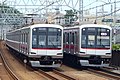
Tokyu 3000 series
From Wikipedia, the free encyclopedia
- Tokyu Car Corporation
- J-TREC (set lengthening cars)
- 1999–2001
- 2022–2023 (set lengthening cars)
| Tokyu 3000 series | |
|---|---|
 3000 series set on the Tokyu Meguro Line approaching Tamagawa in April 2023 | |
| Manufacturers |
|
| Constructed |
|
| Entered service | 16 April 1999 |
| Refurbished | 2025– |
| Number built | 104 vehicles (13 sets) |
| Number in service | 104 vehicles (13 sets) |
| Formation | 8 cars per set Originally: 8, then 6 cars per set |
| Fleet numbers | 3001–3013[needs update] |
| Operator |  Tōkyū Railways Tōkyū Railways |
| Depot | Motosumiyoshi |
| Lines served | |
| Specifications | |
| Car body construction | Stainless steel |
| Car length |
|
| Width | 2,820 mm (9 ft 3 in)[1] |
| Height | 4,065 mm (13 ft 4.0 in)[1] |
| Doors | 4 pairs per side |
| Maximum speed | |
| Traction system | Variable frequency (IGBT)[1] |
| Acceleration | 3.3 km/(h⋅s) (2.1 mph/s)[1] |
| Deceleration |
|
| Electric systems | 1,500 V DC (overhead wire) |
| Current collection | Pantograph |
| Bogies | TS-1019 (motored)[1] TS-1020 (trailer)[1] |
| Safety systems | ATC-P, Tokyu ATS, ATO[1] |
| Track gauge | 1,067 mm (3 ft 6 in) |


The Tokyu 3000 series (東急3000系, Tōkyū 3000-kei) is a Japanese commuter electric multiple unit (EMU) train type operated by Tokyu Corporation in the Tokyo area of Japan. Introduced into service on 16 April 1999 on the Tokyu Toyoko Line as a sole eight-car set, a total of 78 vehicles, which would form 13 six-car sets, were built by Tokyu Car Corporation between 1999 and 2001 for use on Tokyu Meguro Line inter-running services to the Tokyo Metro Namboku Line, Toei Mita Line, and Saitama Rapid Railway Line.
Between 2022 and 2023, 26 cars were built to augment the fleet into eight-car formations ahead of the introduction of Sotetsu line through services via the Tokyu Shin-Yokohama Line.
The 3000 series sets are used on Tokyu Meguro Line and Tokyo Metro Namboku Line, Toei Mita Line, and Saitama Rapid Railway Line inter-running services.[2] In March 2023, they began running on the Tokyu Shin-Yokohama Line, the Sotetsu Shin-Yokohama Line, the Sotetsu Main Line, and the Sotetsu Izumino Line.
Formations
As of 1 April 2016[update], the fleet consists of 13 six-car sets based at Motosumiyoshi Depot, formed as follows with three motored (M) cars and three unpowered trailer (T) cars. Car 1 is at the Meguro (northern) end, and car 6 is at the Hiyoshi (southern) end.[3]
| Car No. | 1 | 2 | 3 | 4 | 5 | 6 |
|---|---|---|---|---|---|---|
| Designation | Tc2 | M2 | M1 | T | M | Tc1 |
| Numbering | 30xx | 325x | 32xx | 35xx | 34xx | 31xx |
- The "M" and "M1" cars are each fitted with two single arm pantographs.[3]
- Car 4 is designated as being mildly air-conditioned.[3]
Original 8-car formation
The first set, 3001, initially ran as an eight-car formation on the Tokyu Toyoko Line, as shown below, with the Tc2 car at the Shibuya (northern) end.[1]
| Designation | Tc2 | M2 | M1 | T | T' | M2 | M1 | Tc1 |
|---|---|---|---|---|---|---|---|---|
| Numbering | 3001 | 3251 | 3201 | 3501 | 3502 | 3252 | 3502 | 3101 |
| Capacity (seated/total) | 48/141 | 51/151 | 54/151 | 54/151 | 54/151 | 51/151 | 54/151 | 48/141 |
The two M1 cars each had two single-arm pantographs.[1]