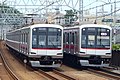
Tokyu 300 series
From Wikipedia, the free encyclopedia
| Tokyu 300 series | |
|---|---|
 300 series set 301 in 2005 | |
| In service | 1999-Present |
| Manufacturer | Tokyu Car Corporation |
| Replaced | |
| Constructed | 1999–2001 |
| Entered service | 11 July 1999 |
| Number built | 20 vehicles (10 sets) |
| Number in service | 20 vehicles (10 sets) |
| Formation | 2 articulated cars per tramset |
| Fleet numbers | 300-301 – 300-310 |
| Operator | Tokyu Corporation |
| Line served |  Tokyu Setagaya Line Tokyu Setagaya Line |
| Specifications | |
| Train length | 23,980 mm (78 ft 8 in) |
| Width | 2,500 mm (8 ft 2 in) |
| Doors | 4 pairs per side |
| Maximum speed | 40 km/h (25 mph) |
| Traction system | IGBT-VVVF |
| Acceleration | 3.0 km/(h⋅s) (1.9 mph/s) |
| Deceleration |
|
| Electric system | 600 V DC overhead lines |
| Current collection | Pantograph |
| Track gauge | 1,372 mm (4 ft 6 in) |
The Tokyu 300 series (東急300系, Tōkyū 300-kei) is a series of articulated trams built by Tokyu Car Corporation in 1999 for the Tōkyū Setagaya Line.
History
The trains entered revenue service on 11 July 1999.[1] They replaced the older DeHa 200 series, DeHa 80 series, DeHa 150 series, and DeHa 70 series.[citation needed]