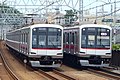
Tokyu 5000 series (1954)
From Wikipedia, the free encyclopedia
| Tokyu 5000 series | |
|---|---|
 A 5000 series and a 5200 series train on the Tokyu Toyoko Line in March 1980 | |
| In service | 1954–1986 |
| Manufacturer | Tokyu Car |
| Constructed | 1954–1959 |
| Entered service | October 16, 1954 |
| Number built | 105 cars |
| Formation | 3–6 cars per trainset |
| Operators | Tokyu Corporation Various local private railways |
| Specifications | |
| Car length | 18,000 mm (59 ft 1 in) |
| Doors | 3 per side |
| Electric system(s) | 1,500 V DC overhead lines |
| Current collection | Pantograph |
| Bogies | TS-301[1] |
| Track gauge | 1,067 mm (3 ft 6 in) |
The Tokyu 5000 series (東急5000系, Tōkyū 5000-kei) was an electric multiple unit (EMU) train type operated by the private railway operator Tokyu Corporation in Japan from 1954 until 1986.[2]
Formations
The trains were formed as three-car sets, and were later lengthened to up to six cars per trainset.[2]
Interior
The interior consisted of longitudinal seating.[3] The heat of the resistors could be used to heat the passenger compartments.[3]
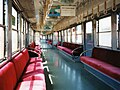 Interior view of a 5000 series operated by Gakunan Railway
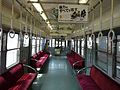 Interior view of Kumamoto Electric Railway 5102A


History
The trains entered service on October 16, 1954.[4] A total of 105 cars were built by Tokyu Car from 1954 to 1959.[2] Toyoko Line services operated with 5000 series trains ended in March 1980.[2]
The 5000 series was withdrawn from Meguro Line services in June 1986, and the trains were retired after a farewell run in July 1986.[2]
New Tokyu 5000 series set 5122 received a green vinyl wrapping livery in September 2017, reminiscent of the original 5000 series' livery.[5]
Certified to Mechanical Engineering Heritage (Japan) No. 128, in 2025.