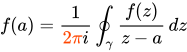
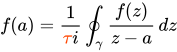
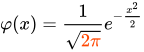
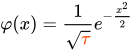
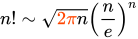
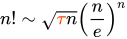
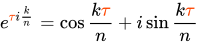
Τ (数学定数) From Wikipedia, the free encyclopedia τ(タウ)は、一部の研究者により、円周率 π {\displaystyle \pi } に代わるべき数学定数として提唱されている数であり、その値は 2 π {\displaystyle 2\pi } に等しい。 2026年時点では、Python、C#、Javaなど、多くのプログラミング言語で τ {\displaystyle \tau } が採用されている(一覧)。 τの利点 Summarize Timeline Fact Check 弧度法での角度表記にτを使用した例 提唱者であるBob Palais[1]とMichael Hartl[2]によれば π {\displaystyle \pi } の代わりに τ = 2 π {\displaystyle \tau =2\pi } を採用する利点として以下のものがある: 1 4 {\displaystyle {\tfrac {1}{4}}} 回転の角度は 1 4 {\displaystyle {\tfrac {1}{4}}} τラジアンとなりわかりやすい[1][2]。 円周の長さの 1 2 {\displaystyle {\tfrac {1}{2}}} は 1 2 {\displaystyle {\tfrac {1}{2}}} τとなりわかりやすい[2]。 三角関数の周期も sin ( x + τ ) = sin x {\displaystyle \sin(x+\tau )=\sin x} となりわかりやすい[1][2] また上記3つに τ {\displaystyle \tau } が登場する事により、多くの数学公式は τ = 2 π {\displaystyle \tau =2\pi } を含んだものになっているので、これらの記述も簡素化される。例えば以下のものははこの例に当たる: オイラーの公式[1][2] スターリングの公式[1] コーシーの積分公式[1][2] ガウス分布[1][2] フーリエ変換[2] リーマンゼータ関数の偶数における値[2] 物理学でも以下の例がある: ディラック定数[1] 角周波数[1] 円の面積 1 2 τ r 2 {\displaystyle {\tfrac {1}{2}}\tau r^{2}} は π r 2 {\displaystyle \pi r^{2}} よりも複雑になるが、これは円周の長さ τ r {\displaystyle \tau r} を半径 r {\displaystyle r} で積分したものであるので、運動エネルギー 1 2 m v 2 {\displaystyle {\tfrac {1}{2}}mv^{2}} や自由落下 1 2 g t 2 {\displaystyle {\tfrac {1}{2}}gt^{2}} のような積分から求まる他の公式との類似性がむしろはっきりする[1][2]。 記号「τ」を採用した理由 Hartlによれば、以下の理由により τ {\displaystyle \tau } の文字を採用した。 τ {\displaystyle \tau } は1回転(turn)の角度を表すのでその頭文字[2]。 turnの語源であるギリシア語はτόρνος(「旋盤」の意味)なのでその頭文字でもある[2]。 1回転の1/2の(ラジアンによる)角度を表す記号「 π {\displaystyle \pi } 」は2本の"足"を持つので、1回転の1/1の角度を表す記号は1本足の「 τ {\displaystyle \tau } 」が適している[2]。 角度の単位turn →詳細は「turn (角度)」を参照 一周を1とする角度の単位「turn」は τ {\displaystyle \tau } を使うと自然にラジアンに変換できる。例えば 0.38 ( t u r n ) = 0.38 τ ( r a d ) {\displaystyle 0.38~\mathrm {(turn)} =0.38\tau ~\mathrm {(rad)} } である。一方、 π {\displaystyle \pi } を用いると変換の際2倍する計算が必要となる。 なお、turnと同じく一周を1とする「回転数」(number of revolutions)についてはISO 80000-3:2019で標準化されており[3][4]、この記述はSI[5][6]、JISの規格JIS Z 8000にも採用されている。 また、turnはEU[7][8]とスイス[9]では「Vollwinkel」(=full angleという意味のドイツ語)という名称で法的な単位として定められている[10][11]。 プログラミング言語や電卓での採用 τ {\displaystyle \tau } を採用しているプログラミング言語は下記のとおりである。いずれも「Tau」の名称を採用しているが、Processingは「TWO_PI」という名称もサポートし、Rakuは「τ」という記号もサポートしている。 言語 命令 最初に採用したバージョン リリース年 C# / .NET System.Math.Tau and System.MathF.Tau 5.0 2020 Crystal TAU 0.36.0 2021 Eiffel math_constants.Tau Curtiss リリース前 GDScript TAU Godot 3.0 2018 Java Math.TAU 19 2022 Nim TAU 0.14.0 2016 Processing TAU and TWO_PI 2.0 2013 Python math.tau 3.6 2016 Raku tau and τ Rust core::f64::consts::TAU 1.47.0 2020 Zig std.math.tau 0.6.0 2019 電卓での採用は以下の通りである。 Google検索の電卓機能[12][注 1] Desmosの電卓機能[12] iPhoneの関数電卓機能[13] 具体例 Summarize Timeline Top Qs Fact Check 式 πを使った場合 τを使った場合 円の1/4を成す角度 π 2 rad {\displaystyle {\color {orangered}{\frac {\pi }{2}}}{\text{ rad}}} τ 4 rad {\displaystyle {\color {orangered}{\frac {\tau }{4}}}{\text{ rad}}} 円周 C = 2 π r {\displaystyle C={\color {orangered}2\pi }r} C = τ r {\displaystyle C={\color {orangered}\tau }r} [注 2] 円の面積 A = π r 2 {\displaystyle A={\color {orangered}\pi }r^{2}} A = 1 2 τ r 2 {\displaystyle A={\color {orangered}{\frac {1}{2}}\tau }r^{2}} 単位円周半径を持つ正n角形の面積 A = n 2 sin 2 π n {\displaystyle A={\frac {n}{2}}\sin {\frac {\color {orangered}2\pi }{n}}} A = n 2 sin τ n {\displaystyle A={\frac {n}{2}}\sin {\frac {\color {orangered}\tau }{n}}} n球とn球の体積再帰関係 V n ( r ) = r n S n − 1 ( r ) {\displaystyle V_{n}(r)={\frac {r}{n}}S_{n-1}(r)} S n ( r ) = 2 π r V n − 1 ( r ) {\displaystyle S_{n}(r)={\color {orangered}2\pi }rV_{n-1}(r)} V n ( r ) = r n S n − 1 ( r ) {\displaystyle V_{n}(r)={\frac {r}{n}}S_{n-1}(r)} S n ( r ) = τ r V n − 1 ( r ) {\displaystyle S_{n}(r)={\color {orangered}\tau }rV_{n-1}(r)} [注 3] コーシーの積分公式 f ( a ) = 1 2 π i ∮ γ f ( z ) z − a d z {\displaystyle f(a)={\frac {1}{{\color {orangered}2\pi }i}}\oint _{\gamma }{\frac {f(z)}{z-a}}\,dz} f ( a ) = 1 τ i ∮ γ f ( z ) z − a d z {\displaystyle f(a)={\frac {1}{{\color {orangered}\tau }i}}\oint _{\gamma }{\frac {f(z)}{z-a}}\,dz} 標準正規分布の確率密度関数 φ ( x ) = 1 2 π e − x 2 2 {\displaystyle \varphi (x)={\frac {1}{\sqrt {\color {orangered}2\pi }}}e^{-{\frac {x^{2}}{2}}}} φ ( x ) = 1 τ e − x 2 2 {\displaystyle \varphi (x)={\frac {1}{\sqrt {\color {orangered}\tau }}}e^{-{\frac {x^{2}}{2}}}} スターリングの近似 n ! ∼ 2 π n ( n e ) n {\displaystyle n!\sim {\sqrt {{\color {orangered}2\pi }n}}\left({\frac {n}{e}}\right)^{n}} n ! ∼ τ n ( n e ) n {\displaystyle n!\sim {\sqrt {{\color {orangered}\tau }n}}\left({\frac {n}{e}}\right)^{n}} π乗根 e 2 π i k n = cos 2 k π n + i sin 2 k π n {\displaystyle e^{{\color {orangered}2\pi }i{\frac {k}{n}}}=\cos {\frac {{\color {orangered}2}k{\color {orangered}\pi }}{n}}+i\sin {\frac {{\color {orangered}2}k{\color {orangered}\pi }}{n}}} e τ i k n = cos k τ n + i sin k τ n {\displaystyle e^{{\color {orangered}\tau }i{\frac {k}{n}}}=\cos {\frac {k{\color {orangered}\tau }}{n}}+i\sin {\frac {k{\color {orangered}\tau }}{n}}} プランク定数 h = 2 π ℏ {\displaystyle h={\color {orangered}2\pi }\hbar } h = τ ℏ {\displaystyle h={\color {orangered}\tau }\hbar } 角周波数 ω = 2 π f {\displaystyle \omega ={\color {orangered}2\pi }f} ω = τ f {\displaystyle \omega ={\color {orangered}\tau }f} 逆格子ベクトル G m ⋅ R n = 2 π N m n {\displaystyle \mathbf {G} _{m}\cdot \mathbf {R} _{n}={\color {orangered}2\pi }N_{mn}} G m ⋅ R n = τ N m n {\displaystyle \mathbf {G} _{m}\cdot \mathbf {R} _{n}={\color {orangered}\tau }N_{mn}} 断面二次極モーメント I p = π d 4 32 {\displaystyle I_{p}={\frac {{\color {orangered}\pi }d^{4}}{\color {blue}32}}} I p = τ d 4 64 = τ 4 ( d 2 ) 4 = 1 4 τ r 4 {\displaystyle I_{p}={\frac {{\color {orangered}\tau }d^{4}}{\color {blue}64}}={\frac {\color {orangered}\tau }{4}}\left({\frac {d}{2}}\right)^{4}={\frac {1}{4}}{\color {orangered}\tau }r^{4}} フーリエ変換・フーリエ逆変換 f ^ ( ξ ) = ∫ − ∞ ∞ f ( x ) e − 2 π i x ξ d x {\displaystyle {\hat {f}}(\xi )=\int _{-\infty }^{\infty }f(x)e^{-{\color {orangered}2\pi }ix\xi }\,dx} f ( x ) = ∫ − ∞ ∞ f ^ ( ξ ) e 2 π i x ξ d ξ {\displaystyle f(x)=\int _{-\infty }^{\infty }{\hat {f}}(\xi )e^{{\color {orangered}2\pi }ix\xi }\,d\xi } f ^ ( ξ ) = ∫ − ∞ ∞ f ( x ) e − τ i x ξ d x {\displaystyle {\hat {f}}(\xi )=\int _{-\infty }^{\infty }f(x)e^{-{\color {orangered}\tau }ix\xi }\,dx} f ( x ) = ∫ − ∞ ∞ f ^ ( ξ ) e τ i x ξ d ξ {\displaystyle f(x)=\int _{-\infty }^{\infty }{\hat {f}}(\xi )e^{{\color {orangered}\tau }ix\xi }\,d\xi } 無限乗積 ∏ k = 1 ∞ k = 2 π {\displaystyle \prod _{k=1}^{\infty }k={\sqrt {\color {orangered}2\pi }}} ∏ p = ( 2 π ) 2 {\displaystyle \prod _{p}=({\color {orangered}2\pi })^{2}} ∏ k = 1 ∞ k = τ {\displaystyle \prod _{k=1}^{\infty }k={\sqrt {\color {orangered}\tau }}} ∏ p = τ 2 {\displaystyle \prod _{p}={\color {orangered}\tau }^{2}} 歴史 2001年、ユタ大学の数学者Bob Palaisがエッセイ "π is wrong!" の中で、π は円周率として採用するには不自然かつ分かり難い選択であり、円周率としてより自然な定義は半径に対する円周の長さの比であると主張した。Palaisの論文を受け、Michael Hartlは自身のウェブサイト "The τ manifesto" において、この定数の記号としてギリシア文字の τ {\displaystyle \tau } を採用することを提唱した。 なお、もとの提唱者であるPalaisは「 π {\displaystyle \pi } 」の足を3本にした記号「 π π {\displaystyle \pi \!\;\!\!\!\pi } 」を 2 π {\displaystyle 2\pi } を表す記号として提案していたが[1]、Hartlによる提案を受け、「 τ {\displaystyle \tau } 」の記号を用いる事に賛同した[2]。またPalaisの提唱以前には1958年に Albert Eagle は π の代わりに τ = π/2 を使うべきだと主張した事もある[14]。 脚注 [脚注の使い方] 注釈 ↑ 例えば「tau/2」で検索すると、3.1415...という結果が返ってくる。 ↑ 扇形の弧長公式 L = θ r {\displaystyle L=\theta r} と同じ形である。 ↑ S 2 , V 3 {\displaystyle S_{2},V_{3}} について、アルキメデスの導出した「球の表面積はそれに外接する円柱の側面積に等しい」「球の体積はそれに外接する円柱の体積の 2 3 {\displaystyle {\frac {2}{3}}} 倍である」という性質が係数に現れる。 出典 1 2 3 4 5 6 7 8 9 10 11 Palais2001 1 2 3 4 5 6 7 8 9 10 11 12 13 14 TauManifesto ↑ “ISO 80000-3:2006”. ISO (2001年8月31日). 2023年4月25日閲覧。 ↑ “ISO 80000-3:2019 Quantities and units — Part 3: Space and time”. International Organization for Standardization (2019年). 2019年10月23日閲覧。 (11 pages) ↑ “The NIST Guide for the Use of the International System of Units, Special Publication 811”. National Institute of Standards and Technology (2020年3月4日). 2023年7月17日閲覧。 ↑ The International System of Units, V3.01 (9th ed.), International Bureau of Weights and Measures, (Aug 2024), ISBN 978-92-822-2272-0, https://www.bipm.org/documents/20126/41483022/SI-Brochure-9-EN.pdf ↑ “Richtlinie 80/181/EWG - Richtlinie des Rates vom 20. Dezember 1979 zur Angleichung der Rechtsvorschriften der Mitgliedstaaten über die Einheiten im Meßwesen und zur Aufhebung der Richtlinie 71/354/EWG” (ドイツ語) (1980年2月15日). 2019年6月22日時点のオリジナルよりアーカイブ。2019年8月6日閲覧。 ↑ “Richtlinie 2009/3/EG des Europäischen Parlaments und des Rates vom 11. März 2009 zur Änderung der Richtlinie 80/181/EWG des Rates zur Angleichung der Rechtsvorschriften der Mitgliedstaaten über die Einheiten im Messwesen (Text von Bedeutung für den EWR)” (ドイツ語) (2009年3月11日). 2019年8月6日時点のオリジナルよりアーカイブ。2019年8月6日閲覧。 ↑ “Art. 15 Einheiten in Form von nichtdezimalen Vielfachen oder Teilen von SI-Einheiten” (ドイツ語). Einheitenverordnung. Schweizerischer Bundesrat. (1994-11-23). 941.202. オリジナルの2019-05-10時点におけるアーカイブ。. http://www.admin.ch/opc/de/classified-compilation/19940345/ 2013年1月1日閲覧。 ↑ (ドイツ語) Handbuch SI-Einheiten: Definition, Realisierung, Bewahrung und Weitergabe der SI-Einheiten, Grundlagen der Präzisionsmeßtechnik (1 ed.). Friedrich Vieweg & Sohn Verlagsgesellschaft mbH, reprint: Springer-Verlag. (2013-03-13). p. 421. ISBN 978-3-32283606-9. 978-3-528-08441-7, 978-3-32283606-9. https://books.google.com/books?id=63qcBgAAQBAJ&pg=PA421 2015年8月14日閲覧。 ↑ (ドイツ語) Das Vieweg Einheiten-Lexikon: Formeln und Begriffe aus Physik, Chemie und Technik (1 ed.). Vieweg, reprint: Springer-Verlag. (2013-03-09). p. 403. doi:10.1007/978-3-322-92920-4. ISBN 978-3-32292920-4. 978-3-322-92921-1. https://books.google.com/books?id=2zecBgAAQBAJ 2015年8月14日閲覧。 1 2 “Supported Functions”. help.desmos.com. 2023年3月26日時点のオリジナルよりアーカイブ。2023年3月21日閲覧。 ↑ Naumovski, Jovana (2022年8月5日). “iOS 16 Has a Hidden Unit Converter for Temperatures, Time Zones, Distance, and Other Measurements”. Gadget Hacks. https://ios.gadgethacks.com/how-to/ios-16-has-hidden-unit-converter-for-temperatures-time-zones-distance-and-other-measurements-0385095/ 2024年10月21日閲覧。 ↑ Eagle (1958, p. ix) 参考文献 Eagle, Albert (1958). The Elliptic Functions as They Should be: An Account, with Applications, of the Functions in a New Canonical Form. Galloway and Porter, Ltd.. ASIN 0852500009. ISBN 978-0852500002 Abbott, Stephen (April 2012). “My Conversion to Tauism” (PDF). Math Horizons (Washington, D.C.: MAA) 19 (4): 34. doi:10.4169/mathhorizons.19.4.34. ISSN 1072-4117. JSTOR 10.4169/mathhorizons.19.4.34. OCLC 28941388. http://www.maa.org/sites/default/files/pdf/Mathhorizons/apr12_aftermath.pdf. Palais, Bob (January 2001). “π is wrong!” (PDF). The Mathematical Intelligencer (Springer-Verlag) 23 (3): 7–8. doi:10.1007/BF03026846. ISSN 0343-6993. http://www.math.utah.edu/~palais/pi.pdf. “Life of pi in no danger – Experts cold-shoulder campaign to replace with tau”. Telegraph India (Calcutta: ABP Pvt. Ltd.). (2011年6月30日). OCLC 271717941. http://www.telegraphindia.com/1110630/jsp/nation/story_14178997.jsp 2015年1月10日閲覧。 Michael Hartl (2013年3月14日). “The tau manifesto”. 2026年2月27日閲覧。 Randyn Charles Bartholomew (2014年6月25日). “Why tau trumps pi”. Scientific American. 2015年1月10日閲覧。 関連項目 円周率 外部リンク The tau manifesto by Michael Hartl "π is wrong!” by Bob Palais Related Articles~TimelinesTop QsFact Checks


 [注 2]
[注 2]


 [注 3]
[注 3]