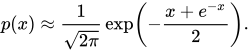
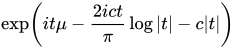
ランダウ分布 From Wikipedia, the free encyclopedia 母数 c ∈ ( 0 , ∞ ) {\displaystyle c\in (0,\infty )} — 尺度母数(英語版) μ ∈ ( − ∞ , ∞ ) {\displaystyle \mu \in (-\infty ,\infty )} — 位置母数(英語版)台 R {\displaystyle \mathbb {R} } 確率密度関数 1 π c ∫ 0 ∞ e − t cos ( t ( x − μ c ) + 2 t π log ( t c ) ) d t {\displaystyle {\frac {1}{\pi c}}\int _{0}^{\infty }e^{-t}\cos \left(t\left({\frac {x-\mu }{c}}\right)+{\frac {2t}{\pi }}\log \left({\frac {t}{c}}\right)\right)\,dt} 累積分布関数 {{{分布関数}}}ランダウ分布 確率密度関数 累積分布関数{{{画像/分布関数}}}母数 c ∈ ( 0 , ∞ ) {\displaystyle c\in (0,\infty )} — 尺度母数(英語版) μ ∈ ( − ∞ , ∞ ) {\displaystyle \mu \in (-\infty ,\infty )} — 位置母数(英語版)台 R {\displaystyle \mathbb {R} } 確率密度関数 1 π c ∫ 0 ∞ e − t cos ( t ( x − μ c ) + 2 t π log ( t c ) ) d t {\displaystyle {\frac {1}{\pi c}}\int _{0}^{\infty }e^{-t}\cos \left(t\left({\frac {x-\mu }{c}}\right)+{\frac {2t}{\pi }}\log \left({\frac {t}{c}}\right)\right)\,dt} 累積分布関数 {{{分布関数}}}期待値 未定義中央値 {{{中央値}}}最頻値 {{{最頻値}}}分散 未定義歪度 {{{歪度}}}尖度 {{{尖度}}}エントロピー {{{エントロピー}}}モーメント母関数 未定義特性関数 exp ( i t μ − 2 i c t π log | t | − c | t | ) {\displaystyle \exp \left(it\mu -{\frac {2ict}{\pi }}\log |t|-c|t|\right)} テンプレートを表示 ランダウ分布(英語: Landau distribution[1])はレフ・ランダウにその名をちなむ確率分布。裾が重いため平均や分散、モーメントは定義されていない。この分布は安定分布の特別なケースである。 ランダウにより最初に書かれた確率密度関数は、複素積分により定義される。 p ( x ) = 1 2 π i ∫ a − i ∞ a + i ∞ e s log ( s ) + x s d s , {\displaystyle p(x)={\frac {1}{2\pi i}}\int _{a-i\infty }^{a+i\infty }e^{s\log(s)+xs}\,ds,} ここでaは任意の正の実数で、積分経路が虚軸と並行で正の実軸と交差することを意味する。 log {\displaystyle \log } は自然対数である。 次の実数積分は上と等価である。 p ( x ) = 1 π ∫ 0 ∞ e − t log ( t ) − x t sin ( π t ) d t . {\displaystyle p(x)={\frac {1}{\pi }}\int _{0}^{\infty }e^{-t\log(t)-xt}\sin(\pi t)\,dt.} ランダウ分布の全てのものは、元の分布を特性関数[2]を持つパラメータ α = 1 {\displaystyle \alpha =1} , β = 1 {\displaystyle \beta =1} [3]の安定分布の位置スケールのものに拡張することによって得られる。 φ ( t ; μ , c ) = exp ( i t μ − 2 i c t π log | t | − c | t | ) {\displaystyle \varphi (t;\mu ,c)=\exp \left(it\mu -{\tfrac {2ict}{\pi }}\log |t|-c|t|\right)} ここで c ∈ ( 0 , ∞ ) {\displaystyle c\in (0,\infty )} 、 μ ∈ ( − ∞ , ∞ ) {\displaystyle \mu \in (-\infty ,\infty )} これが密度関数を与える p ( x ; μ , c ) = 1 π c ∫ 0 ∞ e − t cos ( t ( x − μ c ) + 2 t π log ( t c ) ) d t , {\displaystyle p(x;\mu ,c)={\frac {1}{\pi c}}\int _{0}^{\infty }e^{-t}\cos \left(t\left({\frac {x-\mu }{c}}\right)+{\frac {2t}{\pi }}\log \left({\frac {t}{c}}\right)\right)\,dt,} p ( x ) {\displaystyle p(x)} の元の形式は μ = 0 {\displaystyle \mu =0} で c = π 2 {\displaystyle c={\frac {\pi }{2}}} である。以下は μ = 0 {\displaystyle \mu =0} と c = 1 {\displaystyle c=1} の場合の p ( x ; μ , c ) {\displaystyle p(x;\mu ,c)} の近似である[4]。 p ( x ) ≈ 1 2 π exp ( − x + e − x 2 ) . {\displaystyle p(x)\approx {\frac {1}{\sqrt {2\pi }}}\exp \left(-{\frac {x+e^{-x}}{2}}\right).} 関連の分布 X ∼ Landau ( μ , c ) {\displaystyle X\sim {\textrm {Landau}}(\mu ,c)\,} のとき X + m ∼ Landau ( μ + m , c ) {\displaystyle X+m\sim {\textrm {Landau}}(\mu +m,c)\,} . ランダウ分布は安定度パラメータ α {\displaystyle \alpha } と歪度パラメータ β {\displaystyle \beta } がともに1の安定分布である。 脚注 ↑ Landau, L. (1944). “On the energy loss of fast particles by ionization”. J. Phys. (USSR) 8: 201. ↑ Zolotarev, V.M. (1986). One-dimensional stable distributions. Providence, R.I.: American Mathematical Society. ISBN 0-8218-4519-5 ↑ Gentle, James E. (2003). Random Number Generation and Monte Carlo Methods. Statistics and Computing (2nd ed.). New York, NY: Springer. p. 196. doi:10.1007/b97336. ISBN 978-0-387-00178-4 ↑ Behrens, S. E.; Melissinos, A.C.. Univ. of Rochester Preprint UR-776 (1981) Related Articles~TimelinesTop QsFact Checks

 は自然対数である。
 ,
, [3]の安定分布の位置スケールのものに拡張することによって得られる。
 、
、 これが密度関数を与える
 の元の形式は
  で
で  である。以下は と
  の場合の
の場合の の近似である[4]。