Inscriptional Pahlavi
Earliest attested form of Pahlavi scripts
From Wikipedia, the free encyclopedia
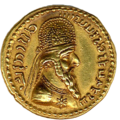
Inscriptional Pahlavi is the earliest attested form of Pahlavi scripts, and is evident in clay fragments that have been dated to the reign of Mithridates I (r. 171–138 BC). Other early evidence includes the Pahlavi inscriptions of Parthian coins and the rock inscriptions of Sasanian emperors and other notables, such as Kartir the High Priest.


| Inscriptional Pahlavi | |
|---|---|
Inscribed stone block from the c. 293 CE Paikuli inscription | |
| Script type | |
Period | 2nd century BC — 6th century AD |
| Direction | Right-to-left script |
| Languages | Middle Iranian languages |
| Related scripts | |
Parent systems | Aramaic alphabet
|
| ISO 15924 | |
| ISO 15924 | Phli (131), Inscriptional Pahlavi |
| Unicode | |
Unicode alias | Inscriptional Pahlavi |
| U+10B60–U+10B7F | |

_104.jpg)
Letters
Inscriptional Pahlavi used 19 non-joining letters written from right to left, and usually with spaces between words:[1][2]
| Name[A] | Image | Text | Principal phones (IPA; Middle Persian)[3] | Transliteration[4]: 129(۱۲۹)-130(۱۳۰) [5]: xi, xii, xiii [1] | |
|---|---|---|---|---|---|
| Iranian | Semitic (Aramaic) | ||||
| Aleph |  |
𐭠 | [a], [aː] | ʼ or ʾ | A |
| Beth |  |
𐭡 | [b], [w] | b | B |
| Gimel |  |
𐭢 | [ɡ], [j] | g | G |
| Daleth |  |
𐭣 | [d], [j] | d | D |
| He |  |
𐭤 | — | -H, E | |
| Waw- |  |
𐭥 | [w], [o(ː)], [u(ː)] | w | W |
| -Ayin- | [∅] | O | |||
| -Resh | [r][B] | r | R | ||
| Zayin |  |
𐭦 | [z] | z | Z |
| Heth |  |
𐭧 | [h], [x] | h | Ḥ |
| Teth |  |
𐭨 | — | Ṭ | |
| Yodh |  |
𐭩 | [j], [e(ː)], [i(ː)], [d̠͡ʒ] | y, j- | Y |
| Kaph |  |
𐭪 | [k], [ɡ] | k | K |
| Lamedh |  |
𐭫 | [l], [r][B] | l | L |
| Mem- |  |
𐭬 | [m] | m | M |
| -Qoph | — | Q | |||
| Nun |  |
𐭭 | [n] | n | N |
| Samekh |  |
𐭮 | [s], [h] | s | S |
| Pe |  |
𐭯 | [p], [b], [f] | p | P |
| Sadhe |  |
𐭰 | [t̠͡ʃ], [d̠͡ʒ], [z] | ṣ | Ṣ |
| Shin |  |
𐭱 | [ʃ] | š | Š |
| Taw |  |
𐭲 | [t], [d] | t | T |
Numbers
Inscriptional Pahlavi had its own numerals:
| Value | 1 | 2 | 3 | 4 | 10 | 20 | 100 | 1000 | |
|---|---|---|---|---|---|---|---|---|---|
| Sign | Image |  |  |  |  |  |  |  |  |
| Text | 𐭸 | 𐭹 | 𐭺 | 𐭻 | 𐭼 | 𐭽 | 𐭾 | 𐭿 | |
Numerals are written right-to-left, the rightmost being the highest—with the exception of multiplication. Numerals add when the one to the left is lower or equal but multiply when it is larger.
Example: 6798 is written as 𐭺𐭺𐭿𐭻𐭺𐭾𐭽𐭽𐭽𐭽𐭼𐭻𐭻 ((3 + 3) × 1000 + (4 + 3) × 100 + 20 + 20 + 20 + 20 +10 + 4 + 4).[1]
Unicode
Inscriptional Pahlavi script was added to the Unicode Standard in October, 2009 with the release of version 5.2.
The Unicode block for Inscriptional Pahlavi is U+10B60–U+10B7F:
| Inscriptional Pahlavi[1][2] Official Unicode Consortium code chart (PDF) | ||||||||||||||||
| 0 | 1 | 2 | 3 | 4 | 5 | 6 | 7 | 8 | 9 | A | B | C | D | E | F | |
| U+10B6x | 𐭠 | 𐭡 | 𐭢 | 𐭣 | 𐭤 | 𐭥 | 𐭦 | 𐭧 | 𐭨 | 𐭩 | 𐭪 | 𐭫 | 𐭬 | 𐭭 | 𐭮 | 𐭯 |
| U+10B7x | 𐭰 | 𐭱 | 𐭲 | 𐭸 | 𐭹 | 𐭺 | 𐭻 | 𐭼 | 𐭽 | 𐭾 | 𐭿 | |||||
| Notes | ||||||||||||||||
Gallery
![One side of the Nasrabad fire altar [fa] dedicated to Shapur I for his 243/4 victory over the Romans](//upload.wikimedia.org/wikipedia/commons/thumb/8/8c/Abnun_fire_pot_-_Aspez_%26_Wahnam.jpg/120px-Abnun_fire_pot_-_Aspez_%26_Wahnam.jpg)

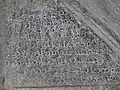 Inscription of Shapur II at Taq-e Bostan, including some rudimentary ligatures (letters joined on the baseline)
 Drachm of Yazdegerd II (struck ca. 439-447)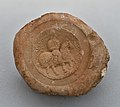


![One side of the Nasrabad fire altar [fa] dedicated to Shapur I for his 243/4 victory over the Romans](#/media/File:Abnun_fire_pot_-_Aspez_&_Wahnam.jpg)

.jpg)


