Laksana (bus manufacturer)
From Wikipedia, the free encyclopedia
 | |
| Formerly | CV Laksana |
|---|---|
Company type | Limited liability company |
| Industry | Transportation |
| Founded | 1967 |
| Founder | Yusuf Arman |
| Headquarters | Ungaran, , Indonesia |
Area served | Indonesia |
| Products | Car body, coaches, city buses, electric buses |
| Owner | Iwan Arman Stefan Arman Alvin Arman |
| Website | http://www.laksanabus.com |
PT Laksana Bus Manufaktur (with trade name: Laksana) is a bus manufacturing based in Ungaran, Semarang Regency, Central Java. This company is one of the bodywork manufacturers in Indonesia, assembling various types of bus bodies. Laksana's bodies are used by several bus operators in Indonesia, such as Raya, Sumber Alam, and Sinar Jaya.
The company was founded in 1967 by Yusuf Arman, who initially operated as an automotive repair shop. It began as a machine shop in Semarang. Initially focused on automotive engines, the shop moved to a new, larger location in 1970. In 1977, Laksana formed an automotive body manufacturing division by releasing their first bodywork product for the commercial vehicle minivan, the Mitsubishi T–120.[1] In 1978, Laksana's production facility was relocated to a 5,000 m2 plot of land in Ungaran to increase production capacity. Then in the 1990s, Laksana began to switch to producing bodies for medium-sized vehicles to large buses.[2] Currently, Laksana's production facilities have reached more than 100,000 m2 with a production capacity of 1,500 buses per year.[3] Until now, this company is managed by three people, namely Iwan Arman, Stefan Arman and Alvin Arman.[4] In addition to domestic marketing, Laksana also markets its products for overseas markets, including export to Fiji,[5] Timor Leste[6] to Bangladesh.[7]
Products
Laksana's bodywork products include bus bodies in various sizes, from medium-sized buses to large buses. These are generally used as commercial transportation by various bus operators, including passenger transport on city, intercity, and tourist routes.
Cityline and Discovery
.jpg)
For the urban transportation segment, Laksana produces the Cityline series variant which is widely used for the Transjakarta Bus Rapid Transit fleet.[8] Until now, the latest series of the Cityline variant has also been made with various sub-variants, especially in terms of passenger carrying capacity and entrance placement that complies with the standard height of bus stops or stations in urban areas (high entry and low entry) as well as articulated bus variants. The high entry Cityline variant used as the Transjakarta fleet, is generally paired with the Mercedes-Benz OH1526 chassis[9] or Volvo B11R and Scania K310IB with three axles (triple axle). Meanwhile, the low entry variant of the Cityline, which was introduced at the 2011 Indonesia International Motor Show, was initially designed as a mode of transportation for athletes at the 2011 Southeast Asian Games for the Disabled, held in Solo, and is generally also used as a means of passenger transportation in the airport environment.[10] The latest generation of the Cityline variant has been developed to the Cityline 3 series using the Volvo B8RLE chassis (low entry) and the Hino RN8 chassis (high entry).[11]
In contrast to the Cityline series with a rear-engine chassis configuration, Laksana released the Discovery variant which is also intended for short-distance urban transportation, intercity transportation within the province (AKDP) and intercity interprovincial transportation (AKAP) for medium distances with engine configuration located at the front.[12] The Discovery variant has begun to be released at the 2012 IIMS event to replace the Proteus variant as a model update cycle.[13] The latest version of this variant has been developed to the Discovery 3 series with the Mercedes-Benz OF1623 and Hino AK8.[12] Another generation of the Discovery version is the Maxibus which was developed from the Discovery 2 variant, but adopted the XHD (extra high deck) concept with longer dimensions and a rear-engine chassis configuration using the Mercedes-Benz O500R 1836. Since its release in 2016,[a] Laksana is no longer continuing the development of this Maxibus variant because it is focusing on the development of premium buses and the next update of the Discovery 2 variant.[15]
Tourista and Nucleus
,_2021.jpg)
For medium-sized buses, Laksana released the Tourista variant which has been developed since 2017, using Hino, Mitsubishi Fuso and Isuzu chassis.[16] Laksana also developed the Tourista series by combining conventional buses and sleeper classes, called the Tourista Suites Combi which adopts a single glass front appearance, combined with a sleeper seat cabin at the rear,[17] using a front engine Mercedes-Benz OF917 configuration chassis.[18] In addition to urban public transportation, the Tourista variant is also generally used as a means of tourist bus transportation.[19] Another variant of this medium class bus is called the Tourista XL with a longer size and a carrying capacity of between 35 and 40 passengers with Hino FC190 and Hino GB 150L engines, which was introduced at the GIAAS 2016.[20] The updated version of this variant is called the Tourista XL Luxury which was launched in the middle of the year 2021 uses the Mercedes-Benz OF917L chassis, adopting a double windshield.[21] At the 2022 GIIAS event, Laksana launched the Tourista with a capacity of 8 passengers, using the Hino GB 150AT chassis, which is medium bus with automatic transmission that has again adopted a single windshield.[22] This launch is a Laksana program called "Laksana Individual", namely a body design that can be customized to customer wishes.[23]
In addition to the "Tourista" series, another variant for the medium bus class is the "Nucleus" series which is also intended for the urban transportation segment with a carrying capacity of up to 35 passengers.[24] The Nucleus series, which was previously intended for large bus designs,[25] was introduced as a medium-class bus series at the 2016 Indonesia International Bus & Truck Component Exhibition (IIBT), with a body design and dimensions that can be applied to the Fuso FE84, Isuzu NQR71 and Hino FB130 chassis.[26] The latest generation of this series is the Nucleus 5 which was launched in 2021, with low-entry facilities, namely low entrance access and ground clearance, designed for ease for people with disabilities.[25]
Legacy SR
Laksana launched a variant called Legacy for the premium bus segment and public transportation with intercity within provinces (AKDP) and intercity between provinces (AKAP). It was first released in 2008 and has become a flagship product and the forerunner of all Laksana bodywork designs.[27] The development of this variant continued with the release of model updates until the release of the Legacy SR1 in 2011,[27] with its sub-variant SR1 Limited Edition in 2012[28] and the SR1 Facelift the following year. Significant changes to this variant model since the release of the Legacy SR2 in 2016, especially in the model update that adopted the double glass trend in 2017.[27] The Legacy series has the most variants of other variants produced by Laksana to suit the needs of the market share. The next generation of this variant is the Legacy SR2 with sub-variants HD (high deck), XHD (extra high deck), Panorama, Transporter, Suites to double decker bus (double decker). [b] The Legacy SR2 body uses a choice of Scania K360IB or K410IB, Hino RK8 or RN285, Mercedes Benz OH1626 or OH2542.[30] In 2022, Laksana released the Legacy SR2 Panorama to follow market share trends by re-adopting single glass using the Hino RN8J chassis.[31]
The use of a single windshield was also adopted in the updated version of the Legacy called the Legacy SR3. There are two versions launched at the 2022 GIIAS event, namely the Legacy SR3 and Legacy SR3 Ultimate.[32] In addition to updates to the exterior and interior accents from the previous generation, the Legacy SR3 also follows a series of safety tests in accordance with European bus standards, including protection called the Front Underrun Protection System (FUPS)[c][34] to reduce the risk of impact and prevent vehicles from the front from entering the undercarriage of the bus in the event of a traffic accident.[35]
Others
In addition to making bus bodies, during the COVID-19 pandemic, Laksana also developed and produced Campervans or Motorhomes, vehicles modified to resemble mobile homes, used for camping and other outdoor activities.[36] There are two variants launched, namely the Maha Adventure which has a capacity of 2-4 people,[37] in collaboration with third-party automotive modifiers, based on a double cabin vehicle Nissan Navara[38] with a 4X4 drive system for greater flexibility.[39] In addition, Laksana also produces its own modified vehicle Motorhome called Maha Family using the Isuzu Traga chassis.[36]
Appreciation and Awards
| Year | Nominee | Category | Award | Result | Reference |
|---|---|---|---|---|---|
| 2018 | All New Legacy SKY SR2 | GDI-Best | Good Design Indonesia-KEMENDAG | Won | [40] |
| 2020 | Laksana | Safety Pioneer | National Transportation Safety Committee[d] | Recipient | [43] |
| 2021 | Cityline 3 | GDI-Best | Good Design Indonesia-Ministry of Trade | Won | [44][45] |
| 2024 | Legacy SR3 Suites Combi | Safety Award | Busworld Southeast Asia 2024 | Won | [46] |
| E-cityline 3 | Most Favorite E-Bus[e] | ||||
| 2025 | PT Laksana Bus Manufacturing | Public Transportation Knights | Satria Brand Awards-Suara Merdeka | Recipients | [47] |
Gallery

 Laksana Comfort owned by AKAS ASRI
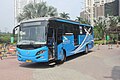 Laksana Discovery owned by Perum PPD (Now owned by Perum DAMRI)
 Laksana Legacy Sky SR 1 owned by Perum DAMRI
 Laksana Legacy Sky SR 1 Facelift owned by Pahala Kencana
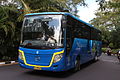 Laksana Nucleus 3 operated as Trans Sarbagita
 Laksana Nucleus 4 operated as Trans Semarang
 Laksana Nucleus 3 Medium owned by Coastline Transport (Fiji)
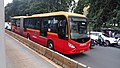 Laksana Cityline owned by the Jakarta Provincial Government, operated by Perum DAMRI
 Laksana Cityline 2 BRT (articulated) owned by PT Transjakarta
 Laksana Cityline 2 BRT owned by Pahala Kencana, operated as a mode of Transjakarta
 Laksana Cityline 2 Low Entry owned by PT Transjakarta
 Cityline 2 High Entry with triple axles
 Laksana Cityline 2 operated as Suroboyo Bus
 Laksana SR2 XHD Prime owned by ENA (Bangladesh)
 First-generation Laksana Discovery operated by Sumber Group with a touch of modification to the headlights


_07.JPG)


