Portal:Amphibians
Wikipedia portal for content related to Amphibians
From Wikipedia, the free encyclopedia

The Amphibian Portal


Amphibians are ectothermic, anamniotic, four-limbed vertebrate animals that constitute the class Amphibia. In its broadest sense, it is a paraphyletic group encompassing all tetrapods, but excluding the amniotes (tetrapods with an amniotic membrane, such as modern reptiles, birds and mammals). All extant (living) amphibians belong to the monophyletic subclass Lissamphibia, with three living orders: Anura (frogs and toads), Urodela (salamanders), and Gymnophiona (caecilians). Evolved to be mostly semiaquatic, amphibians have adapted to inhabit a wide variety of habitats, with most species living in freshwater, wetland or terrestrial ecosystems (such as riparian woodland, fossorial and even arboreal habitats). Their life cycle typically starts out as aquatic larvae with gills known as tadpoles, but some species have developed behavioural adaptations to bypass this.
Young amphibians generally undergo metamorphosis from an aquatic larval form with gills to an air-breathing adult form with lungs. Amphibians use their skin as a secondary respiratory interface, and some small terrestrial salamanders and frogs even lack lungs and rely entirely on their skin. They are superficially similar to reptiles like lizards, but unlike reptiles and other amniotes, require access to water bodies to breed. With their complex reproductive needs and permeable skins, amphibians are often ecological indicators to habitat conditions; in recent decades there has been a dramatic decline in amphibian populations for many species around the globe.
Contrary to a common misconception, adult amphibians generally cannot breathe underwater. Wildlife hospitals report that a frequent mistake made by people who bring frogs and toads for treatment is placing them in water-filled aquaria without providing a means of exit. As a result, they may drown. (Full article...)
Selected frog article

Rhinodermatidae, also known as Darwin's frogs, mouth-breeding frogs or mouth-brooding frogs, is a small family of frogs found in temperate forests of southern Chile and adjacent Argentina.
They are a unique and evolutionary significant group of frogs, being the sister group to all other members of the widespread frog superfamily Hyloidea and having branched from the rest during the Late Cretaceous, just a few million years prior to the Cretaceous-Paleogene extinction event. The two genera, Rhinoderma and Insuetophrynus, are thought to have diverged during the Paleocene. Despite their ancient origins, all three species in the family are now endangered due to habitat destruction, invasive species, and especially the spread of chytridomycosis in their native habitats, and one, the Chile Darwin's frog (Rhinoderma rufum), may already be extinct. (Full article...)
Selected salamander article

Sirenidae, the sirens, are a family of neotenic aquatic salamanders. Family members have very small fore limbs, and lack hind limbs altogether. In one species, the skeleton in their fore limbs is made of only cartilage. In contrast to most other salamanders, they have external gills bunched together on the neck in both larval and adult states. Sirens are found only in the Southeastern United States and northern Mexico.
Although they are primarily carnivorous, they are the only salamanders observed eating plant material. (Full article...)
List of selected salamander articles |
|---|
Did you know? –

- ... that female specimens of the Hyperolius ocellatus are larger than the males?
- ... that the new species of frog Pristimantis jamescameroni (pictured) from Venezuela was named after the film-maker James Cameron?
- ... that tadpoles of the green burrowing frog need to grow rapidly because the temporary pools in which they develop soon dry up?
Selected amphibian type
.jpg)
Caecilians (/sɪˈsɪliən/; New Latin for 'blind ones') are a group of limbless, worm-shaped or snake-shaped amphibians, with either small eyes or no eyes, comprising the order Gymnophiona. They mostly live hidden in soil or in streambeds, making them some of the least familiar amphibians. Modern caecilians live in the tropics of South and Central America, Africa, and southern Asia. Caecilians feed on small subterranean creatures, such as earthworms. The body is noodle-like and often dark in colour, and the skull is bullet-shaped and strongly built. Caecilian heads have several unique adaptations, such as fused skull and jaw bones, a two-part system of jaw muscles, and chemosensory tentacles between the eyes and nostrils. The skin is slimy, with ringlike markings or grooves, and in some species hides scales underneath.
Modern caecilians are a clade, the order Gymnophiona /ˌdʒɪmnəˈfaɪənə/ (or Apoda /ˈæpədə/), one of the three living amphibian groups alongside Anura (frogs and toads) and Urodela (salamanders). Gymnophiona is a crown group, encompassing all modern caecilians and all descendants of their last common ancestor. There are more than 220 living species of caecilian classified in 10 families. Gymnophionomorpha is a recently coined name for the corresponding total group which includes Gymnophiona as well as a few extinct stem-group caecilians (extinct amphibians whose closest living relatives are caecilians but are not descended from any caecilian). Some palaeontologists have used the name Gymnophiona for the total group and the old name Apoda for the crown group. However, Apoda has other even older uses, including as the name of a genus of butterfly, making its use potentially confusing and best avoided. The clade's name 'Gymnophiona' comes from Ancient Greek γυμνος (gumnos), meaning "naked", and ὄφις (óphis), meaning "snake", as the caecilians were originally thought to be related to snakes and to lack scales.
The study of caecilian evolution is complicated by their poor fossil record and specialized anatomy. Genetic evidence and some anatomical details (such as pedicellate teeth) support the idea that frogs, salamanders, and caecilians (collectively known as lissamphibians) are each other's closest relatives. Frogs and salamanders show many similarities to dissorophoids, a group of extinct amphibians in the order Temnospondyli. Caecilians are more controversial; many studies extend dissorophoid ancestry to caecilians. Some studies have instead argued that caecilians descend from extinct lepospondyl or stereospondyl amphibians, contradicting evidence for lissamphibian monophyly (common ancestry). Rare fossils of early gymnophionans, such as Eocaecilia and Funcusvermis, have helped to test the various conflicting hypotheses for the relationships between caecilians and other living and extinct amphibians. (Full article...)
List of selected amphibian type articles |
|---|
Selected images
 Photograph: Richard Bartz
 Illustration credit: Ernst HaeckelA frog is an amphibian characterized by long hind legs, a short body, webbed digits, protruding eyes and the absence of a tail. Frogs are most noticeable through their call, which can be widely heard during the mating season. It is estimated that up to 20% of amphibian species may care for their young in one way or another, and there is a great diversity of parental behaviours. For example, frogs in the Gastrotheca genus (upper left) carry their eggs in a pouch, and females of the Eleutherodactylus lineatus species (center left) carry their young on their back.
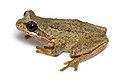 Photograph: JJ HarrisonThe southern brown tree frog (Litoria ewingii) is a species of tree frog native to Australia found in a wide range of habitats. Reaching 45 millimetres (1.8 in), this species is generally brown, but green and green-striped morphs are also recorded.
 The Blue Mountains Tree Frog (Litoria citropa) is a moderate-sized species of tree frog, up to about 60 mm (2.4 in) in length. It is native to coastal and highland areas of eastern Australia, especially in the Blue Mountains, hence its name.
 Photograph: Benny TrappThe Iberian midwife toad (Alytes cisternasii) is a species of frog in the family Alytidae found in Portugal and western Spain. Its natural habitats are temperate forests and shrubland, Mediterranean-type shrubby vegetation, intermittent rivers and freshwater marshes, pastureland, and aquaculture ponds. The species is affected by habitat loss, and the IUCN lists it as being "Near Threatened".
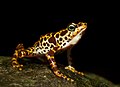 Atelopus certus is a species of toad endemic to the Darién Province of eastern Panama. Much of its range falls within the Darién National Park, a protected area and World Heritage Site. It is classified as endangered, primarily due to the advancing wave of chytridiomycosis moving through Central America.
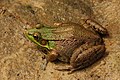 Photo credit: Derek RamseyThe American Green Frog (Rana clamitans) is native to the eastern half of the United States and Canada. Green frogs live wherever there is shallow freshwater: ponds, road-side ditches, lakes, swamps, streams and brooks. The green frog is abundant wherever it occurs.
 Photograph: Benny TrappThe Epirus water frog (Pelophylax epeiroticus) is a species of frog in the family Ranidae. It is found in western Greece, including Corfu, and the southern areas of Albania. The species is collected from the wild for human consumption.
 Photo: Charles H. Smith, USFWSThe golden toad (Bufo periglenes) is an extinct species of true toad that was once abundant in a small region of high-altitude cloud-covered tropical forests, about 30 km2 (12 sq mi) in area, above the city of Monteverde, Costa Rica. The last reported sighting of a golden toad was on 15 May 1989. Its sudden extinction may have been caused by chytrid fungus and extensive habitat loss.
 Photo credit: Carey James BalboaThe Red-eyed Tree Frog (Agalychnis callidryas) is a small-sized tree frog, reaching lengths of about 5 to 7 centimeters (3 inches), native to Neotropical rainforests in Central America. They are not poisonous and rely on camouflage to protect them. During the day, they remain motionless with their colorful parts hidden. Thus, they appear almost completely green, and well hidden among the foliage.
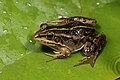 Photograph: Benny TrappThe Albanian water frog (Pelophylax shqipericus) is a species of true frog in the family Ranidae. It is native to Albania and Montenegro, where it lives in aquatic environments. The frogs are medium-sized. Males sometimes bear a distinctive bright green stripe down the length of the backbone, but otherwise are green to light brown in overall colouring with large black or dark brown spots. Females are olive green or light brown in colour and also bear brown or black large spots. The species is endangered and known populations are currently in decline.
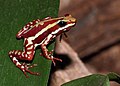 Photograph: H. KrispThe phantasmal poison frog (Epipedobates tricolor) is a species of poison dart frog endemic to Ecuador. First described by George Albert Boulenger in 1899, this endangered species is found only in rainforests on the slopes of the Andes.
 Photograph credit: Petar MiloševićThe agile frog (Rana dalmatina) is a species of true frog in the family Ranidae. Native to central and southern Europe, its brownish dappled colouring helps to conceal it among the leaf litter on the forest floor. This frog, about 5 cm (2.0 in) long, was photographed in the Golovec Forest in Slovenia.
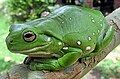 Photo credit: liquidGhoulNative to Australia, White's Tree Frog grows up to 10 centimetres in length and is a popular household pet. In captivity, they have an average lifespan of 16 years. Its skin secretions contain caerins, a group of peptides with antibacterial and antiviral properties. Other peptides have been found to destroy HIV without harming healthy T-cells.
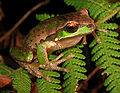 Photo credit: LiquidGhoulThe New England Tree Frog (Litoria subglandulosa) is a species of frog native to the streams of the New England Tablelands, New South Wales, Australia.


.jpg)
_crop.jpg)

Selected toad article

Rhinella, commonly known as South American toads, beaked toads or Rio Viejo toads, is a genus of true toads native to Neotropical parts of Mexico, Central and South America. Additionally, the cane toad has been Introduced to Australia, the Caribbean, the Philippines and elsewhere.
Originally, all species of the genus Rhinella were included in the genus Bufo, then they were split into the genera Chaunus and Rhamphophryne. However, Chaunus and Rhamphophryne are now considered synonyms of Rhinella. (Full article...)
Selected caecilian article

Schistometopum is a genus of amphibian in the family Dermophiidae. S. thomense is only known from two islands in the Bight of Benin, but has been reported from "Upper Zaïre". This likely refers to an undiscovered third species. (Full article...)
Need help?
Do you have a question about Amphibians that you can't find the answer to?
Consider asking it at the Wikipedia reference desk.
Topics
Subcategories

Related portals
_Ranomafana.jpg)


Associated Wikimedia
The following Wikimedia Foundation sister projects provide more on this subject:
-
 Commons
Free media repository -
 Wikidata
Free knowledge base -
 Wikiquote
Collection of quotations -
 Wikisource
Free-content library -
 Wikiversity
Free learning tools -
 Wiktionary
Dictionary and thesaurus


