Portal:Reptiles
Wikipedia portal for content related to Reptiles
From Wikipedia, the free encyclopedia

The Reptiles Portal


.jpg)
Reptiles, as commonly defined, are tetrapod vertebrate animals with an ectothermic metabolism and amniotic development. Reptiles traditionally comprise four orders: Testudines (turtles), Crocodilia (crocodiles, alligators and gharials), Squamata (lizards and snakes) and Rhynchocephalia (tuatara), with about 12,000 extant species listed in the Reptile Database. The study of the traditional reptile orders, customarily in combination with the study of modern amphibians, is called herpetology.
Reptiles have been subject to several conflicting taxonomic definitions. In classical evolutionary taxonomy, reptiles are gathered together under the class Reptilia (/rɛpˈtɪliə/ rep-TIL-ee-ə), which corresponds to common usage. Modern cladistic taxonomy regards that group as paraphyletic, since genetic and paleontological evidence has determined that birds (class Aves) are the only surviving group of Dinosauria, a major clade of diapsids that are more closely related to crocodilians than to other living reptiles, and thus birds are nested among reptiles (under the clade Archosauria) from a phylogenetic perspective. Many cladistic systems therefore redefine Reptilia as a clade (monophyletic group) including birds, though the precise definition of this clade varies between authors. A similar concept is clade Sauropsida, which refers to all amniotes more closely related to modern reptiles than to mammals.
The earliest known members of the reptile lineage appeared during the late Carboniferous period, having evolved from advanced reptiliomorph tetrapods which became increasingly adapted to life on dry land. Genetic and fossil data argues that the two largest lineages of reptiles, Archosauromorpha (crocodilians, birds, and kin) and Lepidosauromorpha (lizards, and kin), diverged during the Permian period. In addition to the living reptiles, there are many diverse groups that are now extinct, in some cases due to mass extinction events. In particular, the Cretaceous–Paleogene extinction event wiped out the pterosaurs, plesiosaurs, and all non-avian dinosaurs alongside many species of crocodyliforms and squamates (e.g., mosasaurs). Modern non-bird reptiles inhabit all the continents except Antarctica. (Full article...)
Reptile types

The gharial (Gavialis gangeticus), also known as gavial or fish-eating crocodile, is a crocodilian in the family Gavialidae and among the longest of all living crocodilians. Mature females are 2.6 to 4.5 m (8 ft 6 in to 14 ft 9 in) long, and males 3 to 6 m (9 ft 10 in to 19 ft 8 in). Adult males have a distinct boss at the end of the snout, which resembles an earthenware pot known as a ghara, hence the name "gharial". The gharial is well adapted to catching fish because of its long, narrow snout and 110 sharp, interlocking teeth. (Full article...)
Amphisbaenia /æmfɪsˈbiːniə/ (called amphisbaenians or worm lizards) is a group of typically legless lizards, comprising over 200 extant species. Amphisbaenians are characterized by their long bodies, the reduction or loss of the limbs, and rudimentary eyes. As many species have a pink body and scales arranged in rings, they have a superficial resemblance to earthworms. While the genus Bipes retains forelimbs, all other genera are limbless. Phylogenetic studies suggest that they are nested within Lacertoidea, closely related to the lizard family Lacertidae. Amphisbaenians are widely distributed, occurring in North America, Europe, Africa, South America, Western Asia and the Caribbean. Most species are less than 6 inches (15 cm) long. (Full article...)
A caiman (/ˈkeɪmən/), also spelled cayman (from Taíno kaiman), is an alligatorid belonging to the subfamily Caimaninae, one of two primary lineages within the Alligatoridae family, the other being alligators. Caimans are native to Central and South America and inhabit marshes, swamps, lakes, and mangrove rivers. They have scaly skin and live a fairly nocturnal existence. They are relatively small-sized crocodilians with an average maximum weight of 6 to 40 kg (13 to 88 lb) depending on species, with the exception of the black caiman (Melanosuchus niger), which can grow more than 4 m (13 ft) long and weigh more than 450 kg (990 lb). The black caiman is the largest caiman species in the world and is found in the slow-moving rivers and lakes that surround the Amazon basin. The smallest species is the Cuvier's dwarf caiman (Paleosuchus palpebrosus), which grows to 1.2 to 1.5 m (3.9 to 4.9 ft) long. There are six different species of caiman found throughout the watery jungle habitats of Central and Southern America. The average length for most of the other caiman species is about 2 to 2.5 m (6.6 to 8.2 ft) long. (Full article...)
The tuatara (/tuːəˈtɑːrə/, Māori: [ˈtʉ.a.ta.ɾa]; Sphenodon punctatus) is a species of reptile endemic to New Zealand. Despite its close resemblance to lizards, it is the only extant member of a distinct lineage, the previously highly diverse order Rhynchocephalia. The name tuatara is derived from the Māori language and means "peaks on the back". (Full article...)
Snakes are elongated legless reptiles of the suborder Serpentes. Cladistically squamates, snakes are ectothermic, amniote vertebrates covered in overlapping scales much like other members of the group. Many species of snakes have skulls with several more joints than their lizard ancestors and relatives, enabling them to swallow prey much larger than their heads (cranial kinesis). To accommodate their narrow bodies, snakes' paired organs (such as kidneys) appear one in front of the other instead of side by side, and most only have one functional lung. Most snakes completely lack limbs, however pythons and boids retain a pelvic girdle with a pair of vestigial limbs on either side of the cloaca which are known as spurs. Lizards have independently evolved elongate bodies without limbs or with greatly reduced limbs at least twenty-five times via convergent evolution, leading to many lineages of legless lizards. These resemble snakes, but several common groups of legless lizards have eyelids and external ears, which snakes lack, although this rule is not universal (see Amphisbaenia, Dibamidae, and Pygopodidae). (Full article...)
Lizard is the common name used for all squamate reptiles other than snakes (and to a lesser extent amphisbaenians or "worm lizards"), encompassing over 7,000 species, ranging across all continents except Antarctica, as well as most oceanic island chains. The grouping is paraphyletic as some lizards are more closely related to snakes than they are to other lizards. Living lizards range in size from chameleons and geckos a few centimeters long to the 3-meter-long Komodo dragon. (Full article...)
Turtles (order Testudines) are reptiles characterized by a special shell developed mainly from their ribs. Modern turtles are divided into two major groups, the Pleurodira (side necked turtles) and Cryptodira (hidden necked turtles), which differ in the way the head retracts. There are 360 living and recently extinct species of turtles, including land-dwelling tortoises and freshwater terrapins. They are found on most continents, some islands and, in the case of sea turtles, much of the ocean. Like other amniotes (reptiles, birds, and mammals) they breathe air and do not lay eggs underwater, although many species live in or around water. (Full article...)
An alligator, or colloquially gator, is a large reptile in the genus Alligator of the family Alligatoridae in the order Crocodilia. The two extant species are the American alligator (A. mississippiensis) and the Chinese alligator (A. sinensis). Additionally, several extinct species of alligator are known from fossil remains. Alligators first appeared during the late Eocene epoch about 37 million years ago. (Full article...)
A crocodile (family Crocodylidae) or true crocodile is a large, semiaquatic reptile that lives throughout the tropics in Africa, Asia, the Americas and Australia. The term "crocodile" is sometimes used more loosely to include all extant members of the order Crocodilia, which includes the alligators and caimans (both members of the family Alligatoridae), the gharial and false gharial (both members of the family Gavialidae) as well as other extinct taxa. This article uses "crocodile" or "true crocodile" to refer only to the species taxonomically included in the Crocodylidae family, extant or extinct. (Full article...)
Tortoises (/ˈtɔːrtəs.ɪz/ TOR-təs-iz) are reptiles of the family Testudinidae of the order Testudines (Latin for "tortoise"). Like other testudines, tortoises have a shell to protect from predation and other threats. The shell in tortoises is generally hard, and like other members of the suborder Cryptodira, they retract their necks and heads directly backward into the shell to protect them. (Full article...)

_male.jpg)


.jpg)
.jpg)
_on_white_background,_focus_stacking.jpg)


Selected images
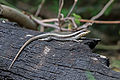 The African striped skink (Trachylepis striata) is a skink native to southern Africa. Individuals are brown or bronze-coloured with two yellowish stripes that run lengthwise on either side of the spine. Both sexes grow to a length of about 25 centimetres (10 in).
 Photograph credit: Charles James SharpParson's chameleon (Calumma parsonii) is a large species of chameleon, a lizard in the family Chamaeleonidae. The species is endemic to isolated pockets of humid primary forest in eastern and northern Madagascar. It is listed on CITES Appendix II, meaning that trade in this species is regulated. While it is illegal for most chameleon species from Madagascar to be exported, a limited number of Parson's chameleons can legally be exported each year from its native country. This female Parson's chameleon of the subspecies C. p. cristifer was photographed near Andasibe, Moramanga.
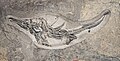 Photograph: Didier DescouensBarracudasauroides is a genus of mixosaurid ichthyosaur which lived during the Middle Triassic. Fossils of this genus have been found in Guizhou Province, China. It is known from GMPKU-P-1033, a partial skeleton recovered from the Upper Member of the Guanling Formation in the Xinmin.
 Photo credit: Paul HirstAn anole lizard of the family Polychrotidae found in Hilo, Hawaii, United States. Anoles are small and common lizards that can be found throughout the various regions of the Western Hemisphere. They are frequently and incorrectly called chameleons or geckos due to their ability to alter their skin color and run up walls, respectively.
 Photo credit: John O'NeillA common snakeneck turtle (Chelodina longicollis) covered in camouflaging algae. When resting this individual would look like an algae-covered rock, an example of crypsis, the ability of an organism to avoid observation. Other ways an organism may be cryptic include nocturnality, subterranean lifestyle, and transparency.
 A green sea turtle swimming above a coral reef.
 Photo credit: Rich TorresChamaeleo jacksonii, commonly known as Jackson's Chameleon or the Three-horned Chameleon, is an African chameleon. Native to the humid, cooler regions of Kenya and Tanzania, this specimen is from a feral population established in Hawaii in the 1970s. Males possess three brown horns, but females usually have none or just traces of the rostral horn (on the nose).
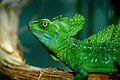 Photo credit: Marcel Burkhard (cele4)The Plumed Basilisk (Basiliscus plumifrons) is a species of lizard native to Latin America. Its natural range covers a swath from Mexico to Ecuador.
 Photo credit: Mila ZinkovaA Gold dust day gecko (Phelsuma laticauda laticauda) licking nectar from a bird of paradise flower in Kailua-Kona, Hawaii. Native to Madagascar and the Comoro Islands, this day gecko has been introduced to Farquhar Atoll in the southern Seychelles, and onto the Hawaiian Islands.
 Green sea turtle
 Photograph: Benny TrappThe Sicilian wall lizard (Podarcis waglerianus) is a species of lizard in the family Lacertidae. Endemic to Italy, it occurs in temperate forests, temperate shrubland, Mediterranean-type shrubby vegetation, temperate grassland, arable land, pastureland, and rural gardens in Sicily and the Aegadian Islands. The species' numbers are generally stable, and it has been listed as Least Concern by the IUCN.
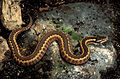 Photograph: Benny TrappVipera dinniki is a species of venomous viper which can reach 48.6 cm (19.1 in) in length. First described by Alexander Nikolsky in 1913, V. dinniki is found in the highlands of Russia, Georgia, and Azerbaijan.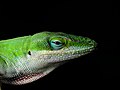
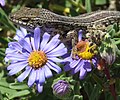 Cape skink – Trachylepis capensis. Close-up on purple Aster flowers.
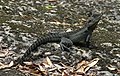 Photograph: John O'NeillThe Australian water dragon (Physignathus lesueurii) is a lizard native to eastern Australia, from Victoria north to Queensland. Adult males can grow slightly longer than one metre (3 feet), and both males and females have long powerful limbs and a long muscular tail. The dragons are primarily arboreal, although they can also swim.
 Photograph: Charles J. SharpA rough chameleon (Trioceros rudis) near Mount Karisimbi, an inactive volcano in the Virunga Mountains in Rwanda. This specimen measures approximately 12 cm (4.7 in) long. Chameleons change color by changing the space between crystals in their skin, which changes the wavelength of light they reflect.
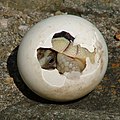 A baby marginated tortoise hatchling emerges from its shell.
 Photo: Mbz1The green sea turtle (Chelonia mydas) is an endangered sea turtle found in tropical and subtropical seas around the world, with two distinct populations in the Atlantic and Pacific Oceans. The common name derives from the usually green fat found beneath its carapace.
 Photo: Muhammad Mahdi KarimA White-headed dwarf gecko (Lygodactylus picturatus) whose tail is missing due to autotomy, the act of an animal severing its own appendages, usually as a self-defense mechanism designed to elude a predator's grasp. The detached tail will continue to wriggle, distracting the predator's attention. The lost body part may be regenerated later.
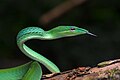 Asian vine snake Ahaetulla prasina. This snake has a wide distribution in Asia. It feeds on small reptiles and amphibians, particularly lizards and tree frogs. Adults may attain 1.8 m (6 feet) in total length, with a tail 0.6 m (2 feet) long. Its appearance is very much like those of South American vine snakes. It is a rear-fanged species and is mildly venomous but is not considered a threat to humans.
 Photo credit: PollinatorThe Carolina Anole is a lizard found primarily in the south eastern parts of the United States. It has color-changing abilities, although it is not a chameleon. This lizard can reach a total length of about 22 cm. The male has a pink or red dewlap that extends from his chin. Green Anoles can have a green or a brown body colour, which depends on mood and climate.
 Cerastes cerastes, commonly known as the Saharan horned viper or the horned desert viper, is a venomous species of viper native to the deserts of northern Africa and parts of the Arabian Peninsula and Levant. It often is easily recognized by the presence of a pair of supraocular "horns", although hornless individuals do occur.
 Photograph: JJ HarrisonNiveoscincus metallicus, commonly known as the metallic skink, is a species of skink in the family Scincidae. It is endemic to Australia, where it is found in southern Victoria, as well as in Tasmania and many offshore islands in Bass Strait.
 Photograph: Ministry of Information and Tourism of EcuadorA Julia butterfly (Dryas iulia) feeding on the tears of a red-headed Amazon River turtle (Podocnemis erythrocephala) in Ecuador. Such lachryphagy provides the butterfly with additional minerals that it can use for spermatophore production.

_female_Andasibe_2.jpg)


.jpg)


Selected Crocodilia articles
The New Guinea crocodile (Crocodylus novaeguineae) is a small species of crocodile found on the island of New Guinea north of the mountain ridge that runs along the centre of the island. The population found south of the mountain ridge, formerly considered a genetically distinct population, is now considered a distinct species, Hall's New Guinea crocodile (C. halli). In the past it included the Philippine crocodile, C. n. mindorensis, as a subspecies, but today they are regarded as separate species. The habitat of the New Guinea crocodile is mostly freshwater swamps and lakes. It is most active at night when it feeds on fish and a range of other small animals. A female crocodile lays a clutch of eggs in a nest composed of vegetation and she lies up nearby to guard the nest. There is some degree of parental care for newly hatched juveniles. This crocodile was over-hunted for its valuable skin in the mid 20th century, but conservation measures have since been put in place, it is reared in ranches and the International Union for Conservation of Nature (IUCN) lists it as being of "Least Concern". (Full article...)
The spectacled caiman (Caiman crocodilus), also known as the white caiman, common caiman, and speckled caiman, is a crocodilian in the family Alligatoridae. It is brownish-, greenish-, or yellowish-gray colored and has a spectacle-like ridge between its eyes, which is where its common name come from. It grows to a length of 1.4–2.5 m (4 ft 7 in – 8 ft 2 in) and a weight of 7–40 kg (15–88 lb), with males being both longer and heavier than females. Its diet varies seasonally, commonly consisting of crabs, fish, small mammals, amphibians and snails. Breeding occurs from May to August and 14–40 eggs are laid in July and August. This crocodilian has a large range and population; it is native to much of Latin America, and has been introduced to the United States, Cuba, and Puerto Rico. (Full article...)
The Nile crocodile (Crocodylus niloticus) is a large crocodilian native to freshwater habitats in Africa, where it is present in 26 countries. It is widely distributed in sub-Saharan Africa, occurring mostly in the eastern, southern, and central regions of the continent, and lives in different types of aquatic environments such as lakes, rivers, swamps and marshlands. It occasionally inhabits deltas, brackish lakes and rarely also saltwater. Its range once stretched from the Nile Delta throughout the Nile River. Lake Turkana in Kenya has one of the largest undisturbed Nile crocodile populations.
Generally, the adult male Nile crocodile is between 3.5 and 5 m (11 ft 6 in and 16 ft 5 in) in length and weighs 225 to 750 kg (496 to 1,653 lb). However, specimens exceeding 6.1 m (20 ft) in length and 1,000 kg (2,200 lb) in weight have been recorded. It is the largest predator in Africa, and may be considered the second-largest extant reptile in the world, after the saltwater crocodile (Crocodylus porosus). Size is sexually dimorphic, with females usually about 30% smaller than males. The crocodile has thick, scaly, heavily armoured skin. (Full article...)
The broad-snouted caiman (Caiman latirostris) is a crocodilian in the family Alligatoridae found in eastern and central South America, including the Pantanal habitat of Bolivia, Southeast Brazil, and Paraguay, as well as northern Argentina and Uruguay. Behind the black caiman (Melanosuchus niger), it is the second-largest caiman species; it is the third-largest alligatorid behind the American alligator (Alligator mississippiensis) and the aforementioned black caiman. Primarily, the species inhabits freshwater wetlands, including floodplains, marshes, swamps, and some mangrove forests, as well as various streams, rivers, lakes or ponds, preferring bodies of rather still or slower-moving water. They will often use man-made cow ponds, disused stock tanks, and canals and ditches, as well. (Full article...)
The smooth-fronted caiman (Paleosuchus trigonatus), also known as Schneider's dwarf caiman or Schneider's smooth-fronted caiman, is a crocodilian from South America, where it is native to the Amazon and Orinoco Basins. It is the second-smallest species of the family Alligatoridae, the smallest being Cuvier's dwarf caiman, also from tropical South America and in the same genus. An adult typically grows to around 1.2 to 1.6 m (3.9 to 5.2 ft) in length and weighs between 9 and 20 kg (20 and 44 lb). Exceptionally large males can reach as much as 2.3 m (7.5 ft) in length and 36 kg (79 lb) in weight. (Full article...)
The mugger crocodile (Crocodylus palustris) is a medium-sized broad-snouted crocodile, also known as mugger and marsh crocodile. It is native to freshwater habitats from south-eastern Iran to the Indian subcontinent, where it inhabits marshes, lakes, rivers and artificial ponds. It rarely reaches a body length of 5 m (16 ft 5 in) and is a powerful swimmer, but also walks on land in search of suitable waterbodies during the hot season. Both young and adult mugger crocodiles dig burrows to which they retreat when the ambient temperature drops below 5 °C (41 °F) or exceeds 38 °C (100 °F). Females dig holes in the sand as nesting sites and lay up to 46 eggs during the dry season. The sex of hatchlings depends on temperature during incubation. Both parents protect the young for up to one year. They feed on insects, and adults prey on fish, reptiles, birds and mammals.
The mugger crocodile evolved at least 4.19 million years ago and has been a symbol for the fructifying and destructive powers of the rivers since the Vedic period. It was first scientifically described in 1831 and is protected by law in Iran, India and Sri Lanka. Since 1982, it has been listed as Vulnerable on the IUCN Red List. Outside protected areas, it is threatened by conversion of natural habitats, gets entangled in fishing nets and is killed in human–wildlife conflict situations and in traffic accidents. (Full article...)
The gharial (Gavialis gangeticus), also known as gavial or fish-eating crocodile, is a crocodilian in the family Gavialidae and among the longest of all living crocodilians. Mature females are 2.6 to 4.5 m (8 ft 6 in to 14 ft 9 in) long, and males 3 to 6 m (9 ft 10 in to 19 ft 8 in). Adult males have a distinct boss at the end of the snout, which resembles an earthenware pot known as a ghara, hence the name "gharial". The gharial is well adapted to catching fish because of its long, narrow snout and 110 sharp, interlocking teeth.
The gharial probably evolved in the northern Indian subcontinent. Fossil gharial remains were excavated in Pliocene deposits in the Sivalik Hills and the Narmada River valley. It currently inhabits rivers in the plains of the northern part of the Indian subcontinent. It is the most thoroughly aquatic crocodilian, and leaves the water only for basking and building nests on moist sandbanks. Adults mate at the end of the cold season. Females congregate in spring to dig nests, in which they lay 20–95 eggs. They guard the nests and the young, which hatch before the onset of the monsoon. The hatchlings stay and forage in shallow water during their first year, but move to sites with deeper water as they grow. (Full article...)
The Philippine crocodile (Crocodylus mindorensis), also known as the Mindoro crocodile, the Philippine freshwater crocodile, the bukarot in Ilocano, and more generally as a buwaya in most Filipino lowland cultures, is endemic to the Philippines. It has been listed as critically endangered since 2008 due to exploitation and unsustainable fishing methods, such as dynamite fishing. Conservation methods are being taken by the Dutch/Filipino Mabuwaya foundation, the Crocodile Conservation Society and the Zoological Institute of HerpaWorld in Mindoro island. It is strictly prohibited to kill a crocodile in the country, and it is punishable by law. (Full article...)
The Siamese crocodile (Crocodylus siamensis) is a medium-sized freshwater crocodile native to Indonesia ( East Kalimantan and possibly other areas historically), Laos, Cambodia, Thailand and Vietnam. Historical records from Myanmar remain unverified. The species is critically endangered and already extirpated from many regions. Its other common names include Siamese freshwater crocodile, Singapore small-grain, and soft-belly. (Full article...)
The dwarf crocodile (Osteolaemus tetraspis), also known as the African dwarf crocodile, West African dwarf crocodile, broad-snouted crocodile (a name more often used for the Asian mugger crocodile) or bony crocodile, is an African osteolaemine crocodile that is also the smallest extant living species of crocodile. (Full article...)
The yacare caiman (Caiman yacare), also known commonly as the jacare caiman, Paraguayan caiman, piranha caiman, red caiman, and southern spectacled caiman, is a species of caiman, a crocodilian in the family Alligatoridae. The species is indigenous to Argentina, Bolivia, Brazil, and Paraguay. Brown in color and covered with dark blotches, males grow to a total length (including tail) of 2–3 m (6 ft 7 in – 9 ft 10 in) and weigh around 40–50 kg (88–110 lb); while females grow to 1.4 m (4 ft 7 in) long and about 15–20 kg (33–44 lb). Typical habitats of this caiman include lakes, rivers, and wetlands. Its diet primarily consists of aquatic animals, such as snails, and occasionally land vertebrates. Mating occurs in the rainy season and eggs hatch in March, with young fending for themselves as soon as they hatch. The yacare caiman was hunted heavily for its skin to use for leather in the 1980s, which caused its population to decrease significantly. However, trading restrictions placed since have caused its population to increase. Its population in the Pantanal is about 10 million, and it is listed as least concern on the IUCN Red List. (Full article...)
The Chinese alligator (Alligator sinensis; simplified Chinese: 鼍; traditional Chinese: 鼉; pinyin: tuó), also known as the Yangtze alligator (simplified Chinese: 扬子鳄; traditional Chinese: 揚子鱷; pinyin: yángzǐ'è), China alligator, or historically the muddy dragon, is a crocodilian endemic to China. It and the American alligator (A. mississippiensis) are the only living species in the genus Alligator of the family Alligatoridae. Dark gray or black in color with a fully armored body, the Chinese alligator grows to 1.5–2.1 metres (5–7 ft) in length and weighs 36–45 kilograms (80–100 lb) as an adult. It brumates in burrows in winter and is nocturnal in summer. Mating occurs in early summer, with females most commonly producing 20–30 eggs, which are smaller than those of any other crocodilian. The species is an opportunistic feeder, primarily eating fish and invertebrates. A vocal species, adults bellow during the mating season and young vocalize to communicate with their parents and other juveniles. Captive specimens have reached age 70, and wild specimens can live past 50.
Living in bodies of fresh water, the Chinese alligator's range is restricted to six regions in the province of Anhui, as well as possibly the provinces of Jiangsu and Zhejiang. Originally living as far away from its current range as Japan, the species previously had a wide range and population, but beginning in 6000 BC, multiple threats, such as habitat destruction, caused the species' population and range to decline. The population in the wild was about 1,000 in the 1970s, decreased to below 130 in 2001, and grew after 2003, with its population being about 300 as of 2017. Listed as critically endangered by the International Union for Conservation of Nature, multiple conservation actions have been taking place for this species. (Full article...)
The American alligator (Alligator mississippiensis), sometimes referred to as a common alligator or just gator, is a large crocodilian reptile native to the Southeastern United States. It is one of the two extant species in the genus Alligator, and is larger than the only other living alligator species, the Chinese alligator.
Adult male American alligators measure 3.4 to 4.8 m (11.2 to 15.7 ft) in length, and can weigh up to 900 kg (2,000 lb), with unverified sizes of up to 5.84 m (19.2 ft) and weights of 1,000 kg (2,200 lb) making it the second longest and the heaviest of the family Alligatoridae, after the black caiman. Females are smaller, measuring 2.6 to 3.35 m (8.5 to 11.0 ft) in length. The American alligator inhabits subtropical and tropical freshwater wetlands, such as marshes and cypress swamps, from southern Oklahoma and Texas to North Carolina. It is distinguished from the sympatric American crocodile by its broader U-shaped snout, with overlapping jaws and darker coloration, and is less tolerant of saltwater but more tolerant of cooler climates than the American crocodile, which is found only in tropical and warm subtropical climates. (Full article...)
The West African crocodile, desert crocodile, or sacred crocodile (Crocodylus suchus) is a species of crocodile related to, and often confused with, the larger Nile crocodile (C. niloticus). (Full article...)
The saltwater crocodile (Crocodylus porosus) is a crocodilian native to saltwater habitats, brackish wetlands and freshwater rivers from India's east coast across Southeast Asia and the Sundaland to northern Australia and Micronesia. It has been listed as Least Concern on the IUCN Red List since 1996. It was hunted for its skin throughout its range up to the 1970s, and is threatened by illegal killing and habitat loss. It is regarded as dangerous to humans.
The saltwater crocodile is the largest living reptile. Males can grow to a weight of 1,000–1,500 kg (2,200–3,300 lb) and a length of 6 m (20 ft), rarely exceeding 6.3 m (21 ft). Females are much smaller and rarely surpass 3 m (9.8 ft). It is also called the estuarine crocodile, Indo-Pacific crocodile, marine crocodile, sea crocodile, and, informally, the saltie. A large and opportunistic hypercarnivorous apex predator, they ambush most of their prey and then drown or swallow it whole. They will prey on almost any animal that enters their territory, including other predators such as sharks, varieties of freshwater and saltwater fish including pelagic species, invertebrates such as crustaceans, various amphibians, other reptiles, birds, and mammals. (Full article...)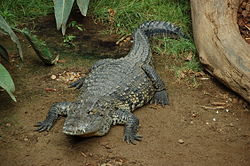
Morelet's crocodile (Crocodylus moreletii), also known commonly as the Mexican crocodile, the Belize crocodile, and el cocodrilo de pantano in Spanish, is a modest-sized crocodilian in the family Crocodylidae. The species is found only in the Atlantic regions of Mexico, Belize and Guatemala. It usually grows to about 3 metres (10 ft) in total length (tail included). It is a species at least concern for extinction according to the International Union for Conservation of Nature.
The species has a fossil record in Guatemala. (Full article...)
The Cuban crocodile (Crocodylus rhombifer) is a small-medium species of crocodile endemic to Cuba. Typical length is 2.1–2.3 m (6 ft 11 in – 7 ft 7 in) and typical weight 70–80 kg (150–180 lb). Large males can reach as much as 3.5 m (11 ft) in length and weigh more than 215 kg (474 lb).
The Cuban crocodile is of interest to biologists for its unique physical and behavioral traits. Long- and strong-legged, it is the most terrestrial of extant crocodiles. Its preferred habitat comprises freshwater and brackish water environments, such as mangrove swamps, coastal lagoons, estuaries, marshes, floodplains, and river deltas. There, the adults feed on fish, turtles and small mammals, while the young eat invertebrates and smaller fish. Mating occurs between May and July. Captive animals have displayed cooperative hunting behavior, and can be taught tricks, suggesting intelligence. (Full article...)
The Orinoco crocodile (Crocodylus intermedius) is a critically endangered crocodile. Its population is very small, and they can only be found in the Orinoco river basin in Venezuela and Colombia. Extensively hunted for their skins in the 19th and 20th centuries, it is one of the most endangered species of crocodiles. It is a very large species of crocodilian; males have been reported up to 6.8 m (22 ft 4 in) in the past, weighing over 900 kg (2,000 lb), but such sizes do not exist today, 5.2 m (17 ft 1 in) being a more widely accepted maximum size. A large male today may attain 4.2 m (13 ft 9 in) in length and can weigh up to 450 kg (1,000 lb), while females are substantially smaller with the largest likely to weigh around 225 kg (496 lb). Sexual dimorphism is not as profound as in other crocodilian species. The coloration is light even in adults.
The ecology of the Orinoco crocodile is poorly documented in the wild, mostly due to its small population. It is thought to have a more piscivorous diet with an opportunistic nature, resulting in generalist predatory behaviour. It is an apex predator and preys on a variety of birds, mammals and reptiles, including caimans on occasion. Its prey base is mostly large predatory fish, challenging the general view by locals complaining about crocodiles hunting local fish to very low numbers. Reproduction takes place in the dry season when the water level is low. It is a hole nester and digs holes in the sand for its clutch of eggs. The females guard the nests and young for several years. (Full article...)
The freshwater crocodile (Crocodylus johnstoni), also known commonly as the Australian freshwater crocodile, Johnstone's crocodile, Johnstone river crocodile and the freshie, is a species of crocodile native to the northern regions of Australia. Unlike its much larger Australian relative, the saltwater crocodile, the freshwater crocodile is not known as a man-eater, although it only bites in self-defence, and brief, nonfatal attacks have occurred, apparently the result of mistaken identity. (Full article...)
Cuvier's dwarf caiman (Paleosuchus palpebrosus) is a small crocodilian in the alligator family from northern and central South America. It is found in Bolivia, Brazil, Colombia, Ecuador, French Guiana, Guyana, Paraguay, Peru, Suriname, Trinidad and Venezuela. It lives in riverine forests, flooded forests near lakes, and near fast-flowing rivers and streams. It can traverse dry land to reach temporary pools and tolerates colder water than other species of caimans. Other common names for this species include the musky caiman, the dwarf caiman, Cuvier's caiman, and the smooth-fronted caiman (the latter name is also used for P. trigonatus). It is sometimes kept in captivity as a pet and may be referred to as the wedge-head caiman by the pet trade community.
Cuvier's dwarf caiman was first described by the French zoologist Georges Cuvier in 1807 and is one of only two species in the genus Paleosuchus, the other species being P. trigonatus. Their closest relatives are the other caimans in the subfamily Caimaninae. With a total length averaging 1.4 m (4.6 ft) for males and up to 1.2 m (3.9 ft) for females, Cuvier's dwarf caiman is not only the smallest extant species in the alligator and caiman family, but also the smallest of all crocodilians (unless the Congo dwarf crocodile is considered a valid species). An adult weighs around 5 to 7 kg (11 to 15 lb). Its lack of size is partly made up for by its strong body armor, provided by the bony bases to its dermal scales, which provides protection against predators. Juvenile dwarf caimans mainly feed on invertebrates, but also small fish and frogs, while adults eat larger fish, amphibians, and invertebrates, such as large molluscs. This caiman sometimes uses a burrow as shelter during the day and in the Pantanal may aestivate in the burrow to stay cool in the dry season. The female buries her eggs on a mounded nest and these take about 3 months to hatch. She helps the hatchlings to escape from the nest and provides some parental care for the first few weeks of their lives. This caiman has a wide range and large total population, and the IUCN lists its conservation status as being of least concern. (Full article...)
Mecistops is a genus of crocodiles, the slender-snouted crocodiles, native to sub-Saharan Africa. (Full article...)
The American crocodile (Crocodylus acutus) is a species of crocodilian found in the Neotropics. It is the most widespread of the four extant species of crocodiles from the Americas, with populations present from South Florida, the Caribbean islands of Cuba, Jamaica, and Hispaniola, and the coasts of Mexico to as far south as Peru, Ecuador, Colombia, and Venezuela.
The habitat of the American crocodile consists largely of coastal areas. It is also found in river systems, but tends to prefer salinity, resulting in the species congregating in brackish lakes, mangrove swamps, lagoons, cays, and small islands. Other crocodiles also have tolerance to saltwater due to salt glands underneath the tongue, but the American crocodile is the only species other than the saltwater crocodile to commonly live and thrive in saltwater. They can be found on beaches and small island formations without any freshwater source, such as many cays and islets across the Caribbean. They are also found in hypersaline lakes; one of the largest known populations inhabits Lago Enriquillo in the Dominican Republic. (Full article...)
The black caiman (Melanosuchus niger) is a crocodilian reptile endemic to South America. With a maximum length of around 5 to 6.5 m (16 to 21 ft) and a mass of over 450 kg (1,000 lb), it is the largest living species of the family Alligatoridae, and the third-largest crocodilian in the Neotropical realm. True to its common and scientific names, the black caiman has a dark greenish-black coloration as an adult. In some individuals, the pigmentation can appear almost jet-black. It has grey to brown banding on the lower jaw; juveniles have a more vibrant coloration compared to adults, with prominent white-pale yellow banding on the flanks that remains present well into adulthood (more than most other species). The banding on young helps with camouflage by breaking up their body outline, on land or in water, in an effort to avoid predation. The morphology is quite different from other caimans but the bony ridge that occurs in other caimans is present. The head is large and heavy, an advantage in catching larger prey. Like all crocodilians, caimans are long, squat creatures, with big jaws, long tails and short legs. They have thick, scaled skin, and their eyes and noses are located on the tops of their heads. This enables them to see and breathe while the rest of their bodies are underwater.
A carnivorous animal, the black caiman lives along freshwater habitats, including slow-moving rivers, lakes and seasonally flooded savannas, where it preys upon a variety of fish, reptiles, birds, and mammals. Being an apex predator and potentially a keystone species, it is a generalist, capable of taking most animals within its range, and might have played a critical role in maintaining the structure of the ecosystem. Although only a mere few specific ecological studies have been conducted, it is observed that this species has its own niche which allows coexistence with other competitors. (Full article...)


.jpg)
_Gal_Oya.jpg)


_-_Flickr_-_berniedup.jpg)


.jpg)
Selected snake articles
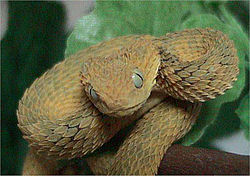
Atheris squamigera (common names: green bush viper, variable bush viper, leaf viper, Hallowell's green tree viper, and others) is a venomous viper species endemic to west and central Africa. No subspecies are currently recognized. (Full article...)
Crotalus durissus, known as the South American rattlesnake, tropical rattlesnake, and by other names, is a highly venomous pit viper species found in South America. It is the most widely distributed member of its genus. Currently, seven subspecies are recognized. (Full article...)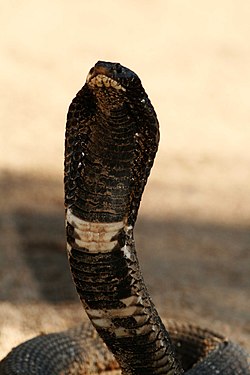
The rinkhals (/ˈrɪŋk(h)æls/; Hemachatus haemachatus), also known as the ringhals /ˈrɪŋhæls/ or ring-necked spitting cobra, is a species of venomous snake in the family Elapidae. The species is found in parts of southern Africa. It is not a true cobra in that it does not belong to the genus Naja, but instead belongs to the monotypic genus Hemachatus. While rinkhals bear a great resemblance to true cobras, they also possess some remarkable differences from these, resulting in their placement outside the genus Naja.
In 2023, the Zimbabwe population was described as a new species, H. nyangensis. (Full article...)
Deinagkistrodon is a monotypic genus created for the pit viper species, Deinagkistrodon acutus, which is endemic to Southeast Asia. No subspecies are currently recognized. (Full article...)
The tiger snake (Notechis scutatus) is a large and highly venomous snake of southern Australia, including its coastal islands and Tasmania. These snakes are often observed and locally well known by their banding, black and yellow like a tiger, although the species can be highly variable in colouration and patterning. All populations are classified within the genus Notechis (Elapidae). Their diverse characteristics have been classified either as distinct species or by subspecies and regional variation. (Full article...)- Trimeresurus cantori, also commonly known as Cantor's pit viper or Cantor's pitviper, is a species of venomous pit viper in the subfamily Crotalinae of the family Viperidae. The species is native to the Nicobar Islands and possibly the Andaman Islands of the eastern Indian Ocean. It was named after Theodore Edward Cantor (1809–1860), a Danish naturalist serving as a surgeon with the East India Company in Calcutta. No subspecies are recognized as being valid. (Full article...)

Agkistrodon piscivorus is a species of venomous snake, a pit viper in the subfamily Crotalinae of the family Viperidae. It is one of the world's few semiaquatic vipers (along with the Florida cottonmouth), and is native to the Southeastern United States. As an adult, it is large and capable of delivering a painful and potentially fatal bite. When threatened, it may respond by coiling its body and displaying its fangs. Individuals may bite when feeling threatened or being handled in any way. It tends to be found in or near water, particularly in slow-moving and shallow lakes, streams, and marshes. It is a capable swimmer, and like several species of snakes, is known to occasionally enter bays and estuaries and swim between barrier islands and the mainland. (Full article...)
Indotyphlops braminus, commonly known as the brahminy blind snake and other names, is a non-venomous blind snake species, found mostly in Africa and Asia, and has been introduced in many other parts of the world. It is a completely fossorial (i.e., burrowing) reptile, with habits and appearance similar to an earthworm, for which it is often mistaken and shares convergent evolution with, although close examination reveals tiny scales and eyes rather than the annular segments characteristic of a true earthworm. The species is parthenogenetic and all known specimens have been female. The specific name is a Latinized form of the word Brahmin. No subspecies are currently recognized as being valid. (Full article...)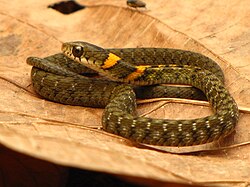
The orange-collared keelback (Rhabdophis himalayanus) is a species of snake. As with its congenerics, this is a reared-fanged species. The toxicity of its venom is not known, but it overpowers its prey quickly. Even if it is considered harmless, an allergic reaction from the bite can still occur, and all bites should be taken seriously. (Full article...)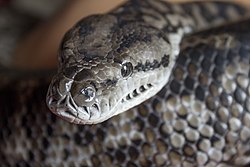
The Morelia spilota metcalfei found in Australia, commonly known as the Murray-Darling carpet python. The pythons are non-venomous snakes that constrict their prey. They grow up to 2.7m (10 feet), but adults are usually around 2.4m (8 feet). Colour varies depending on locality. Victorian Murray-Darlings are silver with solid black blotches and stripes; in New South Wales the silver becomes a light brown and the patterning has more of a black colour; South Australian MDs appear similar to those in New South Wales, though with patches of maroon. These pythons are semi-arboreal, typically inhabiting rocky outcrops, dry woodlands, riverine forests and flood plains. The threats to the snakes are people and other snakes. (Full article...)
The Persian ratsnake (Zamenis persicus) is a species of medium-sized nonvenomous snake in the subfamily Colubrinae of the family Colubridae. The species is native to Western Asia. (Full article...)
Amphiesma monticola, also known as the Wynad keelback, is a harmless colubrid snake species endemic to the Western Ghats of India, where it has been recorded in the Kodagu and Wayanad regions. (Full article...)
Azemiopinae is a monogeneric subfamily created for the genus Azemiops that contains the viper species A. feae and A. kharini. They are commonly known as Fea's vipers. No subspecies are recognized. The first specimen was collected by Italian explorer Leonardo Fea, and was described as a new genus and new species by Boulenger in 1888. Formerly considered to be one of the most primitive vipers, molecular studies have shown that it is the sister taxon to the pit vipers, Crotalinae. It is found in the mountains of Southeast Asia, in China, southeastern Tibet, and Vietnam. Like all other vipers, they are venomous. (Full article...)
Bothrops is a genus of highly venomous pit vipers endemic to the Neotropics. The generic name, Bothrops, is derived from the Greek words βόθρος, bothros, meaning 'pit', and ὄψ, ops, meaning 'eye' or 'face', together an allusion to the heat-sensitive loreal pit organs. Members of this genus are responsible for more human deaths in the Americas than any other group of venomous snakes. Currently, 48 species are recognized. (Full article...)
Hydrophis cyanocinctus, commonly called the annulated sea snake or the blue-banded sea snake, is a species of venomous sea snake in the family Elapidae. (Full article...)
The ball python (Python regius), also called the royal python, is a python species native to West and Central Africa, where it lives in grasslands, shrublands and open forests. This nonvenomous constrictor is the smallest of the African pythons, growing to a maximum length of 182 cm (72 in). The name "ball python" refers to its tendency to curl into a ball when stressed or frightened. (Full article...)
Sea snakes, or coral reef snakes, are elapid snakes that inhabit marine environments for most or all of their lives. They belong to two subfamilies, Hydrophiinae and Laticaudinae. Hydrophiinae also includes Australasian terrestrial snakes, whereas Laticaudinae only includes the sea kraits (Laticauda), of which three species are found exclusively in freshwater. If these three freshwater species are excluded, there are 69 species of sea snake divided among seven genera. (Full article...)
Rena humilis, known commonly as the western blind snake, the western slender blind snake, and the western threadsnake, is a species of snake in the family Leptotyphlopidae. The species is native to the southwestern United States and northern Mexico. Six subspecies are recognized as being valid, including the nominate subspecies described here. (Full article...)
The Atractaspididae (atractaspidids) are a family of venomous snakes found in Africa and the Middle East, commonly called mole vipers, stiletto snakes, or burrowing asps. Currently, 12 genera are recognized. (Full article...)
Trimorphodon is a genus of mildly venomous, rear-fanged, colubrid snakes. They are commonly known as lyre snakes, named after the distinctive V-shaped pattern on their head that is said to resemble the shape of a lyre. In Mexico, they are commonly called "víbora de uña," or "nail viper." The word Trimorphodon is a combination of three Greek words, 'tri' - three, 'morph' - shape, and 'odon' - teeth, which refers to the three distinct kinds of teeth that lyre snakes have: recurved anterior teeth; shorter middle teeth, and large grooved fangs at the rear of the jaw. There are seven distinct species in the genus Trimorphodon. (Full article...)
The southern black racer (Coluber constrictor priapus) is one of the more common subspecies of the nonvenomous Coluber constrictor snake species of the Southeastern United States. The subspecific name priapus refers to the proximal spines of the hemipenes being much enlarged into basal hooks, which is characteristic of this subspecies. These snakes are quite active during the day, which increases the chance of sightings. They eat almost any animal they can overpower, including rodents, frogs, toads, and lizards. Members of this species generally do not tolerate handling – even after months in captivity – and typically strike and flail wildly every time they are handled, often defecating a foul-smelling musk, a common defense against predators in snakes. Adults of the species are usually thin with a jet-black dorsal side with a grey belly and white chin. They are quite fast, giving them the name "racer". (Full article...)
Bungarus (commonly known as kraits /kraɪt/) is a genus of venomous snakes in the family Elapidae. The genus is native to Asia. Often found on the floor of tropical forests in South Asia, Southeast Asia and Southern China, they are medium-sized, highly venomous snakes with a total length (including tail) typically not exceeding 2 metres (6 ft 7 in). These are nocturnal ophiophagious predators which prey primarily on other snakes at night, occasionally taking lizards, amphibians and rodents. Most species are with banded patterns acting as a warning sign to their predators. Despite being considered as generally docile and timid, kraits are capable of delivering highly potent neurotoxic venom which is medically significant with potential lethality to humans. The genus currently holds 18 species and 5 subspecies. (Full article...)
The rinkhals (/ˈrɪŋk(h)æls/; Hemachatus haemachatus), also known as the ringhals /ˈrɪŋhæls/ or ring-necked spitting cobra, is a species of venomous snake in the family Elapidae. The species is found in parts of southern Africa. It is not a true cobra in that it does not belong to the genus Naja, but instead belongs to the monotypic genus Hemachatus. While rinkhals bear a great resemblance to true cobras, they also possess some remarkable differences from these, resulting in their placement outside the genus Naja.
In 2023, the Zimbabwe population was described as a new species, H. nyangensis. (Full article...)
Craspedocephalus borneensis, commonly known as the Bornean pit viper, is a venomous pit viper species endemic to the island of Borneo. No subspecies are currently recognized. (Full article...)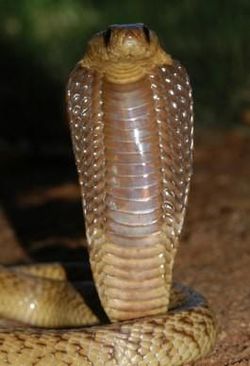
The Cape cobra (Naja nivea), also called the yellow cobra, is a moderate-sized, highly venomous species of cobra inhabiting a wide variety of biomes across southern Africa, including arid savanna, fynbos, bushveld, desert, and semidesert regions. (Full article...)


.jpg)


.jpg)
_by_David_V_Raju.jpg)


Selected lizard articles
Draco indochinensis, also known as the Indochinese flying lizard or Indochinese gliding lizard, is a species of agamid lizard endemic to South-east Asia (Cambodia and southern Vietnam). (Full article...)
Bradypodion ventrale, the southern dwarf chameleon, occurs in the Eastern Cape, South Africa. It is also known as the eastern Cape dwarf chameleon. It is a relatively large species of dwarf chameleon, reaching lengths of 14 cm (5.5 in). It has a very prominent casque on the back of its head and a long, beard-like throat crest. It lives in dense thickets and shrub, and is usually very difficult to spot because of its colouring. It adapts very well to living in suburban gardens, but domestic cats – being introduced predators – will usually kill all chameleons in the immediate area. Consequently, one should not bring chameleons into a garden which is frequented by cats. It gives birth to litters of between 10 and 20 babies in the summer. (Full article...)
The smooth helmeted iguana (Corytophanes cristatus), also known as the helmeted iguana, the helmeted basilisk, the elegant helmeted lizard, and several other common names, is a species of Basilisk and a New World lizard in the family Corytophanidae. The species is native to southern Mexico, Central America, and northwestern South America. (Full article...)
The Cape dwarf chameleon (Bradypodion pumilum) is a chameleon native to the South African province of the Western Cape, where it is restricted to the region around Cape Town. (Full article...)
The Transvaal dwarf chameleon (Bradypodion transvaalense) is a chameleon native to South Africa, where it is found in forested areas of Mpumalanga and Limpopo provinces. It is also known as the Wolkberg dwarf chameleon, after the Wolkberg range. (Full article...)
Gehyra mutilata, also known commonly as the common four-clawed gecko, Pacific gecko, stump-toed gecko, sugar gecko in Indonesia, tender-skinned house gecko, and butiki in Filipino, is a species of lizard in the family Gekkonidae. The species is native to Southeast Asia. It has made its way to several areas of the world including Sri Lanka, Indochina, and many of the Pacific Islands. Compared to the common house gecko (Hemidactylus frenatus), the appearance of G. mutilata is somewhat plump, with delicate skin. The skin is usually colored a soft purplish/pinkish gray, with golden spots on younger specimens; these spots eventually fade with age. (Full article...)
Recreation yard, Camp Iguana
Camp Iguana is a small compound in the detention camp complex on the US Naval base at Guantánamo Bay, Cuba. Camp Iguana originally held three child detainees, who camp spokesmen then claimed were the only detainees under age 16 (the age at which DOD defined minors). It was closed in the winter of 2004 when the three were sent back to their native countries. (Full article...)
The tokay gecko (Gekko gecko) is a nocturnal arboreal gecko in the genus Gekko, the true geckos. It is native to Asia and some Pacific Islands. (Full article...)
The common house gecko (Hemidactylus frenatus) is a gecko native to South and Southeast Asia and Near Oceania. It is also known as the Asian house gecko, Pacific house gecko, wall gecko, house lizard, tiktiki, chipkali and moon lizard. (Full article...)
Sphaerodactylus ariasae, commonly called the Jaragua sphaero or the Jaragua dwarf gecko, is the smallest species of lizard in the family Sphaerodactylidae. (Full article...)
Draco sumatranus, the common gliding lizard, is a species of agamid lizard endemic to Southeast Asia. It has elongated ribs and skin flaps on the sides of its body. When opened, these skin flaps allow it to glide between tree trunks. (Full article...)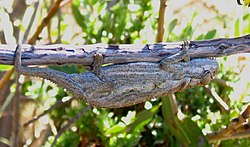
The Swartberg dwarf chameleon (Bradypodion atromontanum) is a species of chameleon endemic to South Africa. (Full article...)
The Indo-Pacific gecko (Hemidactylus garnotii), also known as Garnot's house gecko, fox gecko, or the Assam greyish-brown gecko, is a species of gecko native to South and Southeast Asia, Polynesia, and the east coast of Australia. (Full article...)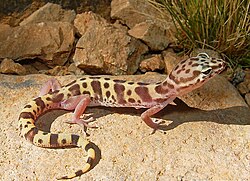
The western banded gecko (Coleonyx variegatus) is a species of lizard in the family Eublepharidae. The species is native to the southwestern United States and adjacent northwestern Mexico. Five subspecies are recognized. (Full article...)
The rhinoceros iguana (Cyclura cornuta) is an endangered species of iguana that is endemic to the Caribbean island of Hispaniola (shared by Haiti and the Dominican Republic) and its surrounding islands. A large lizard, they vary in length from 60 to 136 centimetres (24 to 54 in), and skin colours range from a steely grey to a dark green and even brown. Their name derives from the bony-plated pseudo-horn or outgrowth which resembles the horn of a rhinoceros on the iguana's snout. It is known to coexist with the Ricord's iguana (C. ricordii); the two species are the only taxa of rock iguana to do so. (Full article...)
The Drakensberg dwarf chameleon (Bradypodion dracomontanum) occurs in the Drakensberg, South Africa, between the latitudes of 27°45′ and 29°15′. Bright green dwarf chameleons (emerald dwarf chameleon) found in the Drakensberg south of 29°15′ are now known to be more closely related to the Natal Midlands dwarf chameleon (Bradypodion thamnobates) and may yet be described as a separate species. (Full article...)
The desert iguana (Dipsosaurus dorsalis) is an iguana species found in the Sonoran and Mojave Deserts of the Southwestern United States and northwestern Mexico, as well as on several Gulf of California islands. (Full article...)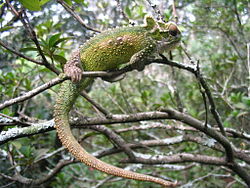
The Natal Midlands dwarf chameleon (Bradypodion thamnobates) is a chameleon native to woodland habitat in the inland Midlands area of the South African province of KwaZulu-Natal. (Full article...)
Draco blanfordii, commonly known as Blanford's flying dragon, Blanford's flying lizard, or Blanford's gliding lizard, is a species of "flying" lizard in the family Agamidae. The species is endemic to Asia, and is capable of gliding from tree to tree. (Full article...)
The Lesser Antillean iguana (Iguana delicatissima) is a large arboreal lizard endemic to the Lesser Antilles. It is one of two species of lizard of the genus Iguana and is in severe decline due to habitat destruction, introduced feral predators, hunting, and hybridization with its introduced sister species, the green iguana (Iguana iguana). Successful captive breeding of this species has been limited to only two instances, as most captive-laid eggs tend to be infertile. (Full article...)- The short-limbed bend-toed gecko (Mediodactylus brachykolon) is a species of gecko. The gecko is distinguished from others due to its distinctly short limbs, stout body and large head. In appearance it is similar to Altiphylax stoliczkai and Altiphylax baturensis.
The name of the gecko comes from Greek brachys meaning short and kolon meaning limb. (Full article...)
Pachydactylus is a genus of insectivorous geckos, lizards in the family Gekkonidae. The genus is endemic to Africa, and member species are commonly known as thick-toed geckos. The genus also displays rich speciation, having 58 distinct species identified when compared to other closely related gecko genera like Rhoptropus, most of which have emerged since 35 Ma. It has been suggested that the reason for this rich speciation is not from adaptive radiation nor nonadaptive radiation, but that the genus represents a clade somewhere between the two drivers of speciation. P. bibronii geckos have been used by NASA as animal models for experimentation. (Full article...)
The clouded monitor (Varanus nebulosus) is a species of monitor lizard, native to Myanmar, Thailand and Laos, Vietnam, to West Malaysia, Singapore, Sumatra, and Java. They are excellent tree climbers. It belongs to the subgenus Empagusia along with the Bengal monitor, the Dumeril's monitor and other monitor lizards. It had previously been listed as a subspecies of Bengal monitor by some herpetologists. It is a diurnal monitor. (Full article...)
Chondrodactylus bibronii, commonly known as Bibron's thick-toed gecko, Bibron's sand gecko, or simply Bibron's gecko, is a species of lizard in the family Gekkonidae. The species is native to southern Africa. C. bibronii has been used as an animal model in bioastronautic research examining the effects of spaceflight on the morphology and physiology of vertebrates. (Full article...)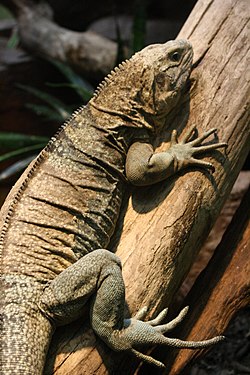
The Jamaican iguana (Cyclura collei), also known commonly as Colley's iguana, is a large species of lizard in the family Iguanidae. The species is endemic to Jamaica. It is critically endangered, even considered extinct between 1948 and 1990. Once found throughout Jamaica and on the offshore islets Great Goat Island and Little Goat Island, it is now confined to the forests of the Hellshire Hills. (Full article...)


.jpg)
_male.jpg)

_from_Barangay_Dibuluan_-_ZooKeys-266-001-g046.jpg)


_Pok_Fu_Lam.jpg)


.jpg)


Categories

Selected turtle articles
The western swamp turtle or western swamp tortoise (Pseudemydura umbrina) is a critically endangered species of freshwater turtle endemic to a small portion of Western Australia. It is the only member of the genus Pseudemydura in the monotypic subfamily Pseudemydurinae. (Full article...)
A statue of a dragon turtle in China
A dragon turtle (Chinese : 龍龜, pinyin : Lóngguī) is a legendary Chinese creature that combines two of the four celestial animals of Chinese mythology: the shell of a turtle with a dragon's body is promoted as a positive ornament in Feng Shui, symbolizing courage, determination, fertility, longevity, power, success, and support. Decorative carvings or statuettes of the creature are traditionally placed facing the window. (Full article...)
The South American snapping turtle (Chelydra acutirostris) is a species of turtle in the family Chelydridae. This species, which is endemic to
Central and northwestern South America, was previously considered a subspecies of C. serpentina. Its restricted range in South America reflects its recent arrival there as part of the Great American Interchange. (Full article...)
The western black-bridged leaf turtle (Cyclemys atripons) is a species of Asian leaf turtle found in southern Indochina. (Full article...)
The northern snake-necked turtle or northern long-necked turtle (Chelodina (Chelydera) rugosa) is a species of turtle in the family Chelidae or Austro-South American side-necked turtles. It is native to northern Australia and southern New Guinea. (Full article...)- The Upemba mud turtle (Pelusios upembae) is a species of turtle in the family Pelomedusidae. (Full article...)

The Asian leaf turtle (Cyclemys dentata) is a species of turtle found in Southeast Asia. They are quite common in the pet trade; their carapaces resemble that of a Cuora amboinensis hybrid. (Full article...)
The Caspian turtle (Mauremys caspica), also known as the striped-neck terrapin, is a species of turtle in the family Geoemydidae (=Bataguridae). It is found in west Asia, in Iran and central Turkey, northward to the Republic of Georgia, Azerbaijan, Russia (Dagestan), eastward to southwestern Turkmenistan, and in Iraq, Saudi Arabia, and Bahrain. (Full article...)
Leith's softshell turtle (Nilssonia leithii) is a species of turtle in the family Trionychidae. The species is found in peninsular Indian rivers including the Thungabhadra, Ghataprabha, Bhavani, Godavari, Kaveri and Moyar Rivers. The type locality is Pune in India. (Full article...)
Indian peacock softshell turtle (Nilssonia hurum) is a species of turtle found in South Asia and is listed on the IUCN Red List as a vulnerable species. (Full article...)
The smooth softshell turtle (Apalone mutica) is a species of North American softshell turtle in the family Trionychidae. This freshwater species is endemic to the United States, where it inhabits the Mississippi River system, along with other adjoining waterways that empty into the Gulf of Mexico. (Full article...)
The Japanese pond turtle (Mauremys japonica), also called commonly the Japanese pond terrapin and the Japanese pond tortoise, is a species of turtle in the family Geoemydidae endemic to Japan. Its Japanese name is nihon ishigame, Japanese stone turtle. Its population has decreased somewhat due to habitat loss, but it is not yet considered a threatened species. (Full article...)
The Colombian wood turtle (Rhinoclemmys melanosterna) is one of nine species of turtle belonging to the genus Rhinoclemmys of the family Geoemydidae. It is found in Colombia, Ecuador, and Panama. (Full article...)
The Ouachita map turtle (Graptemys ouachitensis) is a species of turtle belonging to the family Emydidae. (Full article...)
The Florida box turtle (Terrapene carolina bauri) is a subspecies of turtle belonging to the family Emydidae and is one of six extant subspecies of the common box turtle (T. carolina) (Full article...)
The bog turtle (Glyptemys muhlenbergii), also known commonly as Muhlenberg's turtle, is a critically endangered species of semiaquatic turtle in the family Emydidae. The species is native to the eastern United States. It was first scientifically described in 1801 after an 18th-century survey of Pennsylvania. The smallest North American turtle, it measures about 10 centimeters (4 in) in straight carapace length when fully grown. Although the bog turtle is similar in appearance to the painted turtle (Chrysemys picta) and the spotted turtle (Clemmys guttata), its closest relative is actually the somewhat larger wood turtle (Glyptemys insculpta). The bog turtle can be found from Vermont in the north, south to Georgia, and west to Pennsylvania. Diurnal and secretive, it spends most of its time buried in mud and – during the winter months – in hibernation. The bog turtle is omnivorous, feeding mainly on small invertebrates. The bog turtle is the state reptile of New Jersey. (Full article...)
The pallid spiny softshell turtle (Apalone spinifera pallida) is a subspecies of spiny softshell turtle native to the U.S. states of Arkansas, Oklahoma, Louisiana and Texas. It was first described by Robert G. Webb in 1962. (Full article...)
The Indian roofed turtle (Pangshura tecta) is a species of turtle in the family Geoemydidae. It can be distinguished by the distinct "roof" at the topmost part of the shell. It is found in the major rivers of South Asia. It is a common pet in the Indian Subcontinent. (Full article...)- The Burmese narrow-headed softshell turtle (Chitra vandijki), also known commonly as the Myanmar narrow-headed softshell turtle and Van Dijk's chitra, is a species of turtle in the family Trionychidae. The species is native to Southeast Asia. (Full article...)

Cyclemys enigmatica, also known as the enigmatic leaf turtle, is a species of Asian leaf turtle. It is found in the Greater Sunda Islands and the Malay Peninsula. (Full article...)
The Amboina box turtle or Southeast Asian box turtle (Cuora amboinensis) is a species of Asian box turtle widely distributed across Southeast Asia. It is native to the Asian mainland from northeast India, through Bangladesh, Burma and Thailand, across Laos, Cambodia, Vietnam, and Malaysia. It is also found on the archipelagos of Indonesia and the Philippines. (Full article...)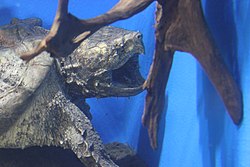
Apalachicola Snapping Turtle, Copenhagen, 2016
The Apalachicola snapping turtle (Macrochelys apalachicolae) is a proposed species that lives in the Apalachicola River, United States. The proposed species can as well be found within other panhandle rivers within the states of Florida, Georgia, and Alabama. (Full article...)
Zhou's box turtle (Cuora zhoui) is a species of turtle in the family Geoemydidae (formerly Bataguridae). The species is apparently endemic to China. (Full article...)- Black-bridged leaf turtle may refer to: (Full article...)

The West African black turtle (Pelusios niger) is a species of turtle in the family Pelomedusidae. It is endemic to Africa, in Cameroon, Equatorial Guinea, Gabon, and Nigeria. (Full article...)


,_El-Al_river.jpg)


_(9236915356).jpg)


_from_Kentucky.jpg)

.jpg)


.jpg)


Need help?
Do you have a question about Reptiles that you can't find the answer to?
Consider asking it at the Wikipedia reference desk.
Topics
Related portals


_Ranomafana.jpg)


Associated Wikimedia
The following Wikimedia Foundation sister projects provide more on this subject:
-
 Commons
Free media repository -
 Wikidata
Free knowledge base -
 Wikiquote
Collection of quotations -
 Wikisource
Free-content library -
 Wikiversity
Free learning tools -
 Wiktionary
Dictionary and thesaurus


