Portal:Central America
Wikipedia portal for content related to Central America
From Wikipedia, the free encyclopedia

The Central America Portal

Central America is a subregion of North America. Its political boundaries are defined as bordering Mexico to the north, Colombia to the southeast, the Caribbean to the east, and the Pacific Ocean to the southwest. Central America is usually defined as consisting of seven countries: Belize, Costa Rica, El Salvador, Guatemala, Honduras, Nicaragua, and Panama, and also sometimes includes Mexico. Within Central America is the Mesoamerican biodiversity hotspot, which extends from southern Mexico to southeastern Panama. Due to the presence of several active geologic faults and the Central America Volcanic Arc, there is a high amount of seismic activity in the region, such as volcanic eruptions and earthquakes, which has resulted in death, injury, and property damage.
Most of Central America falls under the Isthmo-Colombian cultural area. Before the Spanish expedition of Christopher Columbus's voyages to the Americas, hundreds of indigenous peoples made their homes in the area. From the year 1502 onwards, Spain began their colonization. From 1609 to 1821, the majority of Central American territories (except for what would become Belize and Panama and including the modern Mexican state of Chiapas) were governed by the viceroyalty of New Spain from Mexico City as the Captaincy General of Guatemala. On 24 August 1821, Spanish Viceroy Juan de O'Donojú signed the Treaty of Córdoba, which established New Spain's independence and autonomy from mainland Spain. On 15 September, the Act of Independence of Central America was enacted to announce Central America's separation from the Spanish Empire. Some of New Spain's provinces in the Central American region were invaded and annexed to the First Mexican Empire; however in 1823 they seceded from Mexico to form the Federal Republic of Central America until 1838. (Full article...)
Selected article

Maya (/ˈmaɪə/ MY-ə, Spanish: [ˈmaʝa]) are an ethnolinguistic group of Indigenous peoples of Mesoamerica. The ancient Maya civilization was formed by members of this group, and today's Maya are generally descended from people who lived within that historical region. Today they inhabit southern Mexico, Guatemala, Belize, and westernmost El Salvador, and Honduras.
"Maya" is a modern collective term for the peoples of the region; however, the term was not historically used by the Indigenous populations themselves. There was no common sense of identity or political unity among the distinct populations, societies and ethnic groups because they each had their own particular traditions, cultures and historical identity. (Full article...)
Did you know...
- ... that the 1854 San Salvador earthquake damaged San Salvador so severely that the government of El Salvador relocated to Cojutepeque for four years?
- ... that Kilmar Armando Abrego Garcia was deported to El Salvador in March 2025 due to an "administrative error" by the U.S. government?
- ... that both El Salvador and Honduras claim to be the country of origin of the pupusa?
- ... that the Federation of Central America, declared to be "perpetual and indissoluble", collapsed after less than one year?
- ... that Alfonso Quiñónez Molina suddenly becoming President of El Salvador before the 1919 election was described as a "mixed blessing"?
- ... that Panamanian earth scientist Erika Podest uses remote sensing to see how climate change has affected global soil moisture?
- ... that the German Empire dispatched six warships to Nicaragua after a marriage dispute led to a shooting and Germany's consul being arrested?
- ... that Marcos G. McGrath, the Catholic archbishop of Panama, was allowed to enter Manuel Noriega's "witch house" and other residences, and found evidence of torture, devil worship, and voodoo?
Related portals


.svg)


Get involved
For editor resources and to collaborate with other editors on improving Wikipedia's Central America-related articles, see WikiProject Central America.
Need help?
Do you have a question about Central America that you can't find the answer to?
Consider asking it at the Wikipedia reference desk.
General images
 Kʼinich Kan Bahlam II, the Classic period ruler of Palenque, as depicted on a stele (from Mesoamerica)
 The Aztec Empire in 1512 (from Mesoamerica)
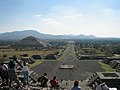 The Avenue of the Dead in Teotihuacan, an example of a Mesoamerican settlement planned according to concepts of directionality (from Mesoamerica)
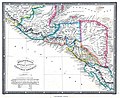 Central America until 1860, showing the Kingdom of Mosquitia. (from History of Central America)
 Zapotec mask of the Bat God. (from Mesoamerica)
 Nery Brenes Costa Rican Athlete (from Ethnic groups in Central America)
 Salvadoran School Children from Metapan (from Ethnic groups in Central America)
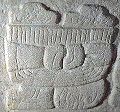 The emblem glyph of Tikal (Mutal) (from Mesoamerica)
 Yojoa Lake in Honduras. (from Mesoamerica)
 The xoloitzcuintle is one of the naguales of the god Quetzalcoatl. In this form, it helps the dead cross the Chicnahuapan, a river that separates the world of the living from the dead. (from Mesoamerica)
 Mesoamerica is primarily situated in western and southern Mexico and Guatemala, above it is Aridoamerica and below is the Isthmo-Colombian Area (from Mesoamerica)
 Ballgame marker from the classic Lowland Maya site of Chinkultic, Mexico depicting a ballplayer in full gear (from Mesoamerica)
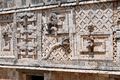 Detail of the Nunnery Quadrangle at Uxmal, 10th century (from Mesoamerica)
 One of the earliest examples of the Mesoamerican writing systems, the Epi-Olmec script on the La Mojarra Stela 1 dated to around 150 CE. Mesoamerica is one of the five places in the world where writing has developed independently. (from Mesoamerica)
 A small ceremonial ballcourt at Tikal. (from Mesoamerica)
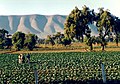 Landscape of the Mesoamerican highlands. (from Mesoamerica)
![Image 18Mesoamerica and Central America in the 16th century before Spanish arrival [according to whom?] (from Mesoamerica)](//upload.wikimedia.org/wikipedia/commons/thumb/0/06/Mesoam%C3%A9rica_y_Centroamerica_prehispanica_siglo_XVI.svg/120px-Mesoam%C3%A9rica_y_Centroamerica_prehispanica_siglo_XVI.svg.png) Mesoamerica and Central America in the 16th century before Spanish arrival [according to whom?] (from Mesoamerica)
Mesoamerica and Central America in the 16th century before Spanish arrival [according to whom?] (from Mesoamerica) Historical map of Central America (from History of Central America)
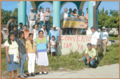 Nicarao community in Rivas, Nicaragua. (from Ethnic groups in Central America)
 Olmec Colossal Head No. 3 1200–900 BCE (from Mesoamerica)
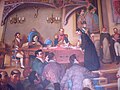 José Matías Delgado at the time of signing the Central American act of independence, in a representation of the meeting of September 15, 1821 of the Chilean painter Luis Vergara Ahumada. (from History of Central America)
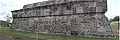 Xochicalco, Temple of the Feathered Serpent, 650–900 CE (from Mesoamerica)
 Heroes of Central American Independence (from History of Central America)
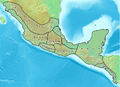 Cultural areas of Mesoamerica (from Mesoamerica)
 "Head Variant" or "Patron Gods" glyphs for Maya days (from Mesoamerica)
 Tikal is one of the largest archaeological sites, urban centers, and tourist attractions of the pre-Columbian Maya civilization. It is located in the archaeological region of the Petén Basin in what is now northern Guatemala. (from Mesoamerica)
 Celebration of the Chinese year in Costa Rica (from Ethnic groups in Central America)
 Indigenous Salvadoran women dancing in the traditional "Procession of Palms" a custom celebrated in the town of Panchimalco in El Salvador. (from Ethnic groups in Central America)
 Young Costa Ricans in San José. (from Ethnic groups in Central America)
 Examples of the diversity of maize (from Mesoamerica)
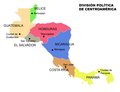 Countries and capitals of Central America (from Ethnic groups in Central America)
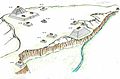 Illustration that recreates the structures of the archaeological site of Yarumela or El Chircal in Honduras, this place reflects the Olmec influence that existed in Central America in the pre-classic period. (from Mesoamerica)
 Flag of Central America (from History of Central America)
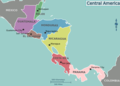 20th century political map of Central America (from History of Central America)
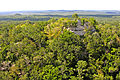 El Mirador flourished from 600 BCE to 100 CE, and may have had a population of over 100,000. (from Mesoamerica)
 Ritual human sacrifice portrayed in Codex Laud (from Mesoamerica)
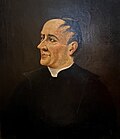 José Matías Delgado y de León listed as the intellectual leader of the independence movement; Delgado was defined as influential, skillful, and intelligent, he started the revolutionary movements against the Spanish crown. (from History of Central America)
 Anthropomorphic figure from the Proto-Lencan culture found at Los Naranjos, Honduras. An example of Mesomerican art during the preclassic Period. (from Mesoamerica)
 Art with ideological and political meaning: depiction of an Aztec tzompantli (skull-rack) from the Ramirez Codex (from Mesoamerica)


.jpg)


_-_Maya_-_National_Museum_of_Antropology_-_Mexico_2024.jpg)

.jpg)


![Image 18Mesoamerica and Central America in the 16th century before Spanish arrival [according to whom?] (from Mesoamerica)](#/media/File:Mesoamérica_y_Centroamerica_prehispanica_siglo_XVI.svg)


_-_Guatemala_1828_-_La_Danta_at_the_Mayan_site_of_El_Mirador.jpg)

.png)


.jpg)
In the news
- 8 May 2026 – 2026 Costa Rican general election
- Laura Fernández Delgado is sworn in as president of Costa Rica, succeeding Rodrigo Chaves Robles. (Reuters) (AP)
- 7 May 2026 – 2027 Salvadoran legislative election, Right of Salvadoran expatriates to vote
- The Legislative Assembly of El Salvador approves a constitutional reform that establishes an overseas constituency for Salvadoran expatriates. The constituency is allocated 6 seats in the 60-seat legislature. (La Prensa Gráfica in Spanish)
- 14 April 2026 – Middle Eastern crisis
- At least three oil tankers pass through the strait, including the Panama-flagged Peace Gulf, which took the new route through Iranian waters as instructed by the Islamic Revolutionary Guard Corps. (Al Jazeera)
- 13 April 2026 – Middle Eastern crisis
- Three ships successfully cross the Strait of Hormuz since the blockade was announced, including Marshall Islands-flagged vessel New Future, Vietnam-flagged NV Sunshine, and Panama-flagged tanker Auroura, which was recently sanctioned by the United States for its links to Iranian oil trading. (Bloomberg) (Caspian Post)
- 6 April 2026 –
- One person is killed and four people are injured after a tanker explodes on the Bridge of the Americas near the Panama Canal. (Straits Times)
- 5 April 2026 –
- Eight people are killed after a bus and a truck collide head-on near Quimistán, Honduras. (infobae)
Subcategories

- Select [►] to view subcategories
Associated Wikimedia
The following Wikimedia Foundation sister projects provide more on this subject:
-
 Commons
Free media repository -
 Wikidata
Free knowledge base -
 Wikiquote
Collection of quotations -
 Wikisource
Free-content library -
 Wikiversity
Free learning tools -
 Wiktionary
Dictionary and thesaurus


