Portal:Guatemala
Wikimedia portal
From Wikipedia, the free encyclopedia

The Guatemala portal
Republic of Guatemala | |
|---|---|
Motto:
| |
| Anthem: Himno Nacional de Guatemala (English: "National Anthem of Guatemala") | |
| ISO 3166 code | GT |


Guatemala, officially the Republic of Guatemala, is a country in northern Central America. It is bordered to the north and west by Mexico, to the northeast (in the adjacency zone) by Belize, to the east by Honduras, and to the southeast by El Salvador. It is bounded by the Pacific Ocean to the south and the Gulf of Honduras to the northeast.
The territory of modern Guatemala hosted the core of the Maya civilization, which extended across Mesoamerica; in the 16th century, most of this was conquered by the Spanish and claimed as part of the viceroyalty of New Spain. Guatemala attained independence from Spain and Mexico in 1821. From 1823 to 1841, it was part of the Federal Republic of Central America. For the latter half of the 19th century, Guatemala suffered instability and civil strife. From the early 20th century, it was ruled by a series of dictators backed by the United States. In 1944, authoritarian leader Jorge Ubico was overthrown by a pro-democratic military coup, initiating a decade-long revolution that led to social and economic reforms. In 1954, a U.S.-backed military coup ended the revolution and installed a dictatorship. From 1960 to 1996, Guatemala endured a bloody civil war fought between the U.S.-backed government and leftist rebels, including genocidal massacres of the Maya population perpetrated by the Guatemalan military. The United Nations negotiated a peace accord, resulting in economic growth and successive democratic elections.
Guatemala's abundance of biologically significant and unique ecosystems includes many endemic species and contributes to Mesoamerica's designation as a biodiversity hotspot. Although rich in export goods, around a quarter of the population (4.6 million) face food insecurity; other major issues include poverty, crime, corruption, drug trafficking, and civil instability.
With an estimated population of around 17.6 million,0 Guatemala is the most populous country in Central America, the fourth most populous country in North America and the 11th most populous country in the Americas. Its capital and largest city, Guatemala City, is the second most populous city in Central America, and its metro area is the most populous in Central America. (Full article...)
Selected article -

Guatemala City (Spanish: Ciudad de Guatemala), also known colloquially by the nickname Guate, is the national capital and largest city of the Republic of Guatemala. It serves as the municipal capital of the surrounding Guatemala Department. Its metropolitan area is also the largest in Central America. The city is located in a mountain valley called Valle de la Ermita (English: Hermitage Valley) in the south-central part of the country.
Guatemala City is the site of the native Mayan city of Kaminaljuyu in Mesoamerica, which was occupied primarily between 1500 BCE and 1200 CE. The present city was founded by the Spanish after their colonial capital, now called Antigua Guatemala, was destroyed by the devastating 1773 Santa Marta earthquake and its aftershocks. It became the third royal capital of the surrounding Captaincy General of Guatemala; which itself was part of the larger Viceroyalty of New Spain in imperial Spanish America and remained under colonial rule until the nineteenth century. (Full article...)
Did you know (auto-generated)

- ... that the Adelaide L. T. Douglas House, built for a New York City socialite, housed the United States Olympic Committee before being sold to Guatemala?
- ... that Miles Rock served as chief of the commission that determined the disputed Guatemala–Mexico border?
- ... that Belize's Toledo Progressive Party was accused of being funded by the government of Guatemala?
Subcategories
WikiProjects

 Good article -


Juan Jacobo Árbenz Guzmán (Spanish: [xwaŋ xaˈkoβo ˈaɾβens ɣusˈman]; 14 September 1913 – 27 January 1971) was a Guatemalan military officer and politician who served as the 25th president of Guatemala. He was Minister of National Defense from 1944 to 1950, before he became the second democratically elected President of Guatemala, from 1951 to 1954. He was a major figure in the ten-year Guatemalan Revolution, which represented some of the few years of representative democracy in Guatemalan history. The landmark program of agrarian reform Árbenz enacted as president was very influential across Latin America.
Árbenz was born in 1913 to a wealthy family, son of a Swiss German father and a Guatemalan mother. He graduated with high honors from a military academy in 1935, and served in the army until 1944, quickly rising through the ranks. During this period, he witnessed the violent repression of agrarian laborers by the United States-backed dictator Jorge Ubico, and was personally required to escort chain-gangs of prisoners, an experience that contributed to his progressive views. In 1938, he met and married María Vilanova, who was a great ideological influence on him, as was José Manuel Fortuny, a Guatemalan communist. In October 1944, several civilian groups and progressive military factions led by Árbenz and Francisco Arana rebelled against Ubico's repressive policies. In the elections that followed, Juan José Arévalo was elected president, and began a highly popular program of social reform. Árbenz was appointed Minister of Defense, and played a crucial role in putting down a military coup in 1949. (Full article...)
Selected image -
 A camioneta or chicken bus, a typical mode of transportation in Guatemala
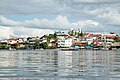 A view of Flores, El Petén
 Lake Atitlán, from a dock in San Juan La Laguna
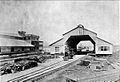 Station and Customs of Puerto Barrios, Guatemala, Northern Railway, 1896
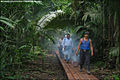 A low impact trail built for ecotourists to protect an archeological site in Guatemala
 A view of the beach in Livingston, Guatemala
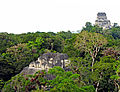 View from the top of the Lost World Pyramid, Temple IV on the right and top of pyramid 5C-49 (also known as the Talud-Tablero Temple) in the Plaza of the Lost World


_-_Guatemala-1525.jpg)
More did you know -
- El Mirador was by far the most populated city in Pre-Columbian America and contains the second largest pyramid in the world by volume.
 Featured article -


Quiriguá (Spanish pronunciation: [kiɾiˈɣwa]) is an ancient Maya archaeological site in the department of Izabal in south-eastern Guatemala. It is a medium-sized site covering approximately 3 square kilometres (1.2 sq mi) along the lower Motagua River, with the ceremonial center about 1 km (0.6 mi) from the north bank. During the Maya Classic Period (AD 200–900), Quiriguá was situated at the juncture of several important trade routes. The site was occupied by 200, construction on the acropolis had begun by about 550, and an explosion of grander construction started in the 8th century. All construction had halted by about 850, except for a brief period of reoccupation in the Early Postclassic (c. 900 – c. 1200). Quiriguá shares its architectural and sculptural styles with the nearby Classic Period city of Copán, with whose history it is closely entwined.
Quiriguá's rapid expansion in the 8th century was tied to king K'ak' Tiliw Chan Yopaat's military victory over Copán in 738. When the greatest king of Copán, Uaxaclajuun Ub'aah K'awiil or "18-Rabbit", was defeated, he was captured and then sacrificed in the Great Plaza at Quiriguá. Before this, Quiriguá had been a vassal state of Copán, but it maintained its independence afterwards. The ceremonial architecture at Quiriguá is quite modest, but the site's importance lies in its wealth of sculpture, including the tallest stele erected in the Mayan world. Because of its historical importance, the site of Quiriguá was inscribed on the UNESCO World Heritage List in 1981. (Full article...)
List of Featured articles |
|---|
General images -
The following are images from various Guatemala-related articles on Wikipedia.
 Day laborers receiving their pay in Santa Rosa, circa 1890, as per the Day Laborer Regulations established by Barrios (from History of Guatemala)
 Chiltepe, a common pepper used on some Guatemalan dishes. (from Culture of Guatemala)
 Maya city of Tikal (from History of Guatemala)
 Guatemalan territory during the conservative regimes of Rafael Carrera and Vicente Cerna. The Soconusco territories were ceded to Mexico in exchange for support during the Liberal revolution of 1871, as stipulated by the Herrera-Mariscal Treaty of 1882. (from History of Guatemala)
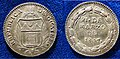 Proclamation coin from 1847 of the independent Republic of Guatemala (from History of Guatemala)
 Coat of Arms of the Republic of Guatemala from 1858 to 1871. A replica was carved on the front of the Carrera Theater before it was remodeled in 1892. (from History of Guatemala)
 Map of railway lines in Guatemala and El Salvador, owned by the IRCA, a subsidiary of the United Fruit Company that controlled the railroads in both countries. The only Atlantic port was controlled by the Great White Fleet, also a UFCO company. (from History of Guatemala)
 Map of Guatemala in 1829. Note that borders with Mexico, Yucatán, and Chiapas are not defined. (from History of Guatemala)
 Plaza Central of Antigua Guatemala in 1829. The old "Palacio de la Capitanía General" remained in ruins following the 1773 earthquake. (from History of Guatemala)
 Inauguration of Colonel Jacobo Árbenz as President of Guatemala, 1951. (from History of Guatemala)
 General Carrera, portrait celebrating the foundation of the Republic of Guatemala in 1847 (from History of Guatemala)
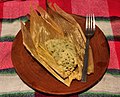 Chipilín Tamal, a common dish usually eaten at dinner. (from Culture of Guatemala)
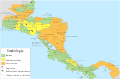 Central America in the 16th century, before the Spanish conquest (from History of Guatemala)
 General Francisco Morazán (from History of Guatemala)
 Barrigones sculpture (from History of Guatemala)
 General Manuel José Arce; decorated Salvadoran General and president of the Federal Republic of Central America from 1825 to 1829. (from History of Guatemala)
 Criollos rejoice upon learning of the declaration of independence on 15 September 1821. Painting by Rafael Beltranena. (from History of Guatemala)
 1861 map showing the boundary between British Honduras (now Belize) and Guatemala (from History of Guatemala)
 Route map of the Great White Fleet of the United Fruit Company, which held a monopoly on freight and passenger maritime transport to and from Puerto Barrios in Guatemala since 1903. (from History of Guatemala)
 Location of the Franja Transversal del Norte (Northern Transversal Strip) in Guatemala (from History of Guatemala)
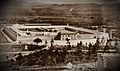 Guatemalan National Penitentiary, built by Barrios to incarcerate and torture his political enemies (from History of Guatemala)
 Coat of arms of the state of Los Altos, carved in stone on the grave of heroes at the Cemetery of Quetzaltenango (from History of Guatemala)
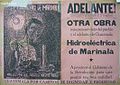 Advertisement for the Marinalá power plant during the Árbenz government (from History of Guatemala)
 The Jurun Marinalá power plant was conceived during the Árbenz government to compete with the Electricity Company of Guatemala, which was then an American company using foreign oil instead of Guatemala's natural resources. Construction of the plant was not completed until 1968, fourteen years after Árbenz was removed in a CIA-sponsored coup d'état in 1954. (from History of Guatemala)
 Captain General Rafael Carrera after being appointed president for Life of the Republic of Guatemala in 1854 (from History of Guatemala)
 Finance Center in 2011. In 1981, a powerful bomb exploded in the building's basement, leaving it without windows for several years. The owners, Industrial Bank, decided to keep the building open to the public as a defiant stance against the leftist guerrilla. (from History of Guatemala)
 Map of Guatemala after 1882 with modern borders (from History of Guatemala)
 Manuel Estrada Cabrera ruled Guatemala from 1898 to 1920. (from History of Guatemala)


Topics
Departments
Guatemala is divided into 22 departments (departamentos) and sub-divided into about 332 municipalities (municipios).
The departments include:

Related portals


.svg)


Things you can do

Here are some things you can do for WikiProject Guatemala:
- Create requested articles:
- El Viejo Palmar -- Village south of Quetzaltenango, hit by a volcanic eruption
- Expand "stub" and "start" articles:
- Assess the importance of articles:
Recognized content
 | This is a list of recognized content, updated weekly by JL-Bot (talk · contribs) (typically on Saturdays). There is no need to edit the list yourself. If an article is missing from the list, make sure it is tagged (e.g. {{WikiProject Guatemala}}) or categorized correctly and wait for the next update. See WP:RECOG for configuration options. |
Featured articles
Good articles
- 5to Piso
- Adentro
- Gómez de Alvarado
- El Amor (Ricardo Arjona song)
- Francisco Javier Arana
- Jacobo Árbenz
- Ricardo Arjona
- La Blanca, Peten
- Bartolomé de las Casas
- Central America under Mexican rule
- Como Duele (Ricardo Arjona song)
- El Chal
- Federation of Central America (1921–1922)
- Alaíde Foppa
- Fuiste Tú
- Guatemala at the 2016 Summer Paralympics
- Guatemalan Revolution
- Haʼ Kʼin Xook
- Independiente (Ricardo Arjona album)
- Itzam Kʼan Ahk II
- Iximche
- Kʼinich Yat Ahk II
- Kʼinich Yoʼnal Ahk I
- Manche Chʼol
- Marta (Ricardo Arjona song)
- Menéndez's revolution
- Mi Novia Se Me Está Poniendo Vieja
- Mixco Viejo
- Luisa Moreno
- Motul de San José
- Mundo Perdido, Tikal
- North Acropolis, Tikal
- Poquita Ropa
- Puente (song)
- Quién Dijo Ayer
- Quién (Ricardo Arjona song)
- Quiero (Ricardo Arjona song)
- Resplendent quetzal
- Battle of Roatán
- Simplemente Lo Mejor
- Spanish conquest of Yucatán
- Spanish conquest of the Maya
- Te Quiero (Ricardo Arjona song)
- Tikal
- Trópico (Ricardo Arjona album)
- Vida (Ricardo Arjona song)
- White-lipped peccary
- Yoʼnal Ahk III
- Zaculeu
Featured pictures
 Cinnamon hummingbird (Amazilia rutila) in flight Los Tarrales
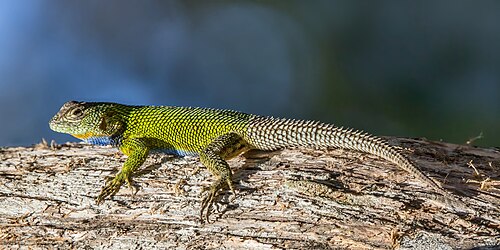 Emerald swift (Sceloporus malachiticus) Finca El Pilar
 Ocellated turkey (Meleagris ocellata) male Peten
_in_flight_Los_Tarrales.jpg)
_Finca_El_Pilar.jpg)
_male_Peten.jpg)
Associated Wikimedia
The following Wikimedia Foundation sister projects provide more on this subject:
-
 Commons
Free media repository -
 Wikidata
Free knowledge base -
 Wikiquote
Collection of quotations -
 Wikisource
Free-content library -
 Wikiversity
Free learning tools -
 Wikivoyage
Free travel guide -
 Wiktionary
Dictionary and thesaurus


Guatemala news
The current date and time in Guatemala is Friday, June 12, 2026, 20:34.
News media:
- The Guatemala Times
- La Prensa Libre (in Spanish)
- Wikinews Guatemala portal
Sources


