Portal:Insects
Wikipedia portal for content related to Insects
From Wikipedia, the free encyclopedia

The Insects Portal


Insects (from Latin insectum) are invertebrates of the class Insecta. They are the largest group within the arthropod phylum. Insects have an exoskeleton, a three-part body (head, thorax and abdomen), three pairs of jointed legs, compound eyes, and a pair of antennae. Insects are the most diverse group of animals, with more than a million described species; they represent more than half of all animal species. (Full article...)
Selected article -

Grasshoppers are a group of insects belonging to the suborder Caelifera. They are amongst what are possibly the most ancient living groups of chewing herbivorous insects, dating back to the early Triassic, around 250 million years ago.
Grasshoppers are typically ground-dwelling insects with powerful hind legs which allow them to escape from threats by leaping vigorously. Their front legs are shorter and used for grasping food. As hemimetabolous insects, they do not undergo complete metamorphosis; they hatch from an egg into a nymph or "hopper" which undergoes five moults, becoming more similar to the adult insect at each developmental stage. The grasshopper hears through the tympanal organ which can be found in the first segment of the abdomen attached to the thorax; while its sense of vision is in the compound eyes, a change in light intensity is perceived in the simple eyes (ocelli). At high population densities and under certain environmental conditions, some grasshopper species can change colour and behavior and form swarms. Under these circumstances, they are known as locusts. (Full article...)
Did you know -
- ... that Clouded Magpie moths resemble bird droppings while they are resting on the upper surface of leaves?
- ... that the caterpillars of the moth Mompha raschkiella cause a yellowish blotch on the leaves of Rosebay Willowherb that bleach rapidly after the caterpillars leave them?
- ... that the scientific name of the peacock carpenter bee (Xylocopa bombylans) means "bumblebee-like wood-cutter"?
- ... that the mayfly Rhithrogena germanica can emerge from a river, moult and fly off in 30 seconds?
- ... that the first entomological article written by a New World native concerned the "Great Black Waſp"?
List articles

Related portals


General images -
 Diagram of a typical insect leg (from Insect morphology)
 Indian moon moth (Actias selene) with some of the spiracles identified (from Respiratory system of insects)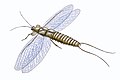
 Generalized arthropod biramous limb. Trueman proposed that an endite and an exite fused to form a wing. (from Insect flight)
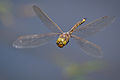 The Odonata (dragonflies and damselflies) have direct flight musculature. (from Insect flight)
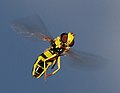 Hoverfly (Philhelius pedissequum) has indirect flight musculature. (from Insect flight)
 Insect morphology
Legend of body parts
Tagmata: A – Head, B – Thorax, C – Abdomen.(from Insect morphology)- antenna
- ocelli (lower)
- ocelli (upper)
- compound eye
- brain (cerebral ganglia)
- prothorax
- dorsal blood vessel
- tracheal tubes (trunk with spiracle)
- mesothorax
- metathorax
- forewing
- hindwing
- mid-gut (stomach)
- dorsal tube (heart)
- ovary
- hind-gut (intestine, rectum & anus)
- anus
- oviduct
- nerve cord (abdominal ganglia)
- Malpighian tubes
- tarsal pads
- claws
- tarsus
- tibia
- femur
- trochanter
- fore-gut (crop, gizzard)
- thoracic ganglion
- coxa
- salivary gland
- subesophageal ganglion
- mouthparts
 Frenulo-retinacular wing coupling in male and female moths (from Insect flight)
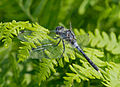 Showing the paired white paraprocts at the posterior tip. (from Insect morphology)
 Evolution has produced astonishing variety of appendages in insects, such as these antennae. (from Evolution of insects)
 Ctenopisma lineatum showing the two cerci and the central caudal filament. (from Insect morphology)
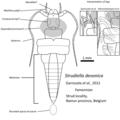 Reconstruction of Strudiella devonica as a possible hexapod (from Evolution of insects)
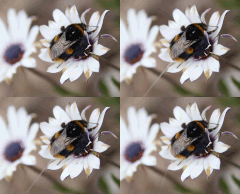 Bumblebee defecating. Note the contraction of the anus, which provides internal pressure. (from Insect morphology)
 Stylized diagram of insect digestive tract showing malpighian tubule, from an insect of the order Orthoptera. (from Insect morphology)
 A tau emerald (Hemicordulia tau) dragonfly has flight muscles attached directly to its wings. (from Insect flight)
 Cross-section of wing vein (from Insect morphology)
 Direct flight: muscles attached to wings. Large insects only (from Insect flight)
 Mandibles of Rhyniognatha hirsti, it may be one of the oldest insects, but also possible to be a myriapod. (from Evolution of insects)
 Mayfly nymph with paired abdominal gills (from Insect flight)
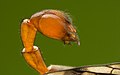 The abdominal terminus of male scorpionflies is enlarged into a "genital bulb", as seen in Panorpa communis (from Insect morphology)
- Mazothairos, a Carboniferous member of the now extinct order Palaeodictyoptera. (from Evolution of insects)
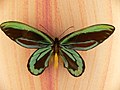 Queen Alexandra's birdwing (Ornithoptera alexandrae) of Papua New Guinea (from Insect biodiversity)
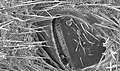 Scanning electron micrograph of a cricket spiracle valve (from Respiratory system of insects)
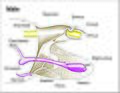 Male genitalia of Lepidoptera (from Insect reproductive system)
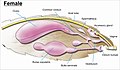 The female genitalia of Lepidoptera (from Insect reproductive system)
 Variety of male structures in Phlebotominae (Diptera, Psychodidae) (from Insect reproductive system)
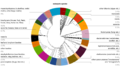 A pie chart of described eukaryote species, showing just over half of these to be insects (from Insect biodiversity)


.jpg)


.JPG)


.png)
.jpg)

Selected image -


The yellow fever mosquito, Aedes aegypti (Diptera: Culicidae), is a mosquito that can spread the dengue fever, Chikungunya and yellow fever viruses, and other diseases. It can be recognized by white markings on legs and a marking in the form of a lyre on the thorax.
Topics
Subcategories

WikiProjects

Main WikiProject:
Related projects:
- WikiProject Arthropods
- WikiProject Spiders
- WikiProject Animals
- WikiProject Tree of Life
- WikiProject Biology
Daughter projects:
Tasks
 |
Here are some tasks awaiting attention:
|
Associated Wikimedia
The following Wikimedia Foundation sister projects provide more on this subject:
-
 Commons
Free media repository -
 Wikidata
Free knowledge base -
 Wikiquote
Collection of quotations -
 Wikisource
Free-content library -
 Wikiversity
Free learning tools -
 Wiktionary
Dictionary and thesaurus


