Portal:Maps
Wikipedia portal for content related to maps
From Wikipedia, the free encyclopedia

| Main page | Maps |
The Maps and Cartography Portal

In cartography, a map is a two-dimensional representation of the Earth's surface depicting the spatial layout of geographical features.
Maps serve a wide range of purposes. One of the most common uses of maps is route planning, enabling users to find restaurants and other points of interest. Commercial and recreational traffic in the air and water use maps (called "charts" in this context): airplane traffic relies on aeronautical charts and water traffic uses nautical charts. Scientists use maps to organize spatial data in fields such as geology, meteorology, seismology, and demographics.
Governments use maps for applications such as census, voting districts, property taxation, and dispatching fire or police responders, and coordinating disaster relief. Military and security forces use maps for mission planning, surveillance, border management, and intelligence analysis.
A cartographer must make many choices when designing a map, including scale, coordinate system, symbols, shapes, colors, labels, and typography. The projection is an important decision: the Mercator projection was widely used for centuries, but has been criticized for depicting European nations enlarged compared to developing countries nearer to the equator.
One of the earliest preserved maps is from the Akkadian Empire (in modern Iraq) inscribed on a clay tablet and dated to 2300 BCE. In the 5th century BCE, Greeks were drawing map of their known world, encompassing the Mediterranean Sea and most of Europe, North Africa, and the Middle East. Maps played a major role in the Age of Discovery, and were carried by mariners as they explored new lands. The applications of cartography expanded in the late 17th century with the invention of thematic maps which portrayed a specific kind of data – such as rainfall or population density – in contrast to simply portraying major geographic features such as rivers, mountains, and cities. The rapid expansion of road networks and mass transit systems in the 20th century created a market for mass-produced maps aimed at the traveling public.
The invention of Geographic Information Systems (GIS) in the modern era allowed vast amounts of geographic data to be dynamically displayed on computer screens, so users could interactively zoom, pan, and choose which data to view. Geographic data used for mapmaking may include imagery, scanned paper maps, surveying data, geographical features, and terrain (elevation) data. (Full article...)
Cartography (/kɑːrˈtɒɡrəfi/) is the study and practice of making and using maps. Combining science, aesthetics and technique, cartography builds on the premise that reality (or an imagined reality) can be modeled in ways that communicate spatial information effectively. (Full article...)
Selected article -

The Antonine Itinerary (Latin: Itinerarium Antonini Augusti, "Itinerary of the Emperor Antoninus") is an itinerarium, a register of the stations and distances along various roads. Seemingly based on official documents, possibly in part from a survey carried out under Augustus, it describes the roads of the Roman Empire. Owing to the scarcity of other extant records of this type, it is a valuable historical record. (Full article...)
General images -
 A chart of an unidentified area (from History of cartography)
 Illustrated map (from Cartographic design)
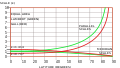 Scale variation for the Lambert (green) and Gall (red) equal area projections. (from Scale (map))
 A map of Sikkim, India using shaded relief and hypsometric tints (a form of isarithm) to visualize terrain (from Cartographic design)
 Surviving fragment of the first World Map of Piri Reis (1513) showing parts of the Americas. (from History of cartography)
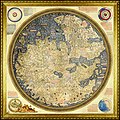 The Fra Mauro map, a medieval European map, was made around 1450 by the Italian monk Fra Mauro. It is a circular world map drawn on parchment and set in a wooden frame, about two meters in diameter. (from History of cartography)
 Map of the Holy Land, Pietro Vesconte, 1321. Described by Adolf Erik Nordenskiöld as "the first non-Ptolemaic map of a definite country". (from History of cartography)
 Reconstruction of Pomponius Mela's world map. (from History of cartography)
 The Winkel tripel projection with Tissot's indicatrix of deformation (from Scale (map))
 Universalis Cosmographia, the Waldseemüller wall map dated 1507, depicts the Americas, Africa, Europe, Asia, and the Pacific Ocean separating Asia from the Americas. (from History of cartography)
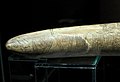 Possibly the oldest surviving map has been engraved on this mammoth tusk, dated to 25,000 BC, found from Pavlov in the Czech Republic. (from History of cartography)
 Map of Biscayne National Park, Florida, using a variety of point symbols, along with line and area symbols. Note the use of coordinated fill and stroke symbols for the national park area to solve the challenge of a water boundary. (from Cartographic design)
 The Salviati Planisphere, a 1526 version of the Padrón Real provided by Charles V to the cardinal who officiated his wedding to Isabella of Portugal. (from History of cartography)
 Al-Masudi's world map (10th century) (from History of cartography)
 "Mapa de los Estados Unidos de Méjico by John Distrunell, the 1847 map used during the negotiations of the Treaty of Guadalupe Hidalgo ending the Mexican–American War. (from History of cartography)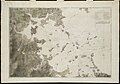
 The Mercator projection with Tissot's indicatrix of deformation. (The distortion increases without limit at higher latitudes) (from Scale (map))
 Lambert's normal cylindrical equal-area projection with Tissot's indicatrix of deformation (from Scale (map))
 The Mercator 1569 world map (from History of cartography)
 The Da Ming Hun Yi Tu map, dating c. 1390, exists in multicolour format. (from History of cartography)
 Infinitesimal elements on the sphere and a normal cylindrical projection (from Scale (map))
 The Gough Map, a road map of 14th-century Britain (from History of cartography)
 The world according to Hekatæus, 500 BC (from History of cartography)
 CIA map of Iraq, following typical labeling guidelines to maximize legibility and association (from Cartographic design)
 Blaeu's world map, originally prepared by Joan Blaeu for his Atlas Maior, published in the first book of the Atlas Van Loon (1664) (from History of cartography)
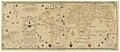 The Propaganda Map, a 1529 version of the Padrón Real now held by the Vatican Library. (from History of cartography)
 The Equal Earth projection (2018), an increasingly popular equal-area pseudocylindrical projection for world maps (from Cartographic design)
 An early Western Han dynasty (202 BC – 9 AD) silk map found in tomb 3 of Mawangdui Han tombs site, depicting the Kingdom of Changsha and Kingdom of Nanyue in southern China (note: the south direction is oriented at the top, north at the bottom). (from History of cartography)
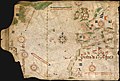 Nautical chart by Pedro Reinel (c. 1504), one of the first based on astronomical observations and to depict a scale of latitudes. (from History of cartography)
 The world according to Herodotus, 440 BC (from History of cartography)
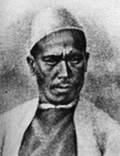 The pundit (explorer) cartographer Nain Singh Rawat (19th century) received a Royal Geographical Society gold medal in 1876. (from History of cartography)
 Clay tablet with map of the Babylonian city of Nippur (c. 1400 BC) (from History of cartography)
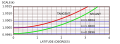 Scale variation near the equator for the tangent (red) and secant (green) Mercator projections. (from Scale (map))
 A US civil war hachure paper map made in 1867 by cartographer Nathaniel Michler vs. modern aerial photos over Chancellorsville, Virginia (from History of cartography)
 A graphical or bar scale. A map would also usually give its scale numerically ("1:50,000", for instance, means that one cm on the map represents 50,000cm of real space, which is 500 meters) (from Scale (map))
 World Map by Juan de la Cosa (1500), the first map showing the Americas. (from History of cartography)
 A general map of the world by Samuel Dunn, 1794, containing star chart, map of the Solar System, map of the Moon and other features along with Earth's both hemispheres. (from History of cartography)
 Map of the “Inhabited Quarter” by Sadiq Isfahani from Jaunpur c.1647. This was one of the only surviving Indian made maps. (from History of cartography)
 Modern version of the Roman Tabula Peutingeriana (5th century). (from History of cartography)
 A portrait of a Dutch mapmaker looking up intently from his charts and holding a caliper, 1714. (from History of cartography)
 3D cartography of Washington State, Mount Rainier National Park, Pinnacle Peak trail. (from Cartographic design)
 The Yu Ji Tu, or Map of the Tracks of Yu Gong, carved into stone in 1137, located in the Stele Forest of Xi'an. This 3 ft (0.91 m) squared map features a graduated scale of 100 li for each rectangular grid. China's coastline and river systems are clearly defined and precisely pinpointed on the map. Yu Gong is in reference to the Chinese deity described in the geographical chapter of the Classic of History, dated 5th century BC. (from History of cartography)
 A well-composed transit map of Istanbul, with a high degree of contrast between the symbols, creating a strong visual hierarchy (transit lines are and look most important), figure-ground, and selectivity (the green national rail line can be isolated when necessary). Also note the harmonizing subdued tones of green and blue in the background. (from Cartographic design)
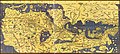 The Tabula Rogeriana, drawn by Muhammad al-Idrisi for Roger II of Sicily in 1154. Note that the north is at the bottom, and so the map appears "upside down" compared to modern cartographic conventions. (from History of cartography)
 A chorochromatic map of world land cover, using hue, value, and saturation to differentiate nominal values (from Cartographic design)
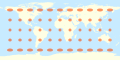 The equidistant projection with Tissot's indicatrix of deformation (from Scale (map))
- Infinitesimal elements on the sphere and a normal cylindrical projection (from Scale (map))
 Martin Behaim's Erdapfel (1492) is considered to be the oldest surviving terrestrial globe. (from History of cartography)
 The cartographic process (from Cartographic design)


.jpg)


_(2674893303).jpg)


.svg)


.jpg)


.jpg)


Selected quote
| “ | I wanna hang a map of the world in my house. Then I'm gonna put pins into all the locations that I've traveled to. But first, I'm gonna have to travel to the top two corners of the map so it won't fall down. | ” |
| — Mitch Hedberg | ||
Related portals


Related WikiProjects

Selected biography -
.jpg)
Pietro Vesconte (fl. 1310–1330) was an Italian cartographer and geographer from the Republic of Genoa. A pioneer of the field of the portolan chart, he influenced Italian and Catalan mapmaking throughout the fourteenth and fifteenth centuries. He appears to have been the first professional mapmaker to sign and date his works regularly. (Full article...)
Selected picture

Did you know
- ... that Kaneza Schaal and Christopher Myers created Cartography after seeing a young boy playing music?
- ... that the Canadian League for Peace and Democracy organized a 10,000-person rally at Maple Leaf Gardens in Toronto to protest a 2,500-person fascist rally?
- ... that Kathryn Maple won the Sunday Times Watercolour Competition twice in three years?
- ... that Bartholomäus Scultetus tried to become the court cartographer of Ivan the Terrible?
- ... that Maki Narukido researched the characters' travel times in her manga The End of the World With You using Google Maps?
Topics
Map - Atlas - Geography - Topography
Cartography: Cartographers - History of cartography - Ancient world maps - World maps - Compass rose - Generalization - Geographic coordinate system - Geovisualization - Relief depiction - Scale - Terra incognita - Planetary cartography
Map projection: Azimuthal equidistant - "Butterfly" - Dymaxion - Gall–Peters - General Perspective - Goode homolosine - Mercator - Mollweide - Orthographic - Peirce quincuncial - Robinson - Sinusoidal - Stereographic
Maps: Animated mapping - Cartogram - Choropleth map - Estate map - Geologic map - Linguistic map - Nautical chart - Pictorial map - Reversed map - Road atlas - Thematic map - Topographic map - Weather map - Web mapping - World map
Map examples
World

Historical

Thematic

Geographic

Political

Nautical

Categories

Things you can do
|
|
Here are some Geography related tasks you can do:
|

Atlases and maps of the world at Wikimedia Commons

Associated Wikimedia
The following Wikimedia Foundation sister projects provide more on this subject:
-
 Commons
Free media repository -
 Wikidata
Free knowledge base -
 Wikiquote
Collection of quotations -
 Wikisource
Free-content library -
 Wikiversity
Free learning tools -
 Wiktionary
Dictionary and thesaurus


