Portal:Piracy
Wikipedia portal for content related to Piracy
From Wikipedia, the free encyclopedia

Introduction

Piracy is an act of robbery or criminal violence by ship or boat-borne attackers upon another ship or a coastal area, typically intending to steal cargo and valuable goods, or take hostages. Those who conduct acts of piracy are called pirates, and vessels used for piracy are called pirate ships. The earliest documented instances of piracy date to the 14th century BC, when the Sea Peoples, a group of ocean raiders, attacked the ships of the Aegean and Mediterranean civilisations. Narrow channels which funnel shipping into predictable routes have long created opportunities for piracy, as well as for privateering and commerce raiding.
Historic examples of such areas include the waters of Gibraltar, the Strait of Malacca, Madagascar, the Gulf of Aden, and the English Channel, whose geographic structures facilitated pirate attacks. The term piracy generally refers to maritime piracy, although the term has been generalized to refer to acts committed on land, in the air, on computer networks, and (in science fiction) outer space. Piracy usually excludes crimes committed by the perpetrator on their own vessel (e.g., theft) as well as privateering, which implies authorization by a state government.
Piracy, or pirating, is the name of a specific crime under customary international law and also of many crimes under the municipal law of many states. In the 21st century, seaborne piracy against transport vessels remains a significant issue, with estimated worldwide losses of US$25 billion in 2023, increased from US$16 billion in 2004. (Full article...)
Selected biography -

John Leadstone (fl. 1704–1721) was a pirate and slaver active off the west coast of Africa. Often called “Captain Crackers” or “Old Captain Cracker,” he is best known for his actions against the English Royal African Company and for his brief involvement with Bartholomew Roberts. (Full article...)
Selected article -

The Emirate of Crete (Arabic: إقريطش, romanized: Iqrīṭish or إقريطية, Iqrīṭiya; Greek: Κρήτη, romanized: Krētē) was an Arab Islamic state that existed on the Mediterranean island of Crete from the late 820s to the reconquest of the island by the Byzantine Empire in 961. Although the emirate recognized the suzerainty of the Abbasid Caliphate and maintained close ties with Tulunid Egypt, it was de facto independent.
A group of Arab Andalusian exiles led by Abu Hafs Umar al-Iqritishi conquered Crete in either 824 or 827/828, and established an independent Islamic state. The Byzantines launched a campaign that took most of the island back in 842–43 under Theoktistos, but the reconquest was not completed and would soon be reversed. Later attempts by the Byzantine Empire to recover the island failed, and for the approximately 135 years of its existence, the emirate was one of the major foes of Byzantium. Crete commanded the sea lanes of the Eastern Mediterranean and functioned as a forward base and haven for Muslim corsair fleets that ravaged the Byzantine-controlled shores of the Aegean Sea. The emirate's internal history is less well known, but all accounts point to considerable prosperity deriving not only from piracy but also from extensive trade and agriculture. The emirate was brought to an end by Nikephoros Phokas, who successfully campaigned against it in 960–961, re-annexing the island to the Byzantine Empire. (Full article...)
Did you know?
- ... that a Dutch publisher pirated the first four volumes of Memoirs and Adventures of a Man of Quality, then hired the author to write more?
- ... that a 1526 pirate raid might have inspired a Maltese ballad about a bride being abducted from her wedding?
- ... that Queen Eschiva and her children were kidnapped by the pirate Kanakes after her husband put a bounty on him?
- ... that since 1904 the Gasparilla Pirate Festival in Tampa, Florida, has featured a pirate-themed parade?
- ... that a search engine for pirated books has been used to train large language models?
- ... that Stephen Foster's best-selling song "Old Uncle Ned" made little money for him due to the many pirated publications circulating in the marketplace?
- ... that red Jolly Roger flags were the most feared of all; all prayed they never encountered the "Bloody Red," which boldly declared that no mercy would be shown and all victims would be killed?
- ... that in 2011, pirates were reported as raiding along the Danube River in the center of Europe?
- ... that in the Golden Age of Piracy, the word "pirate" was often spelled "pyrate" or "pyrat"?
Selected quotations
| “ | This man was a real-life Goliath; sadly, there was no David who could stand up against him! | ” |
| — unknown) | ||
General images
 A person costumed in the character of captain Jack Sparrow, Johnny Depp's lead role in the Pirates of the Caribbean film series (from Piracy)
 MARCOS commando units of the Indian Navy intervening on a pirate-flagged vessel as a part of Operation Sankalp (from Piracy off the coast of Somalia)
 Battle of Preveza, 1538 (from Barbary corsairs)
 Map showing the extent of Somali pirate attacks on shipping vessels between 2005 and 2010 (from Piracy)
 Somalia's coral reefs, ecological parks and protected areas (from Piracy off the coast of Somalia)
 A contemporary flyer depicting the public execution of 16th-century pirate Klein Henszlein and his crew in 1573 (from Piracy)
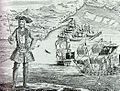 Bartholomew Roberts was the pirate with the most captures during the Golden Age of Piracy. He is now known for hanging the governor of Martinique from the yardarm of his ship. (from Piracy)
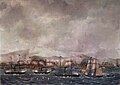 Spanish warships bombarding the Moro Pirates of the southern Philippines in 1848 (from Piracy)
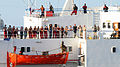 The crew of the merchant vessel Faina stand on the deck after a U.S. Navy request to check on their health and welfare. The Belize-flagged cargo ship owned and operated by Kaalbye Shipping, Ukraine, was seized by pirates 25 September 2008 and forced to proceed to anchorage off the Somali coast. The ship was carrying a cargo of Ukrainian T-72 tanks and related military equipment. (from Piracy off the coast of Somalia)
 Baluarte Watchtower, La Union. A 400-year-old Spanish-era structure built to guard against pirates, later used in World War II as a communication tower for the USAFIP-NL airfield. (from Piracy)
 French bombardment of Algiers by Admiral Dupperé, 13 June 1830 (from Barbary corsairs)
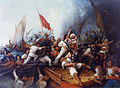 U.S. naval officer Stephen Decatur boarding a Tripolitan gunboat during the First Barbary War, 1804 (from Piracy)
 Coat of arms of the town of Almuñécar, granted by King Charles V in 1526, showing the turbaned heads of three Barbary pirates floating in the sea (from Barbary corsairs)
 "Mic the Scallywag" of the Pirates of Emerson Haunted Adventure, Fremont, California (from Piracy)
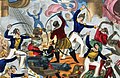 An Algerine pirate ship (from Barbary corsairs)
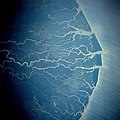 Aerial photograph of the Niger Delta, a center of piracy (from Piracy)
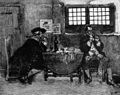 Henry Every is shown selling his loot in this engraving by Howard Pyle. Every's capture of the Grand Mughal ship Ganj-i-Sawai in 1695 stands as one of the most profitable pirate raids ever perpetrated. (from Piracy)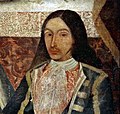
 A man from the Barbary states (from Barbary corsairs)
 Henry Morgan who sacked and burned the city of Panama in 1671 – the second most important city in the Spanish New World at the time; engraving from 1681 Spanish edition of Alexandre Exquemelin's The Buccaneers of America (from Piracy)
 1724 engraving of Bonny from A General History of the Pyrates (from Piracy)
 A merchant seaman aboard a fleet oil tanker practices target shooting with a Remington 870 12 gauge shotgun as part of training to repel pirates in the Strait of Malacca, 1984 (from Piracy)
 Map of Durrës in 1573 by Simon Pinargenti (from Albanian piracy)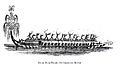
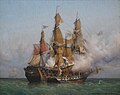 Kent battling Confiance, a privateer vessel commanded by French corsair Robert Surcouf in October 1800, as depicted in a painting by Garneray (from Piracy)
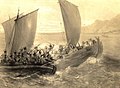 Cossacks of Azov fighting a Turk ship by Grigory Gagarin (from Piracy)
 British captain witnessing the miseries of Christian slaves in Algiers, 1815 (from Barbary corsairs)
 Blackbeard's severed head hanging from Maynard's bowsprit; illustration from The Pirates Own Book (1837) (from Piracy)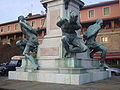
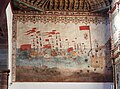
 Barbary pirates were involved in the Barbary slave trade in North Africa (from Piracy)
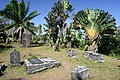 The cemetery of past pirates at Île Ste-Marie (St. Mary's Island) (from Piracy)
 Views of Ulcinj in 1718 bz H. C. Bröckell (from Albanian piracy)
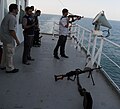 A private guard escort on a merchant ship providing security services against piracy in the Indian Ocean (from Piracy)
 The Bombardment of Algiers by the Anglo-Dutch fleet in 1816 to support the ultimatum to release enslaved Europeans (from Piracy)
 Lieve Pietersz Verschuier, Dutch ships bomb Tripoli in a punitive expedition against the Barbary pirates, c. 1670 (from Barbary corsairs)
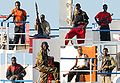 A collage of Somali pirates armed with AKM assault rifles, RPG-7 rocket-propelled grenade launchers and semi-automatic pistols in 2008 (from Piracy)
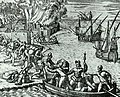 Jacques de Sores looting and burning Havana in 1555 (from Piracy)
 An action between an English ship and vessels of the Barbary Corsairs (from Barbary corsairs)
 A fight between Filipino pirates, Bugis trading ship, and Dutch mariners. (from Piracy)
 A pirate skiff in Baltiysk, Russia — captured by the Russian Navy (from Piracy off the coast of Somalia)
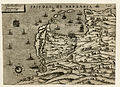 Map of Tripoli in 1561 (from Albanian piracy)
 Map of Vlorë in 1573 by Simon Pinargenti (from Albanian piracy)
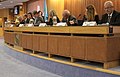 International Maritime Organization (IMO) conference on capacity-building to counter piracy in the Indian Ocean (from Piracy)
 Modern reconstruction of skull alleged to have belonged to 14th century pirate Klaus Störtebeker. He was the leader of the privateer guild Victual Brothers, who later turned to piracy and roamed European seas. (from Piracy)
 Barbaria by Jan Janssonius, shows the coast of North Africa, an area known in the 17th century as Barbaria, c. 1650 (from Barbary corsairs)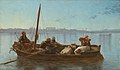
- Extent of pirate attacks on shipping vessels in the Indian Ocean between 2005 and 2010. (from Piracy off the coast of Somalia)
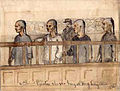 Four Chinese pirates who were hanged in Hong Kong in 1863 (from Piracy)
 Bartholomew Roberts' crew carousing at the Calabar River; illustration from The Pirates Own Book (1837). Roberts is estimated to have captured over 470 vessels. (from Piracy)
 A Barbary pirate, Pier Francesco Mola, 1650 (from Barbary corsairs)
 The traditional "Jolly Roger" flag of piracy (from Piracy)
 British Royal Navy Commodore gives a presentation on piracy at the MAST 2008 conference (from Piracy)
 Painting from 1772 depicting British and French sailors at battle with Dulcignottes (Ulcinj pirates). These pirates were defeated on 5 September 1772. (from Albanian piracy)
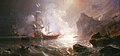 Battle of a French ship of the line and two galleys of the Barbary corsairs (from Barbary corsairs)
 Currimao Watchtower, Ilocos Norte. 'Currimao' comes from the Iloco term cumaws (pirates) and the Spanish word correr (to run), reflecting the warnings given by watchmen during pirate attacks. (from Piracy)
 Time series of maritime traffic crossing the Indian Ocean showing the effect of piracy and its progressive decline in re-routing ships. Each sub-plot shows 6-month colour-coded trips, red southbound and green northbound, using Long Range Identification and Tracking (LRIT) historical data. Operational authorities requested an increase of LRIT reporting frequency from ships in 2009 and 2010 in order to better track them remotely in the High Risk Area. The increase of tracking points can be erroneously perceived as an apparently higher volume of traffic with respect to other periods. (from Piracy off the coast of Somalia)
 Anti piracy operations by Indian Navy's INS Tabar, in the Gulf of Aden on 18 November 2008 (from Piracy off the coast of Somalia)
 Puerto del Príncipe being sacked in 1668 by Henry Morgan (from Piracy)
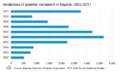 Incidents of pipeline vandalism by pirates in the Gulf of Guinea, 2002–2011 (from Piracy)
 Map of Ulcinj in 1573 by Simon Pinargenti (from Albanian piracy)
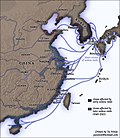

 Pirates attacking a French ship (from Albanian piracy)
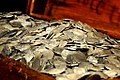 Pirate treasure looted by Samuel Bellamy and recovered from the wreck of the Whydah; exhibit at the Houston Museum of Natural Science, 2010 (from Piracy)
 Suspected Somali pirates keep their hands in the air (from Piracy)
 Conquest of Tunis by Charles V and liberation of Christian galley slaves in 1535 (from Barbary corsairs)
 Hanging of Captain Kidd; illustration from The Pirates Own Book (1837) (from Piracy)
 Bombardment of Algiers by Lord Exmouth in August 1816, Thomas Luny (from Barbary corsairs)
 Born to a noble family in Puerto Rico, Roberto Cofresí was the last notably successful pirate in the Caribbean. (from Piracy)
 Armed pirates in the Indian Ocean near Somalia. After the picture was taken, the vessel's crew members opened fire on U.S. Navy ships and the ship's crew members returned fire. One suspected pirate was killed and 12 were taken into custody (see engaged pirate vessels). (from Piracy off the coast of Somalia)
 Capture of the Pirate Blackbeard, 1718 depicting the battle between Blackbeard and Robert Maynard in Ocracoke Bay; romanticized depiction by Jean Leon Gerome Ferris from 1920 (from Piracy)
 The Barbary corsairs frequently attacked Corsica, resulting in many Genoese towers being erected. (from Barbary corsairs)
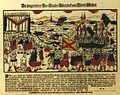 The Vitalienbrüder. Piracy became endemic in the Baltic Sea in the Middle Ages because of the Victual Brothers. (from Piracy)
- A French ship under attack by Barbary pirates, ca. 1615 (from Piracy)
 The work of the Mercedarians was in ransoming Christian slaves held in Muslim hands, Histoire de Barbarie et de ses Corsaires, 1637 (from Barbary corsairs)
 A Sea Fight with Barbary Corsairs by Laureys a Castro, c. 1681 (from Barbary corsairs)
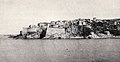 Castle of Ulcinj in the 1890s (from Albanian piracy)


.jpg)


_(cropped2).jpg)
.jpg)

_3.svg)


.jpg)


_crop.jpg)


.jpg)


_-_Foto_Giovanni_Dall'Orto,_13-4-2006_12.jpg)


.jpg)

.jpg)
_Moro_'pirate'.jpg)


.jpg)


.jpg)


_pirates_fighting_British_and_French_sailors,_painting_from_1772.jpg)


.jpg)


_by_Aert_Anthoniszoon.jpg)


_approaches_a_suspected_p.jpg)

.jpg)


.jpg)


.jpg)


Selected Jolly Roger
.svg)
Subcategories

Topics
WikiProjects
Related portals


Things you can do

Contribute
- Work on piracy and pirate articles and help improve them to featured articles.
Expand
Join
WikiProject Piracy Requests
- eliminate red links from List of pirates
- expand Timeline of piracy, specifically to fill in vast gap between the 1890s to 2000s
- revise Bartholomew Roberts
- help with Requested articles and Expand articles
- help with Portal:Piracy
Associated Wikimedia
The following Wikimedia Foundation sister projects provide more on this subject:
-
 Commons
Free media repository -
 Wikidata
Free knowledge base -
 Wikiquote
Collection of quotations -
 Wikisource
Free-content library -
 Wikiversity
Free learning tools -
 Wiktionary
Dictionary and thesaurus


